Introduction
Heat indicators in a fluid bed drying process offer a practical way to monitor temperature distribution during pharmaceutical manufacturing. Fluid bed drying remains one of the most widely used drying technologies because it provides rapid heat and mass transfer between heated air and particulate materials. However, manufacturers often struggle to visualize how heat moves through a fluidized bed. This challenge becomes even greater when processing heat-sensitive active pharmaceutical ingredients (APIs). Therefore, Lakio and co-workers investigated microcapsulated thermochromic pigments as real-time temperature indicators. These materials change color at predefined temperatures and reveal heat distribution throughout the process. As a result, operators can identify critical temperature zones and reduce the risk of thermal degradation, polymorphic transitions, or other temperature-related changes in pharmaceutical products.
Thermochromic Technology for Heat Indicators in a Fluid Bed Drying Process
Microcapsulated Thermochromic Pigments
The study focused on ChromaZone® thermochromic pigments. These microencapsulated materials contain chromogenic compounds protected by polymeric shells. The pigments remain colored below a specific activation temperature. Once the temperature rises above this threshold, the pigments become colorless or significantly lighter. When the temperature falls again, the original color returns. Consequently, the pigments provide a reversible and highly visible indication of thermal exposure.
In addition, the researchers measured color changes with a tristimulus colorimeter using the CIELAB color space. This technique generated objective and reproducible color data. Therefore, the team could quantify temperature-induced color transitions throughout fluidization and drying experiments.
Materials Used in the Study
The researchers prepared both granules and coated pellets as heat indicators. They produced granules from α-lactose monohydrate and incorporated thermochromic pigments with activation temperatures of 31°C, 35°C, and 40°C. Polyvinyl pyrrolidone served as the granulation binder. These formulations allowed the researchers to evaluate several temperature thresholds relevant to pharmaceutical processing.
The team also coated pellets with thermochromic pigments using a top-spray coating process. They used hydroxypropyl methylcellulose as the coating polymer and purified water as the solvent. Subsequently, they fluidized the coated pellets under controlled operating conditions to assess their performance as heat indicators.
Why CELLETS® 1000 Were Selected
Advantages of Spherical CELLETS® 1000
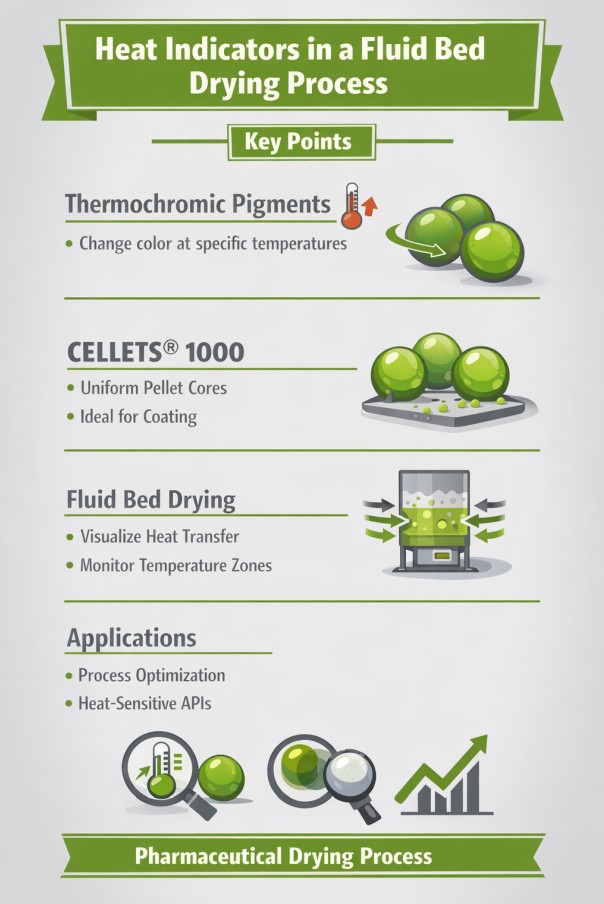
CELLETS® 1000 pellets played a central role in the investigation. The researchers selected these spherical pellet cores as substrates for the thermochromic coating. CELLETS® 1000 provide a narrow particle-size distribution, high mechanical strength, and excellent flow properties. Therefore, they create a reliable platform for coating applications and fluid bed studies.
Furthermore, the spherical shape of CELLETS® 1000 promotes uniform coating deposition. This characteristic helps distribute thermochromic pigments evenly across the pellet surface. In addition, the pellets withstand repeated fluidization cycles without significant damage. Their reproducible properties allow researchers to compare thermal behavior under well-controlled conditions.
Benefits for Heat Indicator Applications
The coated CELLETS® 1000 pellets delivered clear and reliable color transitions during fluidization. As temperatures approached the activation points of the pigments, the pellets changed color and visualized heat transfer throughout the bed. Moreover, the pellets retained heat longer than the granules because of their density and structure. This feature provided additional insight into thermal retention and temperature gradients within the system.
The authors also highlighted practical advantages of pellet-based indicators. For example, pellets tolerate moisture better than granules and maintain consistent flow properties during processing. Consequently, CELLETS® 1000 represent a valuable model material for drying studies, coating trials, and process scale-up investigations.
Process Understanding Through Heat Indicators in a Fluid Bed Drying Process
Visualizing Heat Transfer and Temperature Gradients
The study demonstrated that temperature distribution within a fluidized bed is rarely uniform. Instead, temperature gradients develop between the center and the walls of the chamber. Airflow patterns also influence the heating rate of individual particles. Therefore, thermochromic indicators provide information that conventional temperature probes may not capture completely.
Moreover, the color-changing particles helped visualize how heat moved through the material during fluidization. Researchers observed different fluidization patterns, including crater flow and cavern formation. As a result, they gained a deeper understanding of airflow behavior and heat transfer mechanisms.
Relevance for Heat-Sensitive APIs
Heat indicators can mimic the thermal sensitivity of pharmaceutical ingredients without exposing valuable APIs to unnecessary risk. Therefore, manufacturers can identify critical processing conditions before full-scale production begins. In addition, these indicators help determine whether a process may trigger phase transitions, crystal transformations, or other temperature-dependent changes. Consequently, they support safer and more efficient pharmaceutical development.
Conclusion and Outlook
Heat indicators in a fluid bed drying process provide an innovative tool for monitoring thermal behavior during pharmaceutical manufacturing. Microcapsulated thermochromic pigments offer clear visual feedback and support quantitative color analysis. Furthermore, they enable real-time observation of heat transfer within fluidized systems. The study confirmed that both granules and coated pellets function effectively as temperature indicators. However, CELLETS® 1000 pellets delivered additional benefits through their robust structure, uniform coating characteristics, predictable fluidization behavior, and strong resistance to moisture. Therefore, they represent an excellent carrier material for thermochromic coatings. Looking ahead, manufacturers can combine these heat indicators with advanced imaging systems and process analytical technologies. As a result, future fluid bed drying operations may achieve greater process understanding, improved scale-up performance, and enhanced protection of heat-sensitive pharmaceutical ingredients.
References
[1] S. Lakio, J. Heinämäki, J. Yliruusi, AAPS PharmSciTech 11, 46–53 (2010); doi: 10.1208/s12249-009-9351-x