
Posts

US20250186377A1 cellet‑based modified‑release gamma‑hydroxybutyrate formulation ChatGPT Image 11. Juli 2025, 13_12_09

Introduction

Gamma‑hydroxybutyrate (GHB) is an endogenous neurotransmitter also used pharmaceutically—usually as sodium oxybate—for treating narcolepsy and related disorders. It exerts its therapeutic effects by modulating GABA_B receptors and promoting slow-wave sleep, alleviating cataplexy, and reducing excessive daytime sleepiness. Despite its efficacy, current twice-nightly dosing regimens present challenges: dose‑dumping in the presence of alcohol, variable pharmacokinetics depending on food intake, and patient inconvenience. To address these issues, modern formulations—and especially the innovative use of CELLETS® —pursue once-nightly controlled release.

API Benefits and Patient Advantages

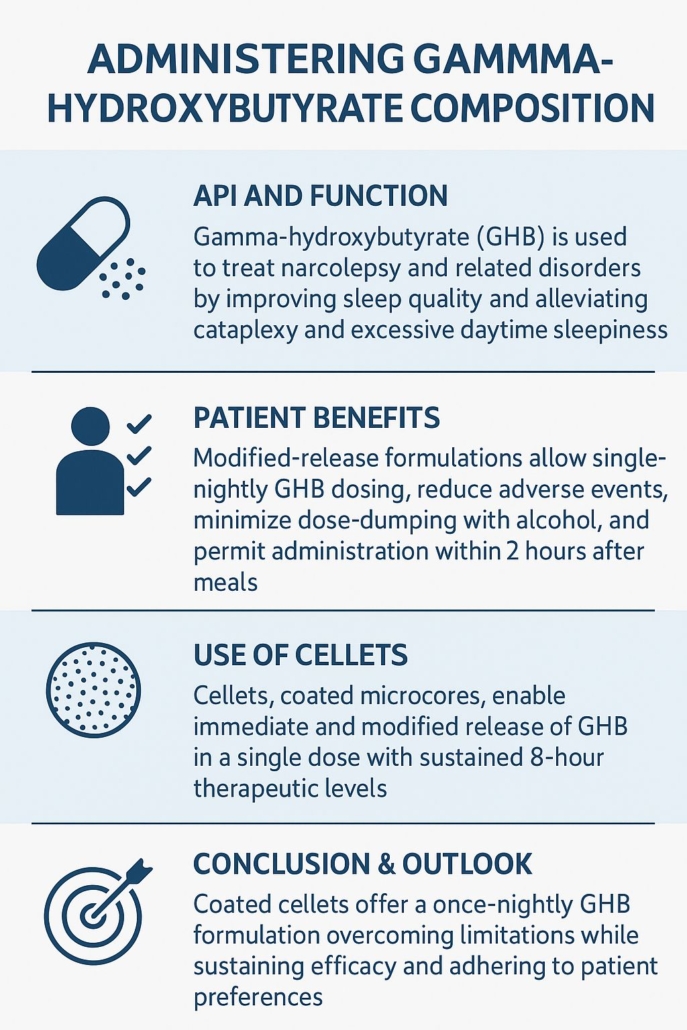
Administering gamma‑hydroxybutyrate compositions in a modified‑release format brings multiple patient-centric benefits. A single nightly dose minimizes repeated nighttime awakenings and improves adherence. These formulations exhibit lower peak concentrations (C_max) with sustained therapeutic exposure (AUC)—achieving similar or better efficacy while reducing adverse events such as dizziness or nausea. This consistency is especially meaningful when dosing less than two hours after eating, which often is more convenient for patients; the controlled formulations are more forgiving of fed-state PK variability and less prone to alcohol-induced dose-dumping.

Use of CELLETS® in methods of administering gamma-hydroxybutyrate compositions

CELLETS® — spherical microcores used in multiparticulate drug delivery—are central to these modern GHB formulations. The patent US 20250186377 A1 introduces coated cellet-based microparticles that incorporate immediate-release (IR) and modified-release (MR) segments within a single unit dose. The MR portion involves CELLETS® (e.g. CELLETS® 90, CELLETS® 100 or CELLETS® 127, and other MCC beads) coated with polymers carrying free carboxyl groups combined with hydrophobic materials (e.g., high melting point waxes), engineered to delay GHB release until intestinal transit. CELLETS® enable precise layering, efficient coating, and reproducible drug release profiles while resisting pH- and alcohol-triggered dose dumping.

This multiparticulate approach achieves desired PK: IR CELLETS® ensure rapid onset while MR CELLETS® sustain plasma GHB levels up to 8 hours. In contrast to IR liquid sodium oxybate, the coated cellet formulation shows dose‑proportional C_max and AUC across doses of 4.5 g, 7.5 g, and 9 g, with most AEs clustering near C_max but at overall milder intensity. Remarkably, cellet-based formulations maintain comparable therapeutic exposure even with postprandial dosing, offering flexibility not seen in immediate-release forms.

Key Findings

The inventive cellet-based GHB composition delivers both immediate and controlled drug release in one unit, offering dose‑proportional pharmacokinetics and sustained therapeutic levels for 8 hours, under single-nightly dosing. It improves safety by reducing peak‑induced adverse events, lowers risk of alcohol‑related dose-dumping, and allows dosing within two hours after meals. Studies show comparable efficacy to twice-nightly IR sodium oxybate on sleep quality and daytime alertness, with better convenience and adherence.

Conclusion & Outlook

The patented cellet‑based modified-release formulation of GHB marks a significant advancement in administering gamma‑hydroxybutyrate compositions. By incorporating coated CELLETS® that combine IR and MR elements, this approach mitigates common limitations—meal dependency, alcohol interactions, multiple nightly doses—while preserving therapeutic efficacy. For patients with narcolepsy or cataplexy, this translates into improved sleep continuity, reduced daytime symptoms, and enhanced quality of life.

Looking ahead, further clinical evaluation could extend the CELLETS® platform to other formulations of gamma‑hydroxybutyrate salts or co‑therapies (e.g., with sodium valproate), further broadening the therapeutic utility. This modular, multiparticulate delivery system could set a new standard for nightly dosing regimens where controlled pharmacokinetics and patient preferences align.

Patent Details

  • Name/Title: cellet‑based modified‑release gamma‑hydroxybutyrate formulation

  • Patent Number: US 20250186377 A1

  • Year of Patent: 2025

  • Patent Holder(s): Not explicitly indicated in the publicly listed data, but associated inventors likely affiliated with pharmaceutical firms focusing on CNS therapeutics (e.g., Jazz Pharmaceuticals or Flamel Ireland).
US20250186377A1 cellet‑based modified‑release gamma‑hydroxybutyrate formulation ChatGPT Image 11. Juli 2025, 13_12_09
US20240350437A1 Patent on gamma-hydroxybutyrate compositions

Patents US20240350437A1 and US20240350438A1 – Gamma-hydroxybutyrate compositions having improved pharmacokinetics in the fed state – cover pharmaceutical compositions and systems that deliver oral drugs in a controlled and consistent way. The invention tackles challenges in delayed or multi-stage drug release. This is especially important for active pharmaceutical ingredients (APIs) with complex absorption profiles or sensitivity to environmental factors, such as pH. Specifically, the formulation uses gamma-hydroxybutyrate (GHB) as the API. GHB belongs to sedatives and doctors approve it for treating narcolepsy with cataplexy in adults.

The patent focuses on multiparticulate formulations. Small spherical particles or granules carry APIs and polymers in coated layers. These coatings control drug release rates, enabling gradual, sustained, or targeted delivery in the gastrointestinal tract. As a result, the technology delivers precise therapeutic effects, reduces dosing frequency, and minimizes side effects caused by rapid drug release.

Moreover, the document highlights improvements in coating techniques and the use of stabilizing agents. These measures enhance the integrity and functionality of the drug delivery system. Additionally, the patent addresses scalability and manufacturing efficiency. Therefore, these formulations are suitable for large-scale production while maintaining consistent dosage and performance.

Potential applications include treatments for chronic conditions or drugs requiring precise dosing. The invention allows flexibility in formulating a range of APIs. This customization meets specific therapeutic needs. By enabling controlled drug release, the technology improves medication adherence and efficacy, benefiting both patients and healthcare providers.

What is the role of MCC pellets as drug carrier of gamma-hydroxybutyrate compositions?

This patent US20240350437A1 focuses on an innovative approach to creating multiparticulate pharmaceutical formulations for oral administration. It introduces CELLETS®, a key component of the drug delivery system. CELLETS® are small, uniform spherical particles made of inert microcrystalline cellulose (MCC). They act as carriers for active pharmaceutical ingredients (APIs). These particles provide an optimal surface for drug layering, which facilitates precise drug release profiles. In this patent, the following types of CELLETS® are used:

  • CELLETS® 90
  • CELLETS® 100
  • CELLETS® 127

The invention tackles challenges in achieving controlled drug release, especially for APIs requiring multi-step or delayed absorption. By coating these MCC carriers with specific polymers and APIs, the system delivers drugs at targeted points in the gastrointestinal tract. This approach is particularly beneficial for drugs with narrow therapeutic windows or sensitivity to pH levels.

Furthermore, the patent highlights improvements in coating techniques and formulation stability. These advancements ensure high reproducibility and efficient manufacturing. Consequently, the multiparticulate system offers dosage flexibility, fewer side effects, and improved patient adherence compared to conventional tablets or capsules.

Additionally, the invention supports the development of treatments for chronic conditions, where consistent and predictable drug release is critical. Applying CELLETS® in this context demonstrates their versatility and potential to enhance both the efficacy and safety of oral drug delivery systems.

Document information

Document Type and Numbers:

  • (“Gamma-hydroxybutyrate compositions having improved pharmacokinetics in the fed state”).
  • US20240350438A1 (“Gamma-hydroxybutyrate compositions having improved pharmacokinetics in the fed state”).
Kind Code: A1

Inventors:

Julien Grassot, Cendrine Grangeon, Jordan Dubow

Disclaimer

This text was partly generated by chatGPT engine version GPT‑4o, on Nov 21, 2024. Image was generated with Adobe Firefly.

Packaged modified release gamma-hydroxybutyrate formulations improve stability and simplify treatment. The patent WO2019123269A1, titled “Packaged modified release gamma-hydroxybutyrate formulations having improved stability,” introduces innovative formulations and packaging methods. These methods enhance both dissolution and chemical stability of gamma-hydroxybutyrate (GHB), a therapy for narcolepsy. Currently, treatments like XYREM® force patients to wake during the night for a second dose, which proves cumbersome. Therefore, this patent develops a once-nightly, modified-release GHB formulation. Moreover, advanced packaging controls relative humidity, ensuring long-term effectiveness and preventing chemical degradation of GHB into gamma-butyrolactone (GBL).

Key Innovations:

  1. Modified Release Formulation: The patent combines immediate and modified release components, both containing GHB or a pharmaceutically acceptable salt. The modified release component controls GHB release over time. As a result, it provides sustained therapeutic effects throughout the night. Therefore, patients do not need a second dose. Consequently, this formulation improves convenience and supports adherence to treatment.
  2. Stability Issues with GHB: GHB is highly hygroscopic and chemically unstable. Consequently, it degrades easily, especially in high-humidity environments. This degradation produces GBL, which reduces the drug’s effectiveness. Therefore, the patent develops a formulation with stable dissolution profiles and improved chemical stability. Moreover, it maintains stability even under stressful storage conditions, such as high temperature and humidity.
  3. Packaging Innovation: To enhance stability, the GHB formulations use packaging that maintains a specific relative humidity range (29% to 54%). This control of humidity is crucial because it prevents GHB from degrading into GBL. Moreover, the packaging material has a low water vapor transmission rate. As a result, it reduces moisture exposure and ensures the drug stays stable over time.
  4. Hydrophobic Coating: The patent applies a hydrophobic coating, such as glyceryl tristearate or hydrogenated vegetable oil, along with methacrylic acid copolymers. These coatings control the release rate of GHB. Moreover, they protect it from moisture. As a result, the formulation provides a steady release and prevents premature degradation.
  5. Pharmaceutical Composition: The GHB composition includes varying ratios of immediate and modified release components. These ratios ensure a sufficient therapeutic dose while maintaining stability. Moreover, particle size and formulation ratios (e.g., 40/60 to 60/40) play key roles in achieving the desired pharmacokinetics and release profiles.

Controlling the relative humidity within the packaging

The primary innovation lies in controlling the relative humidity within the packaging, alongside a modified release formulation with hydrophobic coatings to maintain the drug’s chemical stability and effectiveness. These advancements make GHB therapy more convenient by eliminating the need for a second nightly dose and addressing the stability challenges that have plagued previous formulations.

In this patent, CELLETS® play a crucial role as inert cores used in the formulation of modified release or the active or salts thereof. These starter spheres serve as carriers for the active ingredient by providing a surface for multi-layer drug layering. Their primary function is to ensure uniform drug distribution and control the release profile of GHB. The benefits include enhancing dissolution stability, maintaining the integrity of the dosage form over time, and helping to modulate the release rate of the drug for once-nightly dosing convenience. For these aspects, MCC starter sphere types where employed: CELLETS® 90, CELLETS® 100, CELLETS® 127. Glatt ProCell™ technique is used for spraying molten API.

Document information

Document Type and Number: (“Packaged modified release gamma-hydroxybutyrate formulations having improved stability”).
Kind Code: A1

Inventors:

Hervé GUILLARD

Disclaimer

This text was partly generated by chatGPT engine version GPT‑4o, on Oct 21, 2024. Image was generated with Adobe Firefly.

The patent application titled “Modified Release Gamma-Hydroxybutyrate (GHB) Formulations Having Improved Pharmacokinetics” (US20240148685) focuses on improving the delivery of GHB, a substance used for treating sleep disorders like narcolepsy, through modified-release formulations. The goal is to optimize GHB’s absorption, enhancing patient convenience and compliance by reducing the need for multiple nightly doses.

The key innovation in the patent is the use of CELLETS®, microcrystalline spheres often employed as a neutral core for drug layering. In this application, CELLETS® act as carriers for the active ingredient, allowing precise control over the release profile of GHB. These small spherical particles, made from microcrystalline cellulose, offer uniform size and high mechanical strength, ensuring consistent drug loading and a controlled release rate.

In this patent, the CELLETS® are coated with various layers of GHB and release-modifying agents, enabling a predictable and sustained release of the active substance. This modified release profile allows GHB to be administered in a once-nightly dose rather than requiring the patient to wake up for a second dose, which was a limitation with previous immediate-release formulations. This extended-release mechanism helps maintain stable plasma concentrations of GHB over an 8-hour period, improving both the efficacy of the treatment and patient compliance.

The innovation emphasizes addressing the shortcomings of existing GHB formulations by ensuring a better pharmacokinetic profile—particularly regarding absorption, bioavailability, and minimizing drug levels in the bloodstream after the therapeutic effect has been achieved. In this specific patent, the following MCC Sphere types are recommended: CELLETS® 90, CELLETS® 100, CELLETS® 127.

Document information

Document Type and Number: (“Modified release Gamma-Hydroxybutyrate formulations having improved pharmacokinetics”)
Kind Code: A1

Inventors:

Dubow, Jordan (Lyon, FR)
Guillard, Hervé (Villeurbanne, FR)
Mégret, Claire (Lyon, FR)
Dubuisson, Jean-françois (Lyon, FR)

Disclaimer

This text was generated by chatGPT engine version GPT‑4o, on Oct 21, 2024. Image was generated with Adobe Firefly.

The United States Patent Application US20240024263 focuses on methods of administering gamma-hydroxybutyrate (GHB) in combination with divalproex sodium (DVP), particularly for treating conditions like narcolepsy. The aim is to co-administer these drugs without altering their dosage or efficacy. The patent emphasizes how DVP affects GHB’s pharmacokinetics, allowing adjustments to minimize side effects while ensuring therapeutic benefits.

The role of CELLETS® in this patent is critical. CELLETS® are microcrystalline cellulose spheres used in drug formulations. They provide a stable, controlled-release matrix for GHB, ensuring consistent drug delivery over time. This controlled release minimizes fluctuations in drug concentrations, improving safety and efficacy. These MCC starter beads also help prevent interaction between GHB and DVP, ensuring that neither drug’s therapeutic effects are compromised.

By using CELLETS®, the formulation enhances the pharmacokinetic profile of GHB, ensuring a smoother and more predictable drug release. This innovation is crucial when GHB is administered alongside DVP, as it allows for better management of conditions like excessive daytime sleepiness or cataplexy, without significantly altering either drug’s profile.

In summary, this patent introduces an optimized co-administration strategy for GHB and DVP, with Cellets playing a pivotal role in achieving steady, controlled drug release and mitigating adverse drug interactions. This approach aims to improve the overall effectiveness and safety of treatment for sleep-related disorders. In this specific patent, the following MCC Sphere types are recommended: CELLETS® 90, CELLETS® 100 or CELLETS® 127. United States Patent Application US20240024263 seems as well to be a patent following the patent US11896572B2 wherein modified-release formulations are described.

Document information

Document Type and Number: (“Methods of administering gamma-hydroxybutyrate compositions with divalproex sodium”)
Kind Code: A1

Inventors:

Baek, Bong-Sook, Flamel Ireland Limited (Dublin, IE)

Disclaimer

This text was generated by chatGPT engine version GPT‑4o, on Oct 21, 2024. Image was generated with Adobe Firefly.

The development of modified release gamma-hydroxybutyrate represents a major advancement in narcolepsy therapy, aiming to improve both patient compliance and treatment effectiveness. Traditional formulations of gamma-hydroxybutyrate (GHB) require multiple nightly doses, which can disrupt sleep and reduce overall quality of life. The patented formulation described in US11896572B2 introduces a novel modified release system that extends the duration of action, making it possible to achieve 6 to 8 hours of therapeutic benefit with a single bedtime dose.

How Modified Release Gamma-Hydroxybutyrate Works

This formulation combines immediate-release and delayed-release mechanisms to provide both rapid onset and sustained therapeutic effects. The immediate-release portion allows GHB to take effect quickly, while the delayed-release portion maintains drug levels over time, reducing abrupt concentration peaks and minimizing side effects. This dual-action delivery is designed to improve pharmacokinetics and ensure more consistent symptom control.

The Role of CELLETS® in Modified Release Gamma-Hydroxybutyrate Drug Release

A central innovation in this patent involves the use of CELLETS®, spherical microcrystalline cellulose particles that provide a stable foundation for modified release drug delivery. In the immediate-release portion, CELLETS® carry a coating of sodium oxybate combined with a binder such as povidone. Meanwhile, the delayed-release portion relies on specialized polymers and hydrogenated vegetable oil, which work together to control pH-dependent release in the gastrointestinal tract. Furthermore, CELLETS® maintain consistent particle size and predictable dissolution rates, which in turn improve absorption and strengthen the overall pharmacokinetic profile of modified release gamma-hydroxybutyrate.

The CELLETS® play a crucial role in maintaining particle size consistency, which is important for ensuring predictable dissolution and absorption rates, thereby enhancing the overall pharmacokinetic profile of the drug. This innovation represents an advancement over traditional formulations by offering more reliable and patient-friendly narcolepsy management. This specific patent, recommend the following MCC Sphere types: CELLETS® 90, CELLETS® 100 or CELLETS® 127.

Advantages for Narcolepsy Patients

The patented system combines immediate and delayed release. This design allows for a once-nightly dose, which improves adherence and convenience for patients. The innovation also ensures more restorative sleep. At the same time, it reduces the burden of frequent dosing. As a result, narcolepsy management becomes more reliable and patient-friendly.

By refining the pharmacokinetics of GHB, modified release gamma-hydroxybutyrate offers a significant improvement over traditional formulations.

Document information

Document Type and Number: (“modified release gamma-hydroxybutyrate formulations having improved pharmacokinetics”)
Kind Code: B2

Inventors:

Jordan Dubow
Hervé Guillard
Claire Mégret
Jean-François DUBUISSON

Disclaimer

This text was generated by chatGPT engine version GPT‑4o, on Oct 21, 2024. Image was generated with Adobe Firefly.