
Introduction: Alginate Encapsulation Systems for Synbiotics
Synbiotics—combinations of probiotics and prebiotics designed to confer synergistic health benefits—have gained significant attention in functional food and nutraceutical research due to their potential to modulate the gut microbiome and improve host health outcomes. However, a persistent challenge in their application is the limited viability and stability of probiotic microorganisms during processing, storage, and passage through the harsh gastrointestinal environment. These constraints have driven the development of advanced delivery systems capable of protecting bioactive microorganisms while ensuring their controlled release at target sites within the digestive tract.
Among the various encapsulation strategies explored, alginate-based systems have emerged as one of the most promising and widely studied approaches. Alginate, a naturally derived polysaccharide obtained primarily from brown seaweed, offers several advantages including biocompatibility, mild gelation conditions, and the ability to form hydrogel matrices in the presence of divalent cations such as calcium. These properties make alginate an ideal candidate for encapsulating sensitive biological materials such as probiotic bacteria and prebiotic compounds.
Alginate encapsulation systems for synbiotics leverage these characteristics to enhance microbial survival under acidic gastric conditions and improve targeted release in the intestinal environment. Furthermore, the structural versatility of alginate matrices allows for modifications—such as coating with chitosan, incorporation of resistant starches, or blending with other biopolymers—to optimize mechanical strength, permeability, and release kinetics. As a result, these systems not only improve the functional efficacy of synbiotic formulations but also expand their applicability in food engineering, pharmaceutical delivery, and personalized nutrition.
Given the growing demand for stable and effective microbiome-targeted interventions, alginate encapsulation represents a critical technological platform in the advancement of next-generation synbiotic delivery systems.
In the following, encapsulation technologies are introduced with focus on fluidized-bed drying. Technical information can be found in the thesis by L.L. Tan [1].
Encapsulation Technologies
Alginate Encapsulation Systems for Synbiotics are developed using several encapsulation technologies to improve probiotic stability and functional delivery. Spray drying is widely used because it is scalable and cost-efficient, but it can reduce cell viability due to heat exposure.
In contrast, freeze drying preserves probiotic viability better because it operates at low temperature and vacuum conditions. However, it increases processing time and cost. Extrusion and emulsion techniques also support alginate bead formation under mild conditions, so they protect heat-sensitive probiotic strains effectively. Moreover, electrospraying and electrospinning enable precise control over particle size and morphology.
As a result, these methods improve encapsulation efficiency and release behavior. In addition, fluidized-bed drying plays an important role in coating and post-processing steps. It suspends particles in an air stream and applies uniform protective layers such as alginate, chitosan, or lipid coatings. Therefore, it enhances mechanical strength, moisture resistance, and gastrointestinal protection.
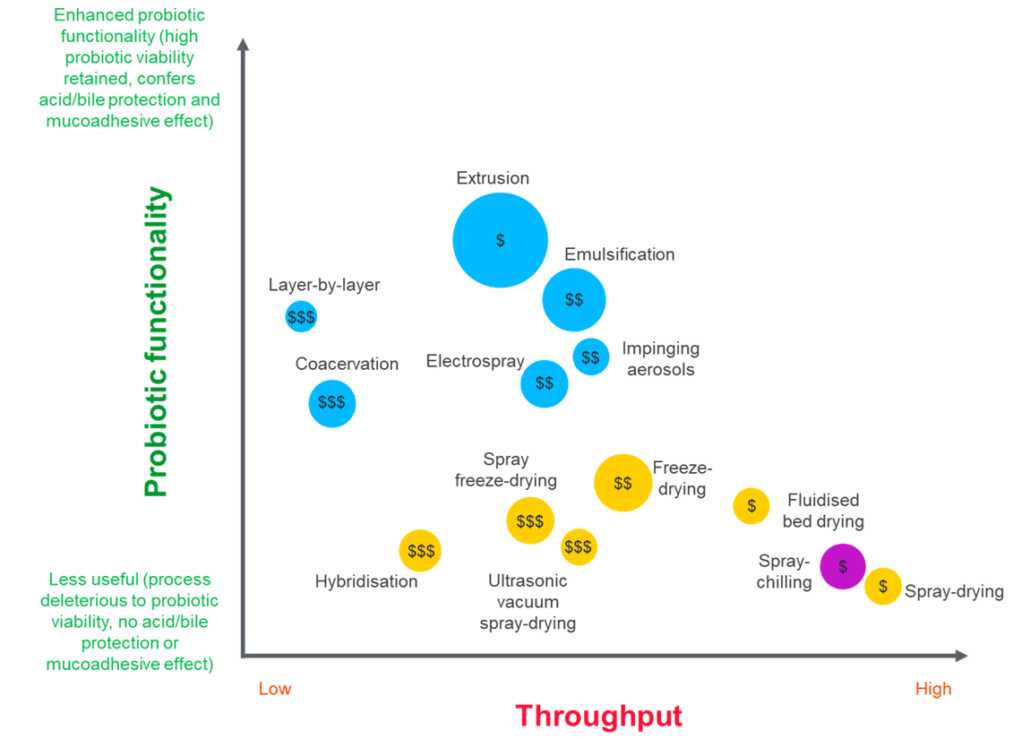
Probiotic functionality versus drying quantity, Alginate Encapsulation Systems for Synbiotics [1].
Focus on Fluidized Bed Drying
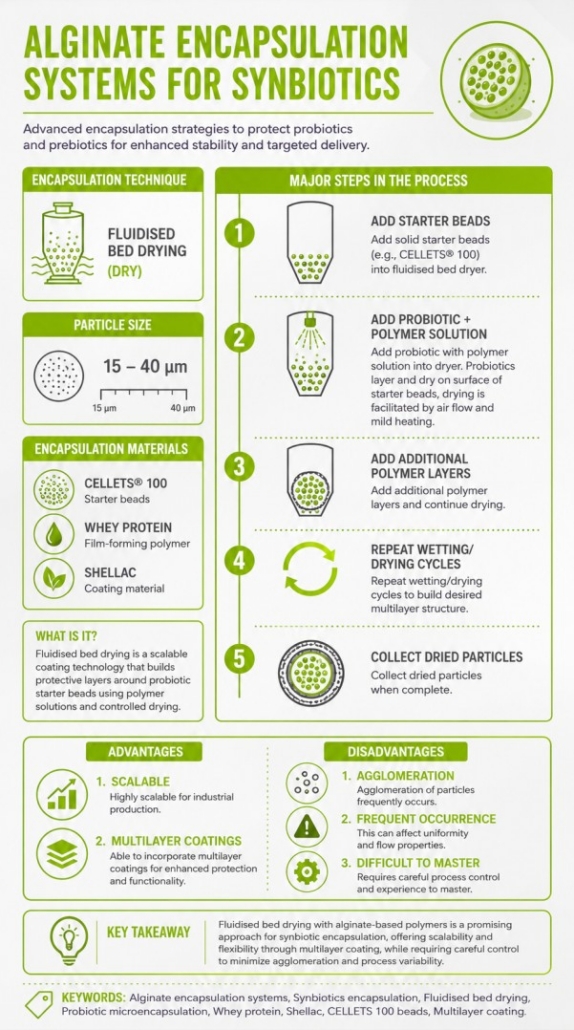
Encapsulation systems for synbiotics may use fluidized bed drying as a dry encapsulation technique to produce coated probiotic particles. This method typically yields particles with a size range of 15–40 μm. In this system, manufacturers commonly use CELLETS® 100 as starter beads, along with whey protein and shellac as encapsulation materials.
The process begins by adding solid starter beads into a fluidized bed dryer. Next, operators introduce probiotics together with a polymer solution into the system. As a result, probiotics deposit and form a coating layer on the surface of the starter beads while air flow and mild heating promote drying. After that, additional polymer layers can be applied to build a multilayer structure. Moreover, the process repeats through successive wetting and drying cycles until the desired coating thickness is achieved. Finally, operators collect the dried encapsulated particles once processing is complete.
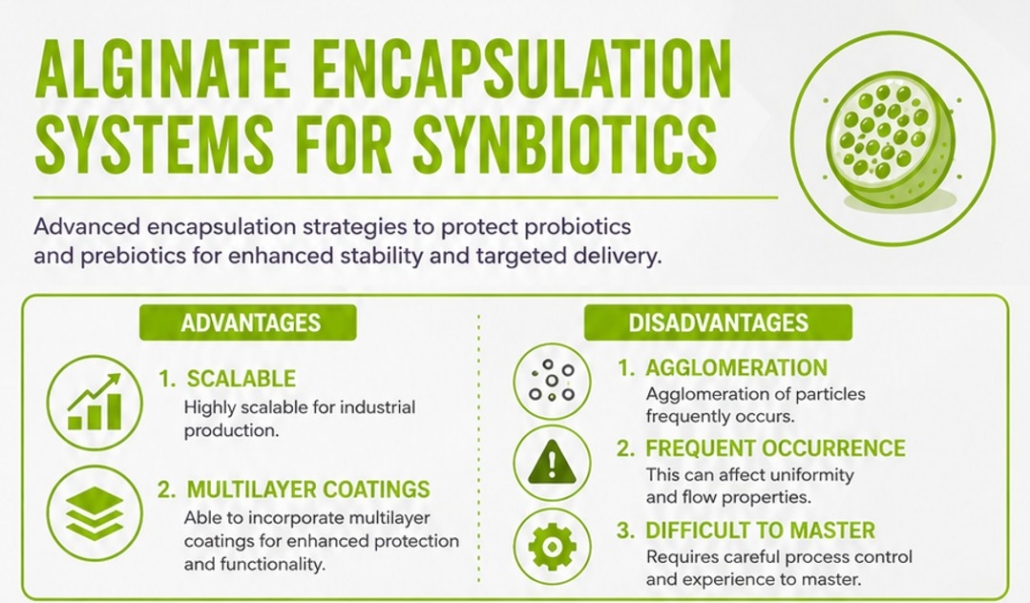
This technique offers clear advantages, as it is highly scalable and allows the incorporation of multilayer coatings for improved protection and functionality. However, it also presents several disadvantages. Particle agglomeration frequently occurs during processing, which can affect product uniformity. In addition, the technique requires significant process control expertise, making it difficult to master in practice.
Short note
Encapsulation technique: Fluidised bed drying (dry).
Particle size: 15 – 40 μm.
Encapsulation materials: CELLETS® 100, Whey protein, shellac.
Major steps in processes: (1) Add solid starter beads into fluidised bed dryer. (2) Add probiotic with polymer solution into dryer. Probiotics layer and dry on surface of starter beads, drying is facilitated by air flow and mild heating. (3) Add additional polymer layers and continue drying. (4) Repeat wetting/drying cycles. (5) Collect dried particles when complete.
Advantages: (1) Scalable; (2) Able to incorporate multilayer coatings.
Disadvantages: (1) Agglomeration of particles; (2) frequently occur; (3) Difficult to master this technique.
Alginate Encapsulation Systems for Synbiotics
Open Discussion on Encapsulation Technologies
When talking about alginate encapsulation systems for synbiotics, there are several technologies to be applied. Effectiveness of probiotic functionality does mainly not align with technology effectiveness of thoughput. High throughput — and thus economic advantages — and probiotic functionality seem to be disconnected.
But is this really the case? Potentially, a comparison of technologies veraua the functionality of synbiotic molecules is lacking of critical information: formulation awareness. The right formulation might play a crucial role in keeping the probiotic functionality of synbiotics at high levels when applying certain encapsulation technologies. In turn, formulation design and technology parameters need an extensive investigation (QbD attempt) to run successful encapsulation of synbiotics. Technology experts with CDMO and formulation development departments in pharma and nutra, such as Glatt group, are reliable partners for driving your project successfully.
References
[1] L.L. Tan, School of Materials Science and Engineering (2023); doi: 10.32657/10356/164624
