
Influence of Water on the Structure of MCC
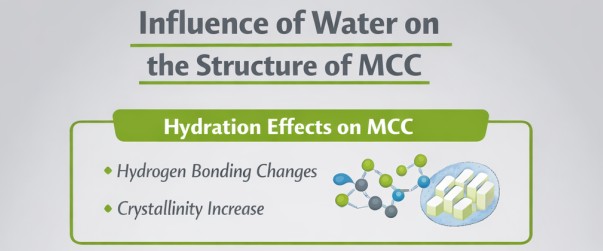
Influence of Water on the Structure of MCC describes how moisture reshapes microcrystalline cellulose at both structural and dielectric levels [1]. Water interacts strongly with hydroxyl groups on cellulose chains. Therefore, it changes hydrogen bonding and mobility inside amorphous and crystalline regions. Moreover, the system develops distinct hydration states depending on water content. At low moisture levels, water remains mostly adsorbed on surfaces. However, at higher levels, it forms multilayer hydration shells around crystallites. Consequently, the material shows measurable changes in crystallite order and dielectric relaxation behavior. In addition, a critical hydration threshold appears where the structure shifts toward a continuous interfacial water network. As a result, both permittivity and loss mechanisms change significantly across temperature and frequency ranges.
Technologies and Materials Used in the Study
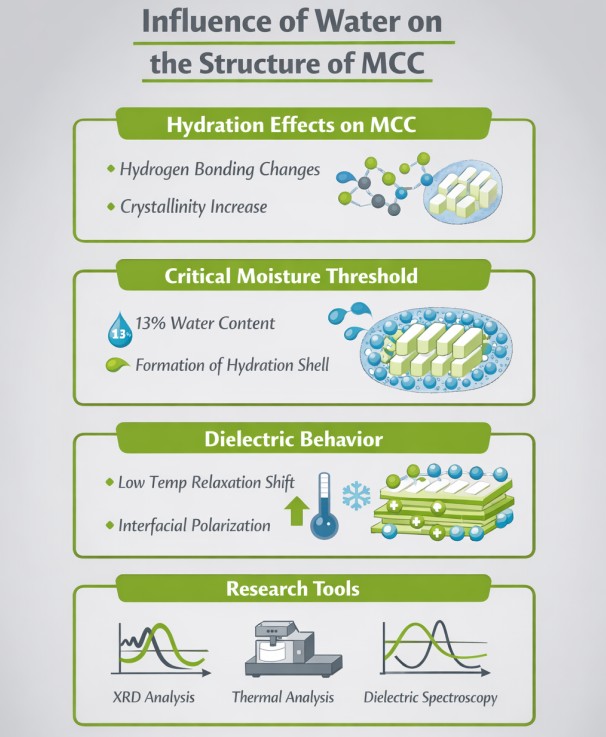
The study combines structural and dielectric characterization techniques to analyze hydrated cellulose systems. Specifically, X-ray diffraction resolves changes in crystallinity and crystallite dimensions. In addition, thermal analysis distinguishes bound water from loosely adsorbed water fractions. Broadband dielectric spectroscopy then tracks relaxation processes across temperature and frequency domains. Therefore, the researchers connect molecular mobility with macroscopic dielectric response.
The material system consists of microcrystalline cellulose processed into compacted pellets for measurement. Moreover, pellet compaction ensures stable geometry and reproducible dielectric contact. In similar experimental frameworks, standardized spherical MCC pellets such as CELLETS® 1000 are often used. These pellets provide uniform particle size, consistent porosity, and predictable packing behavior. Consequently, they reduce structural variability during pressing. In addition, they improve signal stability in dielectric spectroscopy because they minimize air gaps and heterogeneity effects. As a result, researchers can isolate water-induced changes more reliably and compare hydration states under controlled conditions.
Influence of Water on Structure and Dielectric Behavior
Water strongly controls both structure and dielectric response in MCC. Initially, small water amounts occupy surface sites and weak adsorption layers. However, increasing hydration strengthens hydrogen bonding rearrangements. Moreover, water molecules increase chain mobility in amorphous regions. Consequently, the material shows shifts in crystallite boundary structure and apparent crystallinity.
At moderate hydration, water forms multilayer shells around crystallites. Therefore, interfacial polarization becomes more pronounced. In addition, dielectric permittivity increases due to enhanced dipole alignment. Meanwhile, relaxation processes shift toward lower temperatures because water lowers activation barriers for molecular motion. As a result, β-relaxation associated with surface groups becomes more visible.
At higher hydration levels, the system approaches a percolated water network. Thus, the dielectric response becomes dominated by interfacial water dynamics. Moreover, the cellulose–water system transitions into a more flexible structural regime. Consequently, both structural stability and dielectric dispersion change significantly across frequency ranges.
Conclusion and Outlook
Water governs the structural and dielectric behavior of MCC in a direct and measurable way. Specifically, it modifies hydrogen bonding networks and reorganizes interfacial regions. Therefore, hydration controls crystallite order and molecular mobility at the same time. Moreover, a critical moisture threshold marks a transition into a continuous hydration regime.
In addition, these findings highlight the importance of controlled humidity in cellulose-based systems. Future research should focus on tuning water content to engineer dielectric properties. Moreover, standardized pellet systems, including CELLETS 1000-type MCC materials in comparable studies, can improve reproducibility. Consequently, hydrated cellulose systems may support future applications in bio-based dielectrics, sensors, and adaptive functional materials.
References
[1] Kovalov, K.M., Alekseev, O.M., Lazarenko, M.M. et al. Influence of Water on the Structure and Dielectric Properties of the Microcrystalline and Nano-Cellulose. Nanoscale Res Lett 12, 468 (2017); doi: 10.1186/s11671-017-2231-5

