
The Role of Pellets in Advanced Oral Drug Delivery
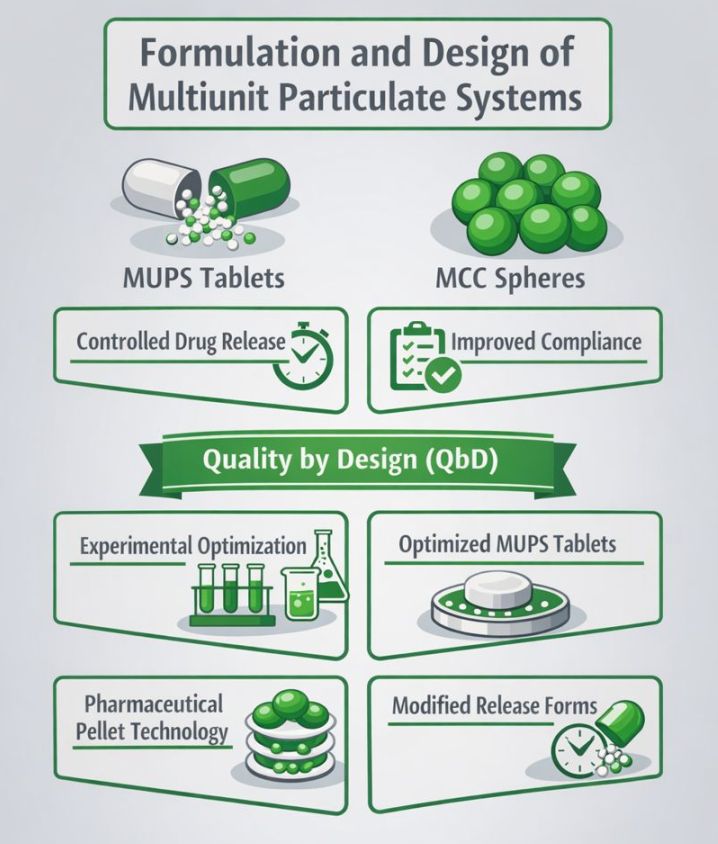
Formulation and design of multiunit particulate systems play a central role in modern oral drug delivery. Pellets used in Multiunit Particulate Systems (MUPS) distribute the active ingredient into many small units. As a result, they reduce the risk of dose dumping and minimize local irritation. In addition, they improve content uniformity and gastric emptying reproducibility. Therefore, patients benefit from safer therapy and lower variability in plasma levels. Moreover, pellet-based systems allow functional coating and precise release control. This advantage becomes critical for acid-labile drugs. Consequently, the formulation and design of multiunit particulate systems offer clear technological and therapeutic benefits. The uploaded publication applies this concept to Pantoprazole and uses a Quality by Design framework to achieve a robust MUPS tablet.
Summary of the Study: QbD-Based Development Strategy
The publication by G. S. Sonar and S. Rawat [1] describes a structured QbD-driven development of an oro-dispersible Pantoprazole MUPS tablet. First, the authors defined a Quality Target Product Profile. Then, they identified critical quality attributes such as acid resistance, buffer-stage dissolution, hardness, friability, and disintegration time.
Next, the team performed risk assessment using cause-and-effect diagrams and Failure Mode and Effects Analysis. This step identified three critical formulation variables. These variables included the quantity of dry enteric polymer, the amount of PlasACRYL® HTP20, and the percentage of pellets in the final tablet. Subsequently, they applied a 2³ full factorial design to study main and interaction effects. This statistical model allowed precise evaluation of formulation influences.
The results showed that the enteric polymer mainly controlled acid-stage drug release. In contrast, PlasACRYL® HTP20 improved film flexibility and reduced pellet rupture during compression. Furthermore, the pellet percentage strongly influenced mechanical strength and disintegration time. Because compression can damage coated pellets, the authors introduced a cushioning layer with PEG 6000. This modification reduced acid-stage drug release significantly.
The optimized formulation achieved less than 10% release in 0.1 N HCl and 70–80% release in pH 6.8 buffer. In addition, the tablets showed acceptable hardness and friability below 1%, a disintegration time at 17 s. Composition was of 100 mg dry polymer, 34 mg PlasACRYL HTP20 and 35% of MCC pellets in a tablet. Starter cores can be used such as CELLETS® 150-300.
for formulation V4. The similarity factor f2 reached 56.5, which confirmed pharmaceutical equivalence to the reference product. Finally, the researchers defined a validated design space with robust operating ranges. Therefore, the study demonstrates how QbD strengthens the formulation and design of multiunit particulate systems.

API, QbD Principle, and Final Formulation
Design Pantoprazole: API Type, BCS Class, and Indication
Pantoprazole is a proton pump inhibitor and a substituted benzimidazole derivative. It irreversibly blocks the H⁺/K⁺-ATPase in gastric parietal cells. Consequently, it suppresses gastric acid secretion. Clinicians prescribe it for gastroesophageal reflux disease, peptic ulcer disease, and Zollinger–Ellison syndrome. Pantoprazole is acid-labile and degrades rapidly at low pH. Therefore, manufacturers formulate it as an enteric-coated dosage form. According to the Biopharmaceutics Classification System, Pantoprazole belongs to BCS Class II. Thus, it shows low solubility but high permeability, which makes dissolution control essential.
QbD Principle and Its Formulation Advantage
Quality by Design follows ICH Q8 to Q10 guidelines. It starts with predefined objectives and builds product understanding through risk management and experimental design. Instead of relying on empirical testing alone, developers link critical material attributes and process parameters to critical quality attributes. Consequently, they can predict product performance. In the formulation and design of multiunit particulate systems, QbD reduces development risk and improves robustness. Moreover, it allows regulatory flexibility when operating within the approved design space.
Final Formulation Design and Drug Release Profile
The final MUPS tablet consists of layered pellets compressed into an oro-dispersible matrix. First, the developers applied a drug-loading layer onto microcrystalline cellulose starter cores. Then, they added a seal coat using hypromellose. Afterward, they applied an enteric coat with Eudragit L30D-55 and PlasACRYL® HTP20. To protect the pellets during compression, they added a cushioning layer containing PEG 6000. Finally, they blended the coated pellets with excipients such as microcrystalline cellulose, mannitol, crospovidone, and lubricants before compression.
The optimized formulation delivered less than 10% drug release after 120 minutes in acidic medium. Subsequently, it released 70–80% of the drug within 30 minutes in phosphate buffer pH 6.8. The tablets showed hardness around 47–48 N, disintegration below 20 seconds, and friability under 0.5%. Therefore, the formulation achieved acid protection, rapid intestinal release, and mechanical stability simultaneously.
Conclusion and Outlook
The study clearly demonstrates that formulation and design of multiunit particulate systems benefit from a structured QbD approach. By combining risk assessment, factorial design, and statistical validation, the researchers developed a robust Pantoprazole MUPS tablet. Moreover, they established a well-defined design space that ensures consistent quality. As pharmaceutical development evolves, QbD will further enhance efficiency and regulatory confidence. In the future, integration of process analytical technology and advanced modeling will strengthen pellet-based platforms even more. Consequently, the formulation and design of multiunit particulate systems will remain a key strategy for complex oral drug delivery.
References
[1] G.S. Sonar1, S. Rawat, International Journal of PharmTech Research, CODEN (USA): IJPRIF, ISSN: 0974-4304, Vol.8, No.8, pp 05-23, 2015. (link)