

Introduction to the Formulation and Design of Multiunit Particulate Systems
Formulation and design of multiunit particulate systems focus on oral dosage forms that contain many small, functional subunits instead of one single unit. These systems typically consist of pellets, granules, or coated spheres that are filled into capsules or compressed into tablets. As a result, they allow precise control of drug release and improved robustness during gastrointestinal transit. Moreover, the formulation and design of multiunit particulate systems emphasize a deep understanding of materials, coating technologies, and compression behavior. Therefore, developers can protect sensitive drug layers while ensuring consistent performance. In recent years, Quality by Design approaches have further strengthened this concept by linking formulation variables directly to product quality and clinical relevance.
Functionality and Consumer Compliance Opportunities of Multiunit Particulate Systems
Multiunit particulate systems offer clear functional advantages that directly support consumer compliance. First, the multiparticulate structure distributes the drug dose along the gastrointestinal tract, which improves absorption consistency. In addition, this distribution reduces local irritation and lowers the clinical risk of dose dumping. Furthermore, these systems often improve swallowability because the individual subunits are small and well tolerated. Consequently, patient groups such as children and older adults benefit significantly. At the same time, multiunit particulate systems enable flexible dosing and advanced release profiles. Therefore, they align better with daily routines and long-term treatment needs, which ultimately enhances adherence.
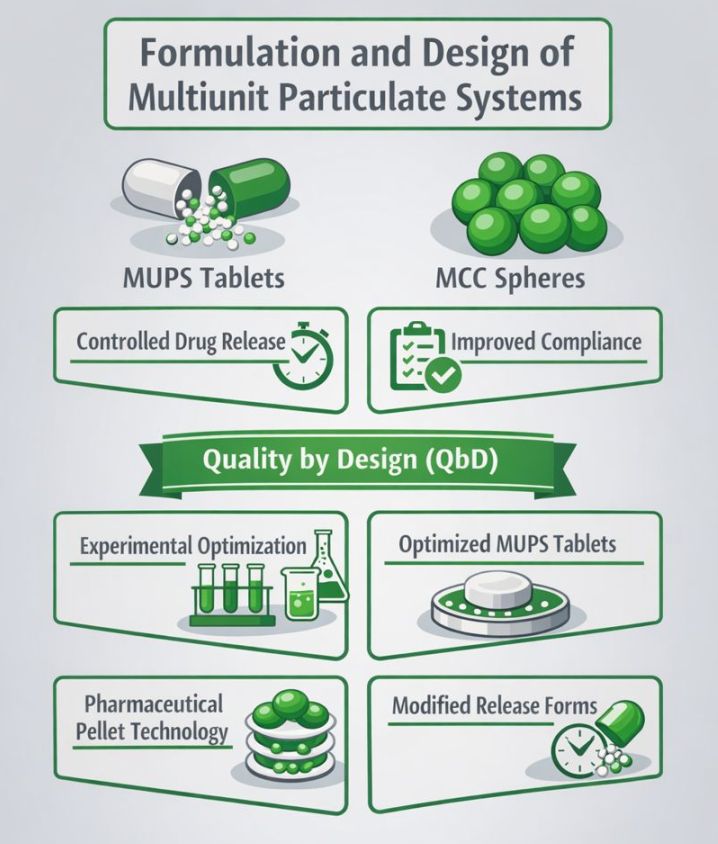
Formulation and Design of Multiunit Particulate Systems
Summary of the Pantoprazole MUPS Tablet Study
The referenced publication examines the formulation and design of multiunit particulate systems (MUPS) through the development of a pantoprazole MUPS tablet using a Quality by Design framework. The study aimed to understand how selected formulation variables affect critical tablet characteristics. To achieve this, the authors used enteric-coated pantoprazole pellets as multiparticulate units and compressed them into tablets with protective excipients. As a result, the formulation needed to balance mechanical strength with coating integrity.
The researchers applied a factorial design of experiments to evaluate three key variables: dry polymer content, matrix-forming polymer concentration, and pellet loading. Subsequently, they measured responses such as dissolution behavior, tablet hardness, friability, and disintegration time. The results showed that each variable influenced tablet quality in a measurable way. For example, higher pellet content increased the risk of coating damage during compression. However, appropriate polymer levels reduced this risk and stabilized drug release.
Based on statistical analysis, the study defined an optimized design space that delivered robust tablets with acceptable mechanical properties. In addition, the optimized formulation demonstrated dissolution behavior comparable to a marketed reference product. Therefore, the study confirmed that a well-designed multiunit particulate system can deliver pantoprazole effectively without compromising enteric protection. Overall, the work highlights how systematic formulation control improves both product performance and development efficiency.
Role of MCC Spheres in the Multiunit Particulate System
MCC spheres (such as CELLETS® 150-300) played a central role as inert starter cores in the multiparticulate formulation. First, they provided a uniform and mechanically stable substrate for drug layering. Moreover, their spherical shape supported homogeneous coating and predictable dissolution behavior. During compression, MCC spheres showed favorable plastic deformation, which helped absorb mechanical stress. As a result, they protected the enteric coating from cracking or rupture. Consequently, MCC spheres enabled the successful conversion of coated pellets into a compressed MUPS tablet while maintaining functional integrity.
Conclusion and Outlook
In conclusion, formulation and design of multiunit particulate systems offer a robust strategy for developing patient-friendly oral dosage forms. The pantoprazole study clearly demonstrates how a Quality by Design approach links formulation variables to tablet performance. Moreover, the use of MCC spheres highlights the importance of selecting suitable core materials for compression stability. Looking ahead, advances in material science and process understanding will further strengthen multiunit particulate systems. Therefore, these systems will continue to play a key role in improving therapeutic consistency and consumer compliance.
References
[1] G.S. Sonar, S. Rawat, International Journal of PharmTech Research, CODEN (USA): IJPRIF, ISSN: 0974-4304, Vol.8, No.8, pp 05-23, 2015. (link)