Figure 3: SEM picture of cross section of a Taste masked pellets coated with 25 mg Eudragit EPO.

Abstract

This case study on Atomoxetine HCl pellets is a short abstract of the publication by Y.D. Priya et al. [1].

Atomoxetine is a medication used to treat attention deficit hyperactivity disorder (ADHD) [2]. The API is marketed under the trade names Atomoxetine, Atomoxe, Agakalin, and Strattera (initially launched) [3]. Atomoxetine is an extremely bitter API. As being initially launched for children as capsules or tablets, the paediatric compliance by improved taste-masking and the simplified administration to paediatrics are in focus of this study.

A multi-unit particulate pellet coating (MUPS) was selected as oral dosage form. The fluidized bed technology (with Wurster column) was employed for coating and layering processes. This is a well-known technology, which Is for instance offered by Glatt. Starter cores were coated with the API, followed by layering with a polymeric coating for which realized the taste-masking.

Atomoxetine layering

Starter cores are made of Microcrystalline Cellulose (MCC) in sizes comparable to CELLETS® 200, while a fair efficiency of drug layering was observed with the combination of HPMC (Hydroxypropyl methyl cellulose) and HPC (Hydroxypropyl cellulose) as binders. The composition of API layering is presented in Table 1. The drug dispersion was sprayed onto the MCC pellets with an inlet temperature between 50 °C and 55 °C and a fluidized bed temperature between 35 °C and 40 °C.

API layering material Composition
Starter core
  MCC pellets 58.00
API layering
  Atomoxetine HCl 25.00
  Hydroxypropyl methylcellulose 3.50
  Hydroxypropyl Cellulose 3.50
  Low-Substituted Hydroxypropyl Cellulose 5.00
  Talc 5.00
  Purified Water Qs
Total weight (mg) 100.00

Table 1: Formulation of API layered pellets.

Taste-masking coating

The polymeric taste-masking layer is made of a methacrylate co-polymer (Eudragit EPO) providing an excellent coating with taste masking properties for fine particles and tablets. The composition of the taste-masking suspension is shown in Table 2. The inlet temperature is between 40 °C and 45 °C, and fluidized bed temperature is between 25 °C and 30 °C.

Polymeric coating material Composition
Drug Layered pellets 100.00
Eudragit EPO 25.00
Sodium Lauryl Sulfate 2.500
Stearic acid 3.750
Talc 6.25
FD&C Yellow No. 6 0.50
FD&C Red No. 3 0.05
Purified Water Qs
Total weight (mg) 138.050

Table 2: Formulation of polymeric coating suspension.

The efficiency of taste-masking was benchmarked by a bitterness rating on human volunteers. Figure 1 shows, that the taste sensitivity identifies a bitterness at 6 µg/ml API concentration and an extreme bitterness at 7 µg/ml API and higher concentration. Thus, the threshold bitterness of Atomoxetine HCl is 6 µg/ml.

Atomoxetine: bitternessFigure 1: Concentration of drug solution (µg/ ml). Bitter intensity ratings from no bitterness (green), bitterness (blue), extremely bitter (red).

Figure 1: Concentration of drug solution (µg/ ml). Bitter intensity ratings from no bitterness (green), bitterness (blue), extremely bitter (red).

All the volunteers felt bitter taste when the drug layered pellets were coated with 6.25 mg of Eudragit EPO. Whereas in the pellets coated with 12.5 mg and 18.75 mg of Eudragit EPO, bitter taste was masked up to 15 seconds after keeping the tablet in the mouth, and later all the human volunteers felt bitter taste. When the concentration of Eudragit EPO was increased to 25 mg, the bitter taste of Atomoxetine HCl was completely taste-masked and no volunteer was felt bitter taste.

Figure 2: In-Vivo Taste evaluation in healthy human volunteers.

Figure 2: In-Vivo Taste evaluation in healthy human volunteers.

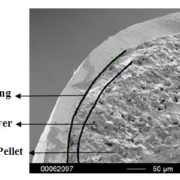
Figure 3 depicts the entire particle size of a taste-masked MCC pellet coated with the Atomoxetine drug layer and 25 mg of Eudragit EPO. The average particle size of the taste-masked pellets is between 180 µm and 250 µm, assuming, that no gritty feeling of particles in patient’s mouth will appear. It should be said, that a micronization of Atomoxetine HCl was deemed to be necessary for the drug layering process. Micronization minimized the surface roughness of the API layered pellet so that an efficient taste-masking coating can be applied.
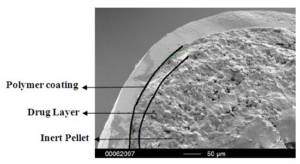
Figure 3: SEM picture of cross section of a Taste masked pellets coated with 25 mg Eudragit EPO.

Figure 3: SEM picture of cross section of a Taste masked pellets coated with 25 mg Eudragit EPO.

Summary

MCC pellets in the size of about 200 µm were layered with Atomoxetine. HPMC and HPC were used as binders, realizing a precise surface definition for a subsequent taste-masking coating. The taste-masking was most efficient at a polymeric concentration of 25 mg. Keeping the size of the coated pellets below 300 µm avoids a gritty feeling and thus increase the patient’s compliance.

This study by Priya et al. indicated that the fluidized bed process produced the most appropriate taste masked pellets of Atomoxetine HCl for oral disintegrating tablets.

References

[1] Y.D. Priya et al., Int J Pharm Pharm Sci, (6) 7, (2014) 110-115

[2] “Atomoxetine Hydrochloride Monograph for Professionals”. Drugs.com. American Society of Health-System Pharmacists. Archived from the original on 4 April 2019. Retrieved 22 March 2019.

[3] ROTE LISTE 2017, Verlag Rote Liste Service GmbH, Frankfurt am Main, ISBN 978-3-946057-10-9, (2017) 162.
Taste masked coated micropellets

Abstract on Tamoxifen

Tamoxifen is widely used in transgenic research in mice to induce Cre recombinase activity and achieve conditional gene knockouts [1]. However administrating tamoxifen to mice is challenging The commonly used dosing methods are oral gavage or intraperitoneal injection [2] which require specialist staff training and can cause pain, distress and adverse effects to the animal. Tamoxifen containing rodent chow is commercially available however, the poor palatability of the diet leads to reduced food intake and weight loss of the mice. The addition of sweeteners improves palatability, but this can affect the metabolic balance of the mice.

In this application a study is described in which a palatable tamoxifen containing rodent chow is developed by mixing taste masking coated micropellets with powdered rodent food. This attempt shell improve:

  • Reduction of potential welfare concerns,
  • Reduction of dose variability,

and induce

  • a more consistent recombinase activity,
  • a decrease in the variability of phenotyping data from these experiments,
  • a reduction in the number of animals used

Methods

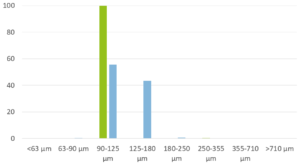
The API was spray layered onto microcrystalline cellulose substrates CELLETS® 100 and subsequently coated using Surelease®, both as aqueous formulations in a bench top fluidized bed coater (Mini Glatt®). Two taste masking coated tamoxifen citrate micropellet formulations were prepared and analyzed. One formulation has a coating levels of 5 % (F1) and the second formulation contains mannitol in the drug layer with a coating level of 10 % (F2). Sieve analysis of taste masking coated micropellets (Figure 2) shows that both formulations achieved yields of at least 99 % (proportion of pellets with size < 250 µm), see Fig. 1.

Tamoxifen sieve analysis

Figure 1: Tamoxifen sieve analysis. Graphs: F1 (light green); F2 (light blue).

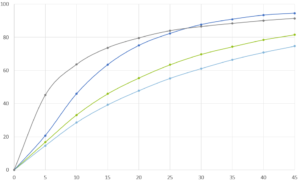
In USP II dissolution test the uncoated tamoxifen citrate (micronized and un-micronized particles) showed a fast dissolution at >80 % release within 45 minutes (Figure 3). The micronized particles dissolved slower than the un-micronized due to particle agglomeration during dissolution.

Drug release slowed down after applying the taste masking coating; with decreasing pore former concentration or increasing coating thickness, the drug release rate decreases. After 45 min, both formulations F1 and F2 showed >75 % drug release, successful as immediate release formulations (Fig. 2).

Drug release of Tamoxifen Citrate in USP II test

Figure 2: Drug release of Tamoxifen Citrate in USP II test. Graphs: F1 with coating Level 5 % and polymer ratio 75:25 (light green); F2 Mannitol with coating level 10 % polymer ratio 85:15 (light blue); Tamoxifen Citrate micronized (blue); Tamoxifen Citrate un-micronized (grey).

Taste masking effectiveness of Tamoxifen micropellets

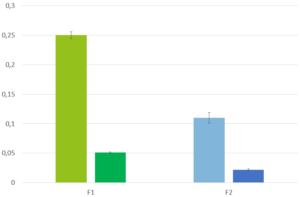
The in vitro tests for evaluating the taste masking effectiveness of the formulations showed that after 30s, micropellets with both coating formulations are effective in providing a taste masking barrier with a tamoxifen citrate release of less than 0.5% (Fig. 3).


Inverted Vial test for taste masking effect evaluation

Figure 3: Inverted Vial test for taste masking effect evaluation. Graphs: F1 (green), F2 (blue) with % Release after 30s (light color) and Concentration (mg/ml) after 30s (dark color).

Summary

Taste masking of coated tamoxifen citrate micropellets were successfully manufactured in a fluidized bed applying the MicroCoat™ technology with > 99% yield and particle size < 250 µm. The coating provided effective protection to prevent tamoxifen citrate release in the mouth but immediate drug release in the stomach pH conditions of the mice. Additionally, the small particle size of the coated micropellets ensured effective mixing with the powder rodent feed with excellent recovery and uniformity. The product is flexible in dose adjustment and improves API handling safety in animal units, offering an innovative approach of doing tamoxifen to mice for Cre recombination research via voluntary food intake. The method has the potential to reduce suffering
and improve welfare of the mice, promoting 3Rs (replacement, reduction and refinement) in animal research.

Taste masked coated micropellets

Taste masked coated micropellets

Acknowledgement

The project is funded by the United Kingdom National Centre for the Replacement, Refinement and Reduction of Animals in Research (the NC3Rs) through the CRACK IT challenge Tat Fit  project number NC/C020S02/1).

Dr. Fang Liu and her team are gratefully acknowledged for serving content for this note.

Fluid Pharma logo

Fluid Pharma Ltd
Contact: Dr. Fang LIU
College Lane, Hatfield, AL10 9AB, UK
Tel: +44 1707 28 4273
+44 796 3230 628
www.fluidpharma.com