
Posts

The development of an innovative method to improve the dissolution performance of rivaroxaban

This article [1] on the development of an innovative method to improve the dissolution performance of rivaroxaban was first published here.

Abstract

The dissolution performance of rivaroxaban has become a critical focus in pharmaceutical research, as this hydrophobic drug is practically insoluble in water, limiting its absorption and therapeutic effectiveness. Recent advancements in formulation strategies have explored the use of drug–cyclodextrin complexes to overcome solubility challenges, but traditional solid-state inclusion methods often result in incomplete encapsulation. To address this limitation, researchers have developed an innovative technique to integrate liquid-state rivaroxaban–hydroxypropyl-β-cyclodextrin complexes into solid dosage forms. By dispersing the drug complex with hydroxypropyl-cellulose and coating cellulose pellets under precisely controlled processing conditions, this approach enhances drug stability, compressibility, and flowability. Comprehensive physicochemical characterization confirmed successful complexation, while dissolution studies demonstrated significantly improved release rates, particularly within the first 10 minutes, when compared to conventional rivaroxaban tablets.

A method to improve the dissolution performance of rivaroxaban

Recent advances in solid dosage form design with active ingredient–cyclodextrin complexes have attracted strong interest in pharmaceutical research. However, most earlier studies focused on solid-state complexes, which often caused incomplete inclusion. Therefore, new methods became necessary to improve drug incorporation.

In this study, the researchers developed a novel way to integrate liquid-state drug–cyclodextrin complexes into solid dosage forms. Specifically, their work centered on rivaroxaban, a poorly water-soluble and hydrophobic drug. To achieve this, Ozon et al. combined rivaroxaban with hydroxypropyl-β-cyclodextrin at a 1:1 molar ratio and kept the mixture in a liquid state. Furthermore, to increase viscosity, the team added 2% hydroxypropyl-cellulose. Finally, they sprayed the resulting dispersion onto cellulose pellets (CELLETS® 780) using a Caleva Mini Coater.

Improved Process Strategies for Rivaroxaban Dissolution

The researchers carefully controlled the process conditions. Specifically, atomization air pressure stayed at 1.1 atm, while fluidizing airflow ranged between 35–45 m³/h. After coating, they analyzed the pellets and raw materials using FTIR, XRD, SEM, and DSC techniques. As a result, these tests confirmed that rivaroxaban successfully formed inclusion complexes with hydroxypropyl-β-cyclodextrin. Furthermore, the final pellets showed excellent flowability, good compressibility, and adequate hardness.

In addition, HPLC-DAD analysis confirmed a drug loading of 10 mg rivaroxaban per 750 mg of coated pellets. For dissolution testing, the researchers used two distinct media: sodium acetate buffer pH 4.5 with 0.2% sodium dodecyl sulfate, and phosphate buffer pH 6.8 without surfactants. They then compared the new capsules with both reference capsules and conventional tablets. Consequently, results showed that the experimental capsules matched the release profile of Xarelto® 10 mg. Moreover, they released rivaroxaban at a faster rate within the first 10 minutes.

Conclusion

In conclusion, this research introduces an effective method to create solid dosage forms from liquid-state drug–cyclodextrin complexes. More importantly, this innovative approach significantly improves the dissolution performance of rivaroxaban. Therefore, it opens promising new possibilities for enhanced drug delivery and greater oral bioavailability. This breakthrough highlights the potential of liquid-state inclusion complexes to optimize the dissolution performance of rivaroxaban, paving the way for more efficient drug delivery systems and enhanced oral bioavailability.
References

[1] E. A. Ozon, E. Mati, Oana Karampelas, V. Anuta, I. Sarbud, A. M. Musuc, R.-A. Mitran. D. C. Culita, I. Atkinson, M. Anastasescu, D. Lupuliasa, M. A. Mitu, Heliyon 10(12), 2024, e33162; doi: 10.1016/j.heliyon.2024.e33162

Connecting information

Are you working on dissolution performance of rivaroxaban or similar API, as well? Get in touch with us. We supply material support for educational research activities.
Benefits of multilayer high drug-loaded amorphous solid dispersions

Introduction on amorphous solid dispersions

What is the benefit of multilayer amorphous solid dispersions? Recently, several studies had been performed on amorphous solid dispersions working spheres or starter beads. Starter beads, such as MCC (Microcrystalline Cellulose) spheres are employed due to their high friability and chemical inertness. Some studies are even working on solventless pelletization and amorphization using high shear granulator techniques [1].

Amorphization of poorly water-soluble drugs is a promising approach to improve the solubility and dissolution rate as amorphous solids lack a crystal lattice with long-range order [2]. Unfortunately, a high chemical potential compared to crystalline forms makes amorphous forms thermodynamically unstable. Thus, amorphous drugs exhibit low physical stability and finally lack of recrystallization [3,4]. In turn, surface crystallization is to be minimized.

Multilayer amorphous solid dispersions

This is the key focus of a publication by Eline Boel and Guy Van den Mooter: They had been investigating a promising solution of multilayer high-drug load amorphous solid dispersions, as follows [5]:

Inhibiting surface crystallization is an interesting strategy to enhance the physical stability of amorphous solid dispersions (ASDs), still preserving high drug loads. The aim of this study was to investigate the potential surface crystallization inhibitory effect of an additional polymer coating onto ASDs, comprising high drug loads of a fast crystallizing drug, layered onto pellets. For this purpose, bilayer coated pellets were generated with fluid-bed coating, of which the first layer constitutes a solid dispersion of naproxen (NAP) in poly(vinylpyrrolidone-co-vinyl acetate) (PVP-VA) in a 40:60 or 35:65 (w/w) ratio, and ethyl cellulose (EC) composes the second layer. The physical stability of these double-layered pellets, in comparison to pellets with an ASD layer only, was assessed under accelerated conditions by monitoring with X-ray powder diffraction (XRPD) at regular time intervals. Bilayer coated pellets were however found to be physically less stable than pellets with an ASD layer only. Applying the supplementary EC coating layer induced crystallization and heterogeneity in the 40:60 and 35:65 (w/w) NAP-PVP-VA ASDs, respectively, attributed to the initial contact with the solvent. Caution is thus required when applying an additional coating layer on top of an ASD layer with fluid-bed coating, for instance for controlled release purposes, especially if the ASD consists of high loads of a fast crystallizing drug.

Read more on doi:10.1016/j.ijpharm.2022.122455.

How about following up studies on ASD formulation with starter beads? Simply, contact us für MCC spheres, such as CELLETS® 700 (700-1000 µm, US mesh 18/25).

Your technology and formulation partner for amorphous solid dispersions:

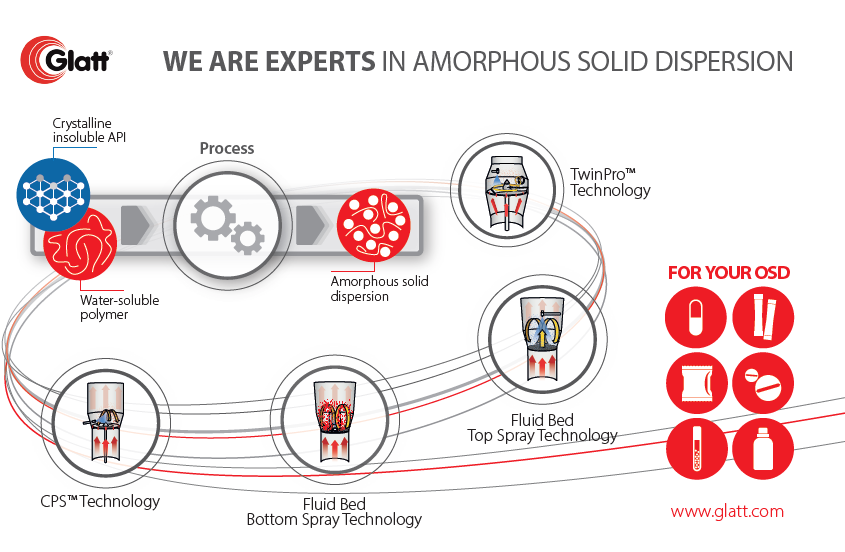
Glatt in amorphous solid dispersions

References

[1] K. Kondo, T. Rades, European Journal of Pharmaceutics and Biopharmaceutics 181 (2022) 183–194 doi:10.1016/j.ejpb.2022.11.011

[2] B.C. Hancock, M. Parks, Pharm. Res. 17 (2000) 397-404.

[3] L.I. Blaabjerg, E. Lindenberg, T. Rades, H. Grohganz, K. Lobmann, Int. J. Pharm. 521 (2017) 232-238.

[4] A. Singh, G. Van den Mooter, Adv. Drug Deliv. Rev. 100 (2016) 27-50.

[5] E. Boel, G. Van den Mooter, International Journal of Pharmaceutics (2022) 122455. doi:10.1016/j.ijpharm.2022.122455