
Ketoprofen – A Nonsteroidal Anti-Inflammatory Drug
Ketoprofen is a nonsteroidal anti-inflammatory drug (NSAID). The drug relieves:
- Pain (such as headaches, dental pain, muscle aches, and menstrual cramps)
- Inflammation (swelling and redness)
- Arthritis symptoms, including osteoarthritis and rheumatoid arthritis
- Fever
The drug works by blocking the production of substances called prostaglandins, which contribute to pain and inflammation.
In modern pharmaceutical formulation, modifed release profiles have a strong impact on drug release, patient acceptance and drug safety. Therefore, pellet technologies are investigated as carrier systems for APIs such as Ketoprofen. Experimentally, Thi Trinh Lan Nguyen [1] examined pellet layered Ketoprofen formulations based on MCC spheres, such as CELLETS®. In the following, an exerpt is presented.
Preparation of Ketoprofen Layered MCC Spheres
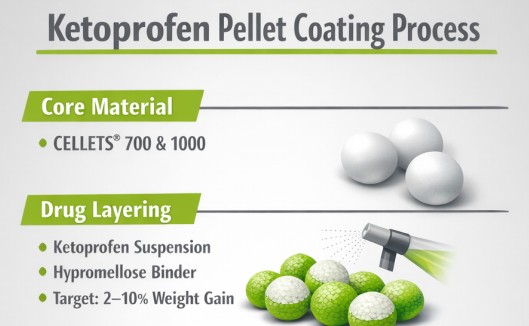
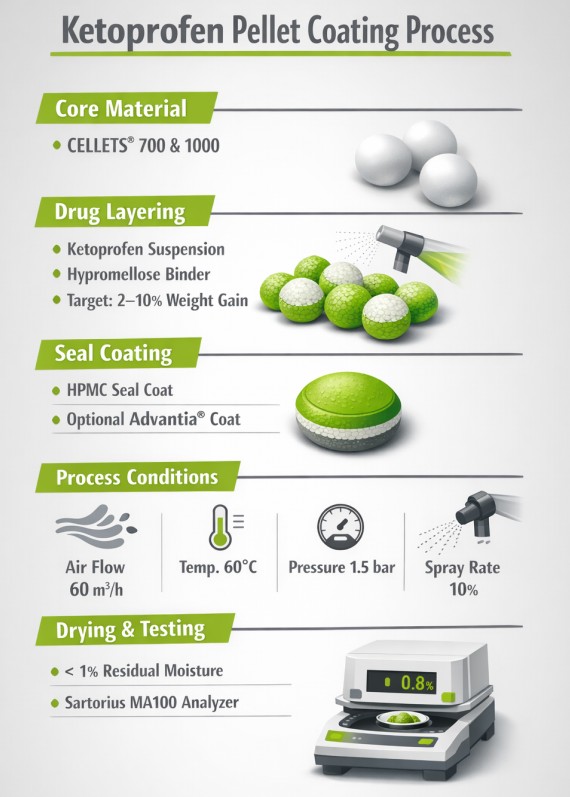
Coating technologies use a fluidized-bed spray-coating process. In this process, a nanoemulsion containing ketoprofen coats inert microgranules. These granules use solid microcrystalline cellulose cores (CELLETS®).
The model drug ketoprofen coats microcrystalline cellulose cores (CELLETS® 700 and CELLETS® 1000). Then, the process runs in a fluid-bed system. It achieves 2%, 5%, and 10% weight gain based on initial core mass.
First, operators fluidize the cellulose spheres in the coating chamber. Then, they spray an aqueous suspension of ketoprofen, hypromellose, and water onto the particles. Next, they apply an additional aqueous hypromellose solution as a seal coat.
Optionally, they add a second seal coat using Advantia® from aqueous solution. Meanwhile, they prepare all coating solutions by mixing excipients in water for 1 hour. They also homogenize the drug suspension for 10 minutes using an IKA50 homogenizer. In addition, they keep the suspension under continuous mixing during spraying.
After coating, operators dry the pellets with fluidizing air. They continue drying until water content drops below 1%. Finally, they measure water content using a Sartorius MA100 infrared moisture analyzer. They analyze 3–4 g of pellets using loss on drying.
Characteristic of the coating layer pellets
Four pellet batches were produced to study the effects of coating material, drug layer uniformity, and drug release in immediate-release pellets.
Fig. 1 summarizes the design specifications for each batch. First, CELLETS® starter cores received a coating of ketoprofen and polymer mixtures. The ketoprofen suspension contained 1% (w/w). The polymer solution contained 10% (w/w). The process continued until the coating reached 10% (w/w) based on core weight.
The process used defined operating parameters. The air flow rate reached 60 m³/h. The inlet air temperature reached 60°C. The atomization pressure stayed at 1.5 bar. The spray rate of the coating solution remained at 10%.
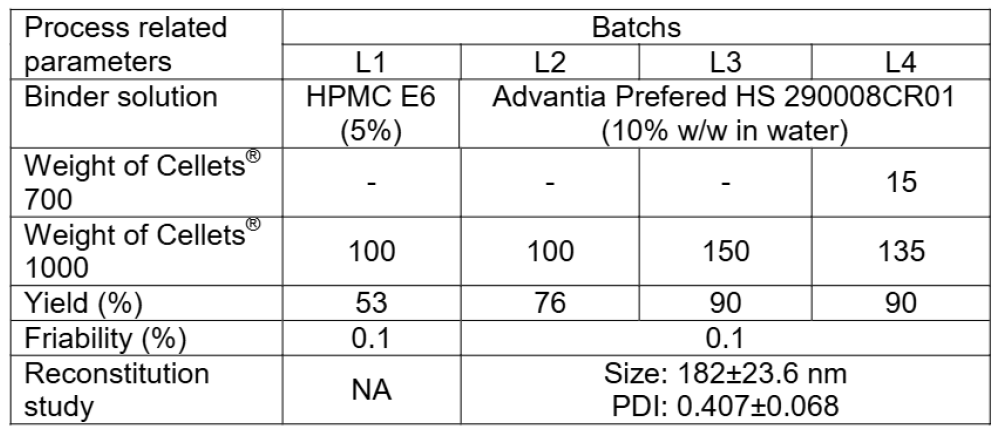
Fig. 1: Composition of the batches and results of drug layering processes.
The coating thickness and its uniformity are two important parameters even when layer coating is applied. More uniform coating results in lower quantities of coating material applied to achieve a desired result, shorter process time and lower power consumption during coating process.
Because of the design of air grinding blades has distance of about 1 mm, some small pellets can “leak” and “were trapped” on the sieve of the product container (Figure 5.10 b) and couldn’t involve in the coating process and effect to the uniformity of the coating layer. Particle size of pellets should be ideal for fluidization and coating. The very small or too large of particle size of pellets makes disorganized fluidizing. If too small, twinning and agglomeration of multiparticulates may occur [2].
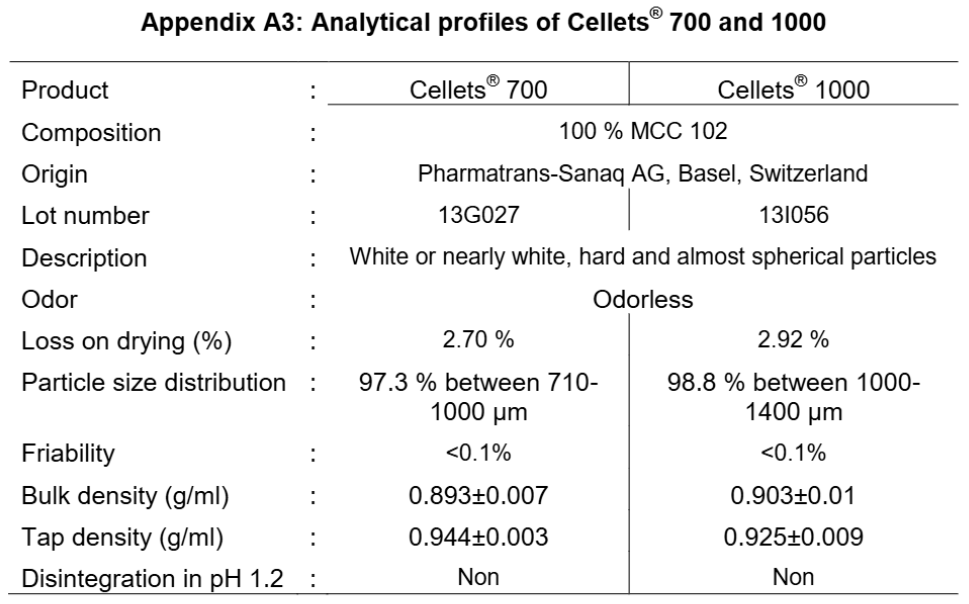
Fig. 2: Analytical profiles of Cellets® 700 and Cellets® 1000
In-vitro drug release study
The effect of adding oil and surfactant on ketoprofen dissolution appears in Fig. 3. In addition, formulation L3 shows a strong increase in dissolution rate. More than 95% of ketoprofen releases within 5 minutes. Moreover, 100% of the drug releases after 10 minutes in pH 1.2.
In contrast, formulation L1 shows slower release. It reaches a maximum of 90% release within 30 minutes at pH 1.2.
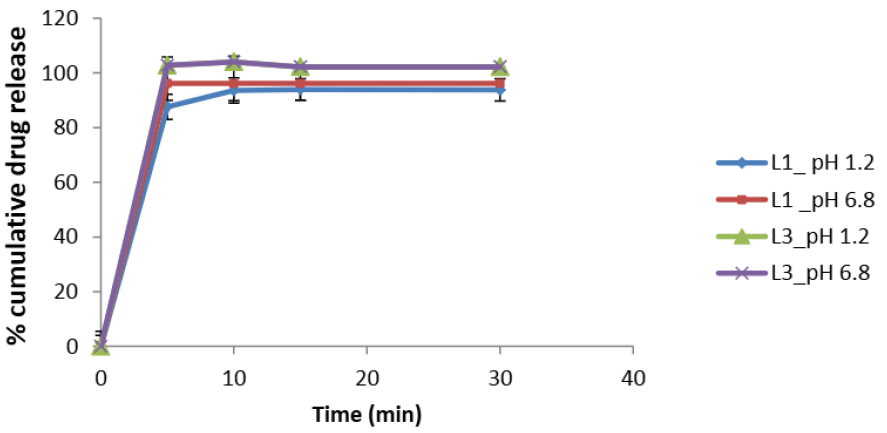
Dissolution profile of layer coating pellets in different media
Conclusion
Fluid bed processor offer unique opportunity to develop and produce coated controlled release products, such as ketoprofen layered MCC spheres. However, various process parameters easily can alter the performance of a product and hence should be examined thoroughly. The interactions of various process parameters presents a great challenge in optimizing the coating process, hence it is important to investigate and understand these variables to ensure a reproducible performance of controlled release products.
The loss of coating material, presumably, due to drying of sprayed droplets before hitting the pellets surface, deposition to the walls of draft tube or attrition because of inter-particle collisions or collisions with the walls of the process chamber are the most important factors affecting the total process yield.
References
[1] Thi Trinh Lan Nguyen, Extrusion- spheronization of pharmaceutical products: system for the delivery of active ingredients which are poorly soluble by oral route, 28/6/2017, PhD thesis, I’université de Strasbourg, link
[2] Barletta M., Gisario A., Guarino S., Tagliaferri V., Engineering Applications of Artificial Intelligence; 21: 1130-43; doi:10.1016/j.engappai.2008.01.004
Ketoprofen Layered MCC Spheres
 adobe firefly
 ingredientpharm

 adobe firefly