
Introduction
Fixed-bed column techniques are widely applied in water and wastewater treatment to achieve continuous adsorption of pollutants. In these systems, aqueous effluent flows through a packed bed of adsorbent material, offering operational simplicity, easy scale-up, and consistent performance—critical features in industrial and pharmaceutical settings. However, removing dyes from pharmaceutical effluents presents unique challenges: dyes are structurally complex, resistant to biodegradation, and often toxic or carcinogenic even at trace levels. Pharmaceutical industries demand exceptionally high water quality, making dye removal both technically difficult and economically significant.
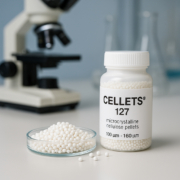
This study evaluates granulated cellulose CELLETS® 200 for organic pollutants adsorption in fixed-bed systems. CELLETS® 200, composed of microcrystalline cellulose, are spherical pellets with defined particle size and porosity, designed to serve as a sustainable biosorbent. Their uniform granulation minimizes bed channeling and pressure drop—common operational issues—while their renewable nature supports greener treatment practices.
Use of CELLETS® 200 for organic pollutants adsorption
In the reported research, Granulated CELLETS® 200 were packed into vertical fixed-bed columns to treat aqueous solutions containing model organic dyes. Prior to column testing, batch experiments were used to determine equilibrium and kinetic parameters, ensuring reliable interpretation of breakthrough behavior. Columns were operated under controlled conditions—including flow rate, temperature (20 °C), and influent concentration—to monitor how CELLETS® 200 performed dynamically. Breakthrough curves were generated to assess adsorption capacity over time, and mathematical models (Thomas, Yoon–Nelson, Bohart–Adams) were applied to approximate performance and guide scale-up efforts.
Key Findings
Granulated cellulose CELLETS® 200 demonstrated effective uptake of cationic dyes such as Methylene Blue in a continuous-flow setup. The fixed-bed columns showed clear breakthrough profiles: bed depth and lower flow rates correlated with delayed breakthrough and increased total adsorption, confirming that the system response is highly dependent on operational variables. The experimental breakthrough data matched well with established fixed-bed adsorption models, suggesting predictable performance in larger-scale applications. Additionally, the mechanical integrity of CELLETS® 200—owing to their spherical shape and granulated structure—ensured low pressure drop and mitigated flow channeling even over extended operation. The study also underscored that CELLETS® 200 can be regenerated through mild washing treatments, maintaining a significant fraction of their capacity across multiple cycles. These findings reinforce the suitability of granulated cellulose CELLETS® 200 for organic pollutants adsorption in fixed-bed systems tailored to industrial effluents.
Conclusion & Outlook
The investigation confirms that granulated cellulose CELLETS® 200 for organic pollutants adsorption offers a sustainable, efficient biosorbent option for fixed-bed column processes, particularly in the removal of indelible dye molecules from pharmaceutical wastewater. The combination of green material sourcing, predictable and scalable performance, low hydraulic resistance, and reusability highlights CELLETS® 200 as a practical alternative to conventional adsorbents like activated carbon.
Future research should explore surface functionalization—such as the introduction of carboxyl or amine groups—to improve selectivity and capacity for various organic pollutants, including pharmaceutical remnants beyond dyes. Pilot-scale validations using actual industrial effluents, alongside techno-economic assessments and lifecycle analyses, will be essential to confirm the feasibility and environmental benefits of integrating CELLETS® 200 into full-scale wastewater treatment operations.
By showcasing granulated cellulose CELLETS® 200 for organic pollutants adsorption, this study advances the dialogue on sustainable biosorbents in fixed-bed systems, offering a strong foundation for both academic and industrial uptake of cellulose-based solutions in water treatment.
References
[1] Separations 2023, 10(2), 143; https://doi.org/10.3390/separations10020143 (PDF)
 adobe firefly