
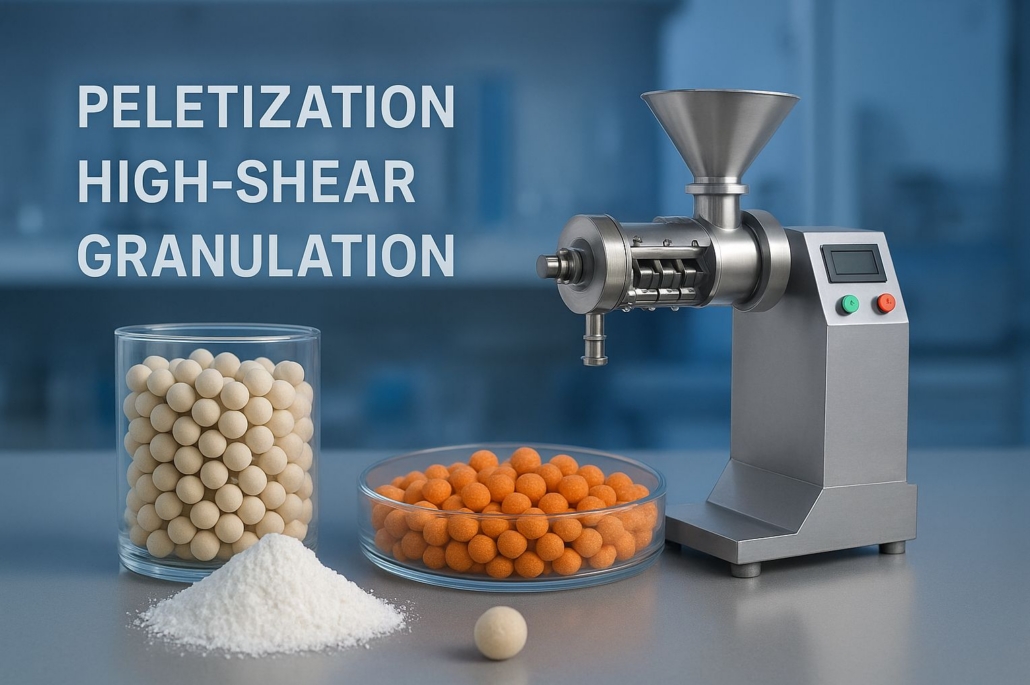
Introduction to Different Pelletization Techniques and Their Functionality in Drug Formulations
Different pelletization techniques form a core part of pharmaceutical manufacturing for solid dosage forms that deliver active pharmaceutical ingredients (APIs) with enhanced performance. Pelletization, a process that generates small, uniform spherical particles, improves flow properties, enables controlled or delayed release, and reduces local irritation in the gastrointestinal tract compared with conventional tablets and capsules. These techniques include direct pelletization, layering pelletization, extrusion-spheronization, spray drying, and other advanced methods, each offering specific functional benefits. Direct pelletization allows quick single-step formation with minimal equipment and lower cost. Layering pelletization deposits drug onto inert cores to improve drug loading and modify release profiles. More complex methods like extrusion-spheronization yield highly uniform pellets but require more processing time. Across all approaches, the choice of technique affects drug dissolution, stability, and manufacturability, and each technique opens opportunities to tailor drug release, enhance bioavailability, and optimize patient compliance through multiparticulate delivery systems.
Summary of the Thesis
The PhD thesis [1] “Application of High-Shear Granulator in Different Pelletization Techniques” by Azza Asim Khalid Mahmoud explores high-shear granulator applications. Furthermore, it demonstrates how these granulators improve different pelletization techniques to produce optimized drug delivery pellets. Consequently, different pelletization techniques become essential for solid dosage forms, enhancing flow properties and ensuring uniform size distribution. Moreover, the study highlights how these techniques enable precise control over drug release while equipment choice reduces cost and streamlines production. In addition, both direct pelletization and layering pelletization are analyzed within a high-shear granulator framework. Therefore, Quality by Design (QbD) principles guide the definition of process parameters that impact pellet quality. Through risk assessments, design of experiments (DoE), and optimization strategies, critical parameters are identified. These include impeller speed, chopper speed, binder volume, and granulating liquid, which strongly affect pellet size, yield, hardness, and dissolution. Overall, the research confirms that mastering different pelletization techniques enhances pharmaceutical pellet formulation efficiency and performance.
Direct pelletization with high-shear granulation
The thesis demonstrates that direct pelletization with high-shear granulation can produce pellets with desirable physical attributes and consistent drug distribution through careful experimental design. By applying a full factorial design and central composite design, the author constructs an optimal design space. The study also incorporates active pharmaceutical ingredients—amlodipine besylate and hydrochlorothiazide—showing how optimized pellets retain good content uniformity and dissolution performance when loaded. On the layering pelletization front, MCC cores serve as a base for drug deposition, with micro-computed tomography and thermal analysis confirming structural features that contribute to improved drug release. The research highlights how the high-shear granulator facilitates physical transformations such as partial amorphization of loaded drugs, which can enhance dissolution rates.
The thesis underscores the advantages of integrating QbD concepts into pelletization, improving reproducibility and understanding of how process variables interact. Overall, the study provides a comprehensive view of how different pelletization techniques benefit from high-shear granulation to produce robust pellet formulations with desirable critical quality attributes.
Use of CELLETS® in the Study
Within the thesis, CELLETS®—spherical microcrystalline cellulose cores—play a key role in the layering pelletization process. These inert cores are typically defined in uniform sizes of approximately 100 µm to 1400 µm. They provide a stable and consistent substrate onto which drug combinations (hydrochlorothiazide and amlodipine besylate) are deposited under high-shear conditions. The application of CELLETS® enhances layering efficiency, facilitates uniform drug distribution, and contributes to improved pellet morphology and mechanical integrity. Their use is integral to investigating how high-shear granulation affects drug layering and the resulting pharmacotechnical properties of the pellets.
Conclusion and Outlook
This thesis confirms that different pelletization techniques, particularly direct and layering methods, gain substantial functional advantages when implemented with high-shear granulation and QbD strategies. The research shows that such integration leads to pellets with optimized size, mechanical strength, and drug release characteristics. Moreover, the use of CELLETS® strengthens drug layering approaches and helps maintain uniformity in multiparticulate systems. Future research may expand on scaling these methods for commercial production, exploring additional API combinations. They are employing real-time monitoring technologies to further enhance control over pellet quality. By advancing the understanding of how process parameters affect critical quality attributes, this work positions high-shear granulation. This technology is a versatile tool for modern drug formulation technologies.
References
[1] SZTE Repository of Dissertations
 ingredient pharm
 ingredientpharm