hydroxynorketamine modified-release dosage form ChatGPT Image 11. Juli 2025, 13_57_57

Introduction

The development of a hydroxynorketamine modified-release dosage form marks an important advance in neuropsychiatric therapy. Hydroxynorketamine (HNK), a ketamine metabolite, shows rapid antidepressant activity through mechanisms different from ketamine itself. It works mainly by modulating α7-nicotinic acetylcholine receptors and activating mTOR pathways.

This targeted action makes HNK a strong candidate as an active pharmaceutical ingredient with a favorable safety profile. Unlike ketamine, it avoids dissociative and addictive side effects. A modified-release form built with CELLETS®—uniform spherical pellets—offers tighter therapeutic control. It sustains plasma concentration, reduces peak-to-trough swings, and helps patients stay consistent with treatment.

In addition, the inert cores often range between 100 and 500 μm in size. A more refined range of 200 to 400 μm improves precision. About 90% of particles fall within this window, confirmed by sieve analysis. One example is CELLETS® 200, which demonstrates this particle size distribution effectively.

API Function and Patient Benefits

Hydroxynorketamine mainly acts by inhibiting α7-nicotinic receptors. This lowers intracellular Ca²⁺ and D-serine levels and reduces NMDA receptor excitotoxicity. At the same time, it boosts mTOR signaling and strengthens AMPA receptor function.

Together, these effects speed up synaptogenesis and create fast antidepressant responses. Evidence comes from both preclinical studies and early clinical findings. For patients, this means rapid mood elevation without ketamine-related side effects. Unlike ketamine, it does not cause hallucinations or carry strong abuse potential.

From a pharmacokinetic view, a modified-release dosage form improves consistency in therapy. It also simplifies dosing schedules and increases tolerability.

Modified‑release dosage Formulation with CELLETS®

The incorporation of CELLETS® into the modified‑release formulation provides several benefits. Their uniform size and high sphericity ensure consistent drug coating and predictable release. CELLETS® also enable multiparticulate dosing, which reduces variability and allows tailored release profiles.

For hydroxynorketamine (HNK), CELLETS® can carry specific polymer coatings such as ethylcellulose or Eudragit. These coatings dissolve or erode at controlled rates, releasing the API steadily over time. This method lowers peak systemic concentrations, which reduces side effects while maintaining efficacy.

Additionally, CELLETS® support monolithic layering or reservoir systems. This setup allows complex release patterns, such as an initial burst followed by sustained delivery. Such profiles are ideal for achieving a rapid onset and maintaining antidepressant effects in depression treatment.

Key Findings on Hydroxynorketamine modified‑release dosage form

In the disclosed patent (US 2025 0177325 A1), researchers describe a multiparticulate modified‑release system for hydroxynorketamine. They use CELLETS® as the core substrate. The CELLETS® carry successive polymer layers that control drug release. This design produces an initial release phase followed by prolonged delivery.

Pharmacokinetic modeling shows a flattened plasma-concentration profile, lower maximum concentration (Cmax), longer time to peak (Tmax), and higher area under the curve (AUC). Together, these factors maintain therapeutic HNK levels over time. This steady exposure may reduce rebound symptoms and cut dosing frequency. As a result, patient adherence improves, and treatment regimens may shift to once-daily or even less frequent dosing.

Conclusion and Outlook

In conclusion, the hydroxynorketamine modified‑release dosage form using CELLETS® offers a promising pharmaceutical approach. It leverages HNK’s unique mechanism as a non-dissociative antidepressant. Controlled release maximizes its clinical potential.

Cellet-based formulations improve pharmacokinetics, enhance tolerability, and increase convenience. These benefits could significantly help patients with treatment-resistant depression. Further work is needed, including in vitro−in vivo correlation studies, polymer selection optimization, and confirmatory clinical trials.

Looking ahead, this technology may expand HNK applications to other neuropsychiatric or neurodegenerative disorders. It provides a refined dosage form that meets both patient needs and therapeutic goals.

Patent Details

  • Name or patent: Hydroxynorketamine for the use in the treatment of depression
  • Patent number: US 20250177325 A1
  • Year of patent: 2025
  • Patent holder names and affiliation: (Names not specified in public abstract; likely the inventors assigned to their sponsoring institution or company as listed in patent document)

This summary underscores the innovative use of CELLETS® in creating a refined hydroxynorketamine modified-release dosage form that elevates both therapeutic performance and patient-centric outcomes.

hydroxynorketamine modified-release dosage form
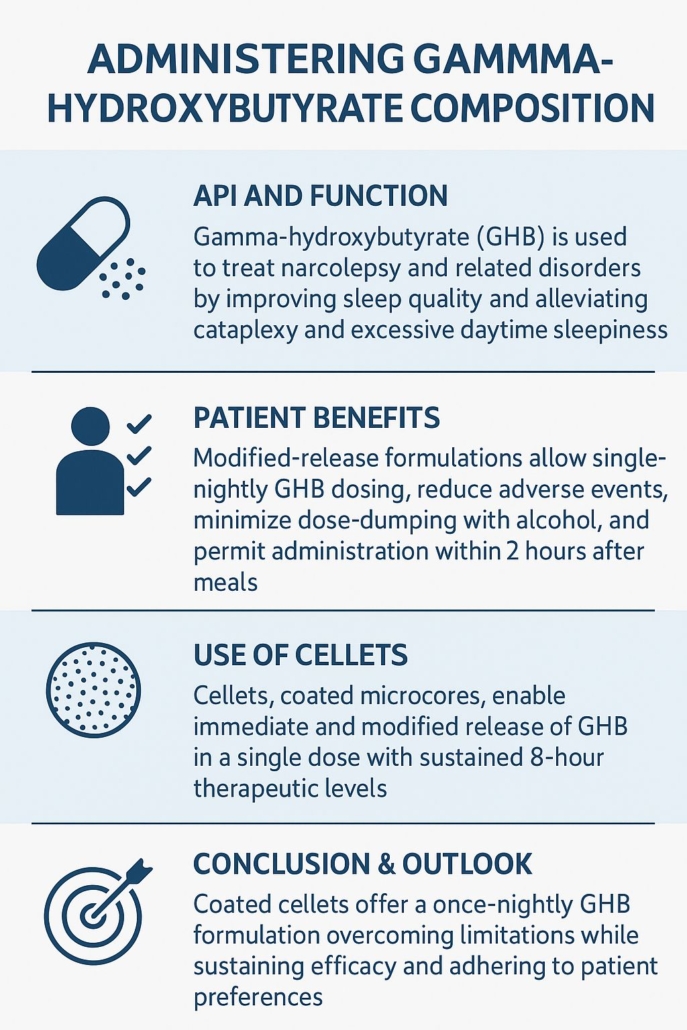
US20250186377A1 cellet‑based modified‑release gamma‑hydroxybutyrate formulation ChatGPT Image 11. Juli 2025, 13_12_09

Introduction

Gamma‑hydroxybutyrate (GHB) is an endogenous neurotransmitter also used pharmaceutically—usually as sodium oxybate—for treating narcolepsy and related disorders. It exerts its therapeutic effects by modulating GABA_B receptors and promoting slow-wave sleep, alleviating cataplexy, and reducing excessive daytime sleepiness. Despite its efficacy, current twice-nightly dosing regimens present challenges: dose‑dumping in the presence of alcohol, variable pharmacokinetics depending on food intake, and patient inconvenience. To address these issues, modern formulations—and especially the innovative use of CELLETS® —pursue once-nightly controlled release.

API Benefits and Patient Advantages

Administering gamma‑hydroxybutyrate compositions in a modified‑release format brings multiple patient-centric benefits. A single nightly dose minimizes repeated nighttime awakenings and improves adherence. These formulations exhibit lower peak concentrations (C_max) with sustained therapeutic exposure (AUC)—achieving similar or better efficacy while reducing adverse events such as dizziness or nausea. This consistency is especially meaningful when dosing less than two hours after eating, which often is more convenient for patients; the controlled formulations are more forgiving of fed-state PK variability and less prone to alcohol-induced dose-dumping.

Use of CELLETS® in methods of administering gamma-hydroxybutyrate compositions

CELLETS® — spherical microcores used in multiparticulate drug delivery—are central to these modern GHB formulations. The patent US 20250186377 A1 introduces coated cellet-based microparticles that incorporate immediate-release (IR) and modified-release (MR) segments within a single unit dose. The MR portion involves CELLETS® (e.g. CELLETS® 90, CELLETS® 100 or CELLETS® 127, and other MCC beads) coated with polymers carrying free carboxyl groups combined with hydrophobic materials (e.g., high melting point waxes), engineered to delay GHB release until intestinal transit. CELLETS® enable precise layering, efficient coating, and reproducible drug release profiles while resisting pH- and alcohol-triggered dose dumping.

This multiparticulate approach achieves desired PK: IR CELLETS® ensure rapid onset while MR CELLETS® sustain plasma GHB levels up to 8 hours. In contrast to IR liquid sodium oxybate, the coated cellet formulation shows dose‑proportional C_max and AUC across doses of 4.5 g, 7.5 g, and 9 g, with most AEs clustering near C_max but at overall milder intensity. Remarkably, cellet-based formulations maintain comparable therapeutic exposure even with postprandial dosing, offering flexibility not seen in immediate-release forms.

Key Findings

The inventive cellet-based GHB composition delivers both immediate and controlled drug release in one unit, offering dose‑proportional pharmacokinetics and sustained therapeutic levels for 8 hours, under single-nightly dosing. It improves safety by reducing peak‑induced adverse events, lowers risk of alcohol‑related dose-dumping, and allows dosing within two hours after meals. Studies show comparable efficacy to twice-nightly IR sodium oxybate on sleep quality and daytime alertness, with better convenience and adherence.

Conclusion & Outlook

The patented cellet‑based modified-release formulation of GHB marks a significant advancement in administering gamma‑hydroxybutyrate compositions. By incorporating coated CELLETS® that combine IR and MR elements, this approach mitigates common limitations—meal dependency, alcohol interactions, multiple nightly doses—while preserving therapeutic efficacy. For patients with narcolepsy or cataplexy, this translates into improved sleep continuity, reduced daytime symptoms, and enhanced quality of life.

Looking ahead, further clinical evaluation could extend the CELLETS® platform to other formulations of gamma‑hydroxybutyrate salts or co‑therapies (e.g., with sodium valproate), further broadening the therapeutic utility. This modular, multiparticulate delivery system could set a new standard for nightly dosing regimens where controlled pharmacokinetics and patient preferences align.

Patent Details

  • Name/Title: cellet‑based modified‑release gamma‑hydroxybutyrate formulation

  • Patent Number: US 20250186377 A1

  • Year of Patent: 2025

  • Patent Holder(s): Not explicitly indicated in the publicly listed data, but associated inventors likely affiliated with pharmaceutical firms focusing on CNS therapeutics (e.g., Jazz Pharmaceuticals or Flamel Ireland).
US20250186377A1 cellet‑based modified‑release gamma‑hydroxybutyrate formulation ChatGPT Image 11. Juli 2025, 13_12_09
microcrystalline cellulose for organic pollutants adsorption

Introduction

Fixed-bed column adsorption is an essential process in modern water treatment systems, widely implemented due to its continuous operation, ease of design, and applicability in large-scale systems. In this method, a contaminant-laden liquid passes through a column packed with adsorbent material, facilitating efficient contaminant removal before discharge or reuse. While effective for many pollutants, the removal of organic dyes—particularly synthetic types such as Methylene Blue—remains a formidable challenge due to their structural complexity, high solubility, and resistance to conventional degradation methods. These characteristics are especially problematic in pharmaceutical applications, where effluents must meet strict regulatory limits to prevent environmental and product contamination.

Organic dyes in pharmaceutical wastewater not only hinder downstream purification but also pose ecotoxicological risks when released into natural water bodies. As such, there is an ongoing demand for adsorbent materials that are effective, regenerable, and environmentally friendly. Within this framework, microcrystalline cellulose for organic pollutants adsorption represents a promising and sustainable approach.

Use of CELLETS® and experimental design

In the study referenced by DOI 10.5004/dwt.2019.23638 [1], researchers evaluated microcrystalline cellulose-based spherical pellets—commercially known as CELLETS® —for their potential to adsorb organic dyes from aqueous solutions. These pellets are manufactured via wet-granulation and extrusion processes, yielding highly uniform, spherical particles with low friability and high surface area. Such properties are ideal for both batch and dynamic (fixed-bed) adsorption studies due to predictable flow behavior and minimal mechanical breakdown under continuous operation.

Batch experiments were initially conducted using Methylene Blue as a model compound. Isotherm analysis revealed strong agreement with the Langmuir model, indicating monolayer adsorption with a maximum capacity of approximately 82 mg/g. Kinetic modeling confirmed that adsorption followed pseudo-second-order dynamics, suggesting chemisorption mechanisms dominated the process.

Key findings

The results showed that microcrystalline cellulose pellets offer a high specific adsorption capacity for Methylene Blue dye, consistent with Langmuir isotherm behavior. The pseudo-second-order kinetic model provided the best fit for experimental data, supporting a chemisorption-driven process. Notably, the physical structure of the CELLETS® 200 remained intact after multiple uses, and regeneration with dilute acids such as acetic and sulfuric acid restored a significant portion of the adsorption capacity without compromising structural integrity. These findings validate the use of microcrystalline cellulose for organic pollutants adsorption, especially where material longevity and repeat usability are essential.

Regeneration cycles and sustainability

One of the critical advantages of CELLETS® lies in their capacity for multiple regeneration cycles. The study demonstrated that after five adsorption-desorption cycles, more than 85% of the original adsorption capacity was retained, especially when 0.01 mol/L sulfuric acid was used as the desorbing agent. Minimal structural degradation was observed, which confirms the material’s resilience to chemical treatment. The efficient desorption and structural stability make these cellulose-based adsorbents both economically and environmentally viable, reducing the need for frequent replacement and waste generation—a key factor in large-scale industrial settings.

Column-scale modeling

Though the primary focus was on batch experiments, the implications of the findings extend to column-scale applications. The authors suggest that due to the spherical shape and low pressure drop of CELLETS®, these materials are ideally suited for packed-bed column use. Future studies are encouraged to employ dynamic modeling approaches such as Thomas, Yoon–Nelson, or Bohart–Adams models to predict breakthrough behavior under continuous flow. Such models would enable optimization of operational parameters (e.g., flow rate, bed height, and influent concentration) and facilitate scale-up for industrial applications.

The material’s excellent flowability and structural uniformity ensure homogeneous packing and minimized channeling—common issues in poorly engineered adsorbent beds. These features underscore the practical applicability of microcrystalline cellulose for organic pollutants adsorption in fixed-bed column configurations.

Comparative performance

Compared to other low-cost and industrial adsorbents—such as activated carbon, bentonite clay, or synthetic resins—microcrystalline cellulose offers several advantages. While activated carbon exhibits higher adsorption capacity per gram, it suffers from high cost, complex regeneration, and variable quality. Conversely, cellulose-based materials are biodegradable, inexpensive, and easier to functionalize chemically if needed.

Moreover, unlike biomass-based powders (e.g., sawdust or peanut shells), CELLETS® provide consistent performance due to controlled manufacturing processes. Their uniform size, sphericity, and mechanical strength reduce operational issues like clogging and channel formation in dynamic systems. These comparative strengths position microcrystalline cellulose for organic pollutants adsorption as a versatile solution in both environmental and industrial water treatment sectors.

Conclusion and outlook

The study presents compelling evidence for the effective use of CELLETS®, a form of microcrystalline cellulose, in the adsorption of organic pollutants such as Methylene Blue. With a high uptake capacity, favorable kinetic behavior, excellent reusability, and strong structural integrity, these cellulose-based pellets are well-suited for sustainable wastewater treatment applications. Their compatibility with both batch and fixed-bed systems broadens their potential for industrial implementation.

Looking ahead, further investigations should focus on scaling the process to pilot and industrial levels, applying column modeling techniques to optimize system design. Additionally, exploring chemical modifications to enhance selectivity and adsorption performance against a wider range of organic pollutants—including pharmaceutical residues and endocrine-disrupting compounds—will further elevate the role of microcrystalline cellulose for organic pollutants adsorption in advanced water treatment technologies.

References

[1] Daniela Suteu, Gabriela Biliuta, Lacramioara Rusu, Sergiu Coseri, Christophe Vial, Iulia Nica (Nebunu), Desalination and Water Treatment Volume 146, April 2019, Pages 176-187, doi:10.5004/dwt.2019.23638.

CELLETS as new type of adsorbent

Abstract

CELLETS, a new type of adsorbent, have emerged as a promising solution in water treatment. They are particularly effective in fixed-bed column systems for removing persistent organic pollutants, such as synthetic dyes. This summary reflects research published by Suteu et al. [1].

Fixed-bed adsorption is a well-established filtration method. It allows continuous treatment of contaminated water by passing it through a packed column filled with adsorbent material. Its advantages include high throughput, easy operation, scalability, and adaptability to various industrial settings. However, one enduring challenge is the effective removal of dyes. These molecules, especially from pharmaceutical and chemical effluents, have complex aromatic structures, high chemical stability, and resistance to biodegradation.

Dyes, both cationic and anionic, are not only visually polluting but also potentially toxic, mutagenic, or carcinogenic. In pharmaceutical wastewater, even trace levels can disrupt downstream processes or contaminate the environment. Consequently, this raises concerns for human and ecological health. Conventional adsorbents, such as activated carbon and ion-exchange resins, are effective but have limitations. They are costly, inefficient to regenerate, and prone to fouling.

In this context, microcrystalline cellulose (MCC) cellets offer a novel approach. Their spherical shape, uniform particle size, mechanical resilience, and hydrophilic surface make them suitable for packed-bed applications. This study examines cellets’ performance in removing representative dyes from aqueous media. By focusing on CELLETS as a new type of adsorbent, the research addresses a critical gap. It offers a sustainable, cost-effective, and scalable solution for dye-laden industrial wastewater, particularly under the stringent requirements of the pharmaceutical sector.

Introduction

Fixed-bed column techniques are essential filtration systems. In these systems, a fluid stream passes continuously through a packed bed of adsorbent material. They are valued for operational simplicity, scalability, and continuous processing—key features for industrial and pharmaceutical wastewater treatment. However, removing dyes remains a major challenge. These molecules are complex, often toxic, and chemically stable, resisting conventional treatment. In pharmaceutical effluents, even trace dye residues can pose serious safety risks and violate strict regulatory limits.

This study investigates CELLETS® as a new type of adsorbent in fixed-bed columns. CELLETS® are spherical microcrystalline cellulose pellets. They are tested for their ability to remove both cationic and anionic dyes from aqueous streams. Thanks to their uniform geometry, mechanical strength, and biocompatibility, CELLETS® show promise in overcoming the limitations of current dye removal methods.

Use of cellulose CELLETS as new type of adsorbent

CELLETS® are uniformly sized spherical pellets made of microcrystalline cellulose. They are typically available in diameters ranging from 100 µm to 500 µm. Their narrow size distribution, smooth surface, and water-insoluble nature reduce friability and minimize clogging. As a result, they are ideal for packed-bed applications [1]. In this study, CELLETS® 200 and CELLETS® 350 served as the fixed-bed medium.

First, the authors characterized their morphology, including sphericity, porosity, and mechanical stability. Then, they applied CELLETS® in fixed-bed column experiments to remove model dyes: Methylene Blue (cationic) and Brilliant Red HE‑3B (anionic).

Additionally, batch experiments were performed to establish equilibrium, kinetics, and isotherm parameters before column testing. In the fixed-bed setup, breakthrough curves were recorded under different operational conditions, such as flow rate, bed height, and influent dye concentration. These tests revealed how CELLETS® perform under dynamic conditions.

Key Findings

The study revealed that CELLETS® exhibit strong adsorption capabilities for both cationic and anionic dyes, performing comparably to other biosorbents used in dynamic treatment systems. The breakthrough curves demonstrated that column performance could be modulated by operational parameters: increasing bed height extended breakthrough time and improved capacity, while higher flow rates accelerated breakthrough due to mass transfer limitations. Mathematical models commonly used for fixed-bed adsorption (Thomas, Yoon–Nelson, Bohart–Adams) fit the experimental data well, enabling the extraction of key design parameters for scale-up. Notably, CELLETS® displayed mechanical robustness, sustaining repeated adsorption–desorption cycles (through mild acid or ethanol washout) with over 80 % retention of initial capacity [1,2]. Their spherical geometry resulted in low pressure drop and uniform flow, mitigating common issues like channeling and bed compaction.

Conclusion & Outlook

This study convincingly positions CELLETS® as a compelling new type of adsorbent for dye removal in fixed-bed systems. Their blend of favorable adsorptive properties, structural resilience, and hydraulic stability make them attractive for continuous water treatment processes, especially where regulatory constraints demand high effluent quality. The renewable nature of microcrystalline cellulose adds environmental value, aligning with sustainable treatment practices.

Future research directions include enhancing CELLETS®’ adsorption capacity via surface functionalization (e.g., with carboxyl or amine moieties) to target specific pollutants, extending studies with real industrial and pharmaceutical effluents, and integrating CELLETS®-based systems with complementary treatment processes such as membrane filtration or advanced oxidation. Pilot-scale studies and economic assessments will be essential to advance CELLETS® from lab-scale validation to industrial adoption.

By demonstrating CELLETS® as new type of adsorbent, this publication highlights their promising role in addressing the persistent challenge of dye removal in fixed-bed column systems—offering a scalable, effective, and sustainable solution for complex aqueous pollution.

References

[1] Environmental Engineering and Management Journal, 2015, Vol.14, No. 3, 525-532; http://www.eemj.icpm.tuiasi.ro/pdfs/vol14/no3/full/4_998_Suteu_14.pdf

[2] Fixed-bed-column studies for methylene blue removal by CELLETS

[3] Renewable Resource Biosorbents: Granulated Cellulose CELLETS 200 for Organic Pollutants Adsorption in Fixed-Bed Column Systems, Separations 202310(2), 143; doi:10.3390/separations10020143

Cellets 200 for organic pollutants adsorption

Introduction

Fixed-bed column techniques are widely applied in water and wastewater treatment to achieve continuous adsorption of pollutants. In these systems, aqueous effluent flows through a packed bed of adsorbent material, offering operational simplicity, easy scale-up, and consistent performance—critical features in industrial and pharmaceutical settings. However, removing dyes from pharmaceutical effluents presents unique challenges: dyes are structurally complex, resistant to biodegradation, and often toxic or carcinogenic even at trace levels. Pharmaceutical industries demand exceptionally high water quality, making dye removal both technically difficult and economically significant.

This study evaluates granulated cellulose CELLETS® 200 for organic pollutants adsorption in fixed-bed systems. CELLETS® 200, composed of microcrystalline cellulose, are spherical pellets with defined particle size and porosity, designed to serve as a sustainable biosorbent. Their uniform granulation minimizes bed channeling and pressure drop—common operational issues—while their renewable nature supports greener treatment practices.

Use of CELLETS® 200 for organic pollutants adsorption

In the reported research, Granulated CELLETS® 200 were packed into vertical fixed-bed columns to treat aqueous solutions containing model organic dyes. Prior to column testing, batch experiments were used to determine equilibrium and kinetic parameters, ensuring reliable interpretation of breakthrough behavior. Columns were operated under controlled conditions—including flow rate, temperature (20 °C), and influent concentration—to monitor how CELLETS® 200 performed dynamically. Breakthrough curves were generated to assess adsorption capacity over time, and mathematical models (Thomas, Yoon–Nelson, Bohart–Adams) were applied to approximate performance and guide scale-up efforts.

Key Findings

Granulated cellulose CELLETS® 200 demonstrated effective uptake of cationic dyes such as Methylene Blue in a continuous-flow setup. The fixed-bed columns showed clear breakthrough profiles: bed depth and lower flow rates correlated with delayed breakthrough and increased total adsorption, confirming that the system response is highly dependent on operational variables. The experimental breakthrough data matched well with established fixed-bed adsorption models, suggesting predictable performance in larger-scale applications. Additionally, the mechanical integrity of CELLETS® 200—owing to their spherical shape and granulated structure—ensured low pressure drop and mitigated flow channeling even over extended operation. The study also underscored that CELLETS® 200 can be regenerated through mild washing treatments, maintaining a significant fraction of their capacity across multiple cycles. These findings reinforce the suitability of granulated cellulose CELLETS® 200 for organic pollutants adsorption in fixed-bed systems tailored to industrial effluents.

Conclusion & Outlook

The investigation confirms that granulated cellulose CELLETS® 200 for organic pollutants adsorption offers a sustainable, efficient biosorbent option for fixed-bed column processes, particularly in the removal of indelible dye molecules from pharmaceutical wastewater. The combination of green material sourcing, predictable and scalable performance, low hydraulic resistance, and reusability highlights CELLETS® 200 as a practical alternative to conventional adsorbents like activated carbon.

Future research should explore surface functionalization—such as the introduction of carboxyl or amine groups—to improve selectivity and capacity for various organic pollutants, including pharmaceutical remnants beyond dyes. Pilot-scale validations using actual industrial effluents, alongside techno-economic assessments and lifecycle analyses, will be essential to confirm the feasibility and environmental benefits of integrating CELLETS® 200 into full-scale wastewater treatment operations.

By showcasing granulated cellulose CELLETS® 200 for organic pollutants adsorption, this study advances the dialogue on sustainable biosorbents in fixed-bed systems, offering a strong foundation for both academic and industrial uptake of cellulose-based solutions in water treatment.

References

[1] Separations 2023, 10(2), 143; https://doi.org/10.3390/separations10020143 (PDF)

Fixed-bed-column studies for methylene blue removal by CELLETS

This study investigated fixed-bed columns for methylene blue removal. It evaluated CELLETS®, a granulated spherical cellulose material, as an adsorbent in the system [1]. CELLETS® 200 has useful properties, including perfect sphericity, narrow particle size distribution, low friability, and chemical inertness. Experiments used a dye solution (9–10 mg/L, pH 4.7) with different flow rates. We modeled dynamic adsorption using the Thomas and Yoon–Nelson models. Results showed an optimal flow rate above 0.01368 m³/day per gram of adsorbent. Adsorption capacities ranged from 1.375 to 3.303 mg/g. These findings confirm that CELLETS® 200 is effective for wastewater treatment targeting organic dyes.

Introduction: fixed-bed column techniques & challenges of dye removal

Fixed-bed column adsorption is widely used in water purification. In this process, contaminated fluid passes through a packed column of adsorbent material. First, the process forms a saturated front zone, and then a sharp adsorption zone (mass transfer zone) develops. As a result, this design allows continuous or semi-batch operation. Moreover, it is favored for cost-efficiency, scalability, and ease of integration into industrial setups. Thus, compared to batch processes, it performs better in real-world applications.

However, removing synthetic dyes like methylene blue remains challenging. This is because these compounds have complex aromatic structures, high stability, and resist biodegradation. Consequently, conventional treatments often fail. In particular, in pharmaceutical and textile industries, dye contamination can compromise product safety and interfere with downstream processes. It also raises environmental and regulatory concerns, especially due to strict effluent purity standards in drug manufacturing. Therefore, developing effective, robust, and regenerable adsorbents is essential.

Use of CELLETS® 200 in this study

The publication “Fixed‑Bed‑Column Studies for Methylene Blue Removal by Cellulose CELLETS®” investigates CELLETS® 200 as a novel adsorbent. CELLETS® are granulated spherical cellulose with several advantages. They have near-perfect sphericity, narrow particle-size distribution, low friability, and chemical inertness. These features ensure predictable column hydraulics, low pressure drop, and resistance to mechanical breakage. Such attributes are essential for reliable fixed-bed media.

Experimental setup

  • Column configuration: A lab-scale glass column was packed with CELLETS® 200 beads.

  • Feed Solution: Aqueous methylene blue dye (9–10 mg/L), pH ~4.7.

  • Operational variables: Volumetric flow rate, bed height, and influent dye concentration were systematically varied.

  • Modeling approaches: Breakthrough data were analyzed using two classic dynamic models:

    • Thomas model – assumes plug flow and Langmuir-type kinetics;

    • Yoon–Nelson model – which simplifies predictions of breakthrough time tied to the probability of adsorption and breakthrough .

Key findings

The study identified key findings on CELLETS® 200 in fixed-bed column adsorption of methylene blue. Higher flow rates caused faster breakthrough times. This reduced the contact between dye molecules and the adsorbent, lowering overall adsorption efficiency. Lower flow rates and taller bed heights extended contact time. This improved dye removal and delayed breakthrough. CELLETS® 200 showed adsorption capacities from 1.375 to 3.303 mg of dye per gram of adsorbent. These values indicate consistent, moderate uptake suitable for treating dilute dye solutions. Experimental data matched the Thomas and Yoon–Nelson kinetic models. This suggests the models can reliably describe dynamic behavior under different operating conditions. The study established an optimal flow rate above 0.01368 m³/day per gram of adsorbent. This threshold ensured efficient dye removal and manageable hydraulic conditions in the column.

Conclusion & outlook

This study, “Fixed-Bed-Column Studies for Methylene Blue Removal by CELLETS”, shows that CELLETS® 200 granules are promising for continuous removal of low-concentration organic dyes like methylene blue. Their physical robustness and predictable hydraulics make them suitable for industrial wastewater applications. The adsorption capacities are moderate but sufficient for tertiary or polishing stages in effluent treatment. They are especially useful in pharmaceutical processes, where dye levels are often in the low mg/L range.

Outlook & Future Directions:

  • Regeneration and reuse: Future work should address desorption protocols and adsorbent longevity—critical for economic and environmental sustainability.

  • Real wastewater testing: Performance in multi-component, real industrial effluents (e.g., pharmaceutical or textile waste streams) needs to be validated to confirm efficacy under complex matrix conditions.

  • Scale-up studies: Pilot-scale trials will help translate lab-scale findings to full-scale operations, where factors like channeling, pressure drops, and extended service life become significant.

  • Material modification: Surface functionalization (e.g., with charged or reactive groups) may enhance uptake and selectivity, improving performance against a broader range of dyes.

In summary, this research highlights CELLETS® 200 as a viable, solid-phase adsorbent for low-level dye removal in dynamic systems. With further development in regeneration, real-world testing, and scaling strategies, it holds strong potential for integration into modern industrial wastewater treatment frameworks.

References

[1] Iulia Nica, Gabriela Biliuta, Carmen Zaharia, Lacramioara Rusu, Sergiu Coseri, Daniela Suteu, Environmental Engineering and Management Journal, 2020, Vol.19, No. 2, 269-279. online Link