
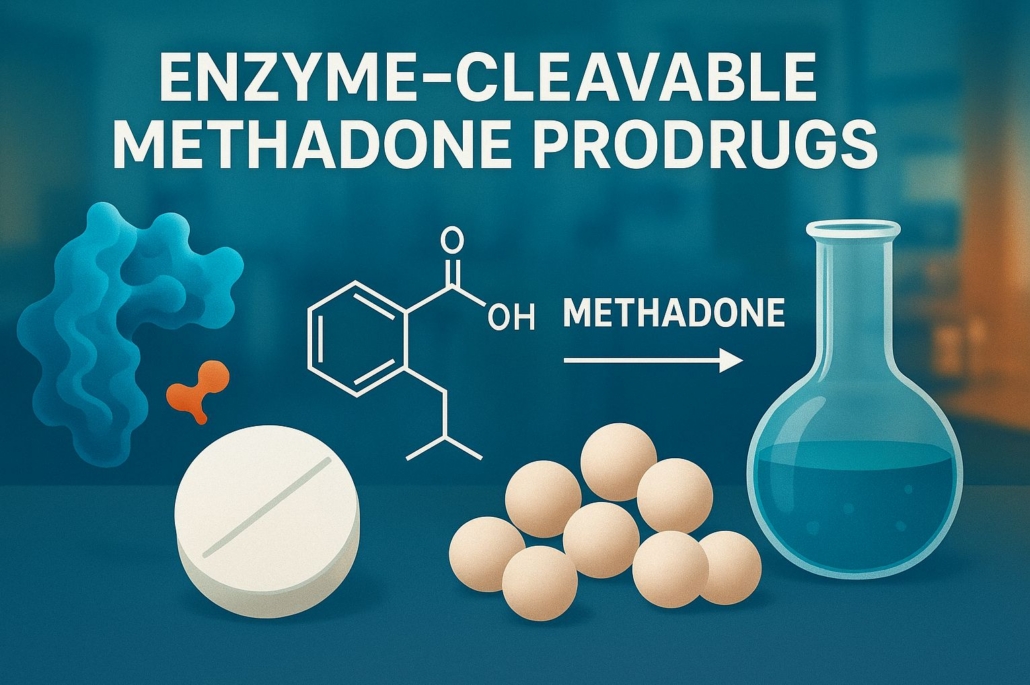
Enzyme‑cleavable methadone prodrugs: Functionality, Opportunities, and Summary of US20250361205A1
Introduction to Enzyme‑cleavable methadone prodrugs
Enzyme‑cleavable methadone prodrugs represent a novel class of pharmacological agents designed to provide controlled release of methadone only after specific enzymatic activation. These prodrugs attach an enzyme‑cleavable promoiety to the methadone molecule, rendering it inactive until a target enzyme cleaves the linkage in vivo. This mechanism reduces misuse potential and provides more predictable pharmacokinetics compared to conventional methadone formulations. By depending upon specific enzymatic activity, this prodrug design can improve safety and minimize risks associated with inappropriate administration or overdose, while maintaining therapeutic efficacy for opioid dependence or chronic pain management.
Beyond safety, enzyme‑cleavable methadone prodrugs offer opportunities in advanced drug formulation. They enable precise control over the timing and extent of methadone release based on the activity of endogenous enzymes. As a result, formulators can tailor release rates and reduce systemic peaks that commonly contribute to adverse effects or abuse. These prodrugs also permit formulation with excipients or technologies that further modulate release profiles, including multiparticulate systems or coatings. In addition, controlled enzyme activation provides a strategy to optimize oral delivery, enhance patient compliance, and potentially reduce the burden of supervised dosing programs in opioid maintenance therapy.
Summary of this patent
The patent application US20250361205A1 discloses enzyme‑cleavable methadone prodrugs and corresponding methods of use, focusing on prodrugs that deliver methadone through enzymatically‑controlled release. These prodrugs contain a promoiety linked to methadone that requires cleavage by specific enzymes, such as digestive proteases, before the active opioid is liberated. By requiring enzymatic cleavage followed by intramolecular cyclization to release active methadone, the design significantly lowers the susceptibility to accidental or intentional misuse, including inappropriate routes of administration or chemical tampering.
The disclosed prodrug moieties can include amino acid residues or peptides of up to about 100 amino acids linked via an amide bond to the methadone nitrogen. By selecting promoieties that are substrates for particular enzymes, formulators can adjust release kinetics based on the target enzyme’s activity and distribution. For example, gastrointestinal enzymes like trypsin are contemplated as triggers for prodrug activation. The application also describes including enzyme inhibitors in the pharmaceutical composition to attenuate the rate of enzymatic cleavage when desired. This addition can further control release profiles and reduce unintended rapid activation.
The patent describes general chemical structures of enzyme‑cleavable methadone prodrugs, outlining variations in functional groups and linkers that influence both stability and enzymatic susceptibility. These structures include several formulae (e.g., MD‑(I), MD‑(II), MD‑(III)), each representing different classes of promoieties attached to the methadone core. Notably, upon enzymatic cleavage of the promoiety, a stable cyclic urea or other cyclic group forms, which is pharmaceutically acceptable and of low toxicity. The description also covers pharmaceutically acceptable salts, solvates, and crystalline forms of the prodrugs, enhancing formulation versatility.
A key advantage emphasized in this disclosure is the reduction of excessive plasma methadone levels when the prodrug is administered improperly. Because the prodrug cannot be converted to methadone without specific enzymatic action and cyclization, the risk of overdose is reduced. Furthermore, the document details that trypsin inhibitors or other enzyme modulators may be co‑formulated to regulate the enzymatic activation rate. In addition to the chemical and pharmacokinetic considerations, the application mentions pharmaceutical compositions that include typical excipients, such as fillers, binders, and disintegrants, that support conventional formulation processes for oral delivery.
Use of CELLETS® in This Context
Although CELLETS® (highly spherical microcrystalline cellulose pellets used as starter cores in multiparticulate drug delivery systems) are not explicitly referenced in US20250361205A1, the broader formulation context suggests potential relevance. CELLETS® provide uniform and inert starter cores that support controlled layering of active pharmaceutical ingredients. In multiparticulate systems, CELLETS® improve coating uniformity, flow properties, and controlled release profiles in oral dosage forms. These characteristics make them useful for advanced prodrug formulations where release kinetics and consistency are critical, particularly when precise layering of enzyme‑cleavable prodrug moieties is required. Unlike conventional inert cores, CELLETS® enable predictable performance and facilitate scalable manufacturing for complex oral formulations.
In this patent, some particle sizes of CELLETS® are explicitely named:
| Type | Particle size distribution (≥ 85 %) |
learn more |
|---|---|---|
| CELLETS® 100 | 100-200 µm (150/80) |
more information |
| CELLETS® 200 | 200-355 µm (80/50) |
more information |
| CELLETS® 350 | 350-500 µm (50/35) |
more information |
| CELLETS® 500 | 500-710 µm (35/25) |
more information |
| CELLETS® 700 | 700-1000 µm (25/18) |
more information |
| CELLETS® 1000 | 1000-1400 µm (18/13) |
more information |
Conclusion and Outlook
In summary, enzyme‑cleavable methadone prodrugs offer a promising advancement in opioid therapy and formulation science, combining controlled enzymatic activation with enhanced safety. The patent US20250361205A1 details chemical constructs and methods that reduce misuse potential and allow sophisticated control of drug release. Given ongoing needs for safer opioid medications, these prodrugs could transform maintenance therapy and pain management by minimizing overdose risks and improving patient compliance. Looking forward, integrating technologies such as multiparticulate delivery systems and optimized excipients (e.g., CELLETS®) will further refine dosing precision and therapeutic outcomes. Future research and clinical evaluation will determine how these designs perform in real‑world settings, including their impact on pharmacokinetics, abuse deterrence, and commercial viability.
Patent Summary
- Name of Patent: Enzyme-cleavable methadone prodrugs and methods of use thereof
- Patent Number: US20250361205A1
- Year of Patent: 2025
- Patent Holders: Lynn Kirkpatrick
- Affiliation: Ensysce Biosciences Inc.

 adobe firefly
  adobe firefly