Homogeneity and mechanical properties of orodispersible films loaded with pellets

Orodispersible films loaded with pellets provide a convenient and patient-friendly approach for drug administration. They dissolve quickly in the mouth, eliminating the need for water and making them ideal for children, elderly patients, and people with swallowing difficulties. Furthermore, combining films with pellets adds the benefits of controlled release and dose flexibility.

Challenges in Formulating Orodispersible Films Loaded with Pellets

Formulating orodispersible films loaded with pellets remains challenging. Large pellets at high concentrations often reduce film homogeneity and weaken mechanical strength. As a result, maintaining tear resistance while ensuring rapid disintegration is essential. Therefore, optimizing the balance between pellet content and film properties is critical for successful formulations.

Study Objective and Method

This study aimed to create fast-disintegrating ODFs with uniformly distributed pellets without compromising mechanical integrity. We used hypromellose films incorporating placebo pellets of 100 µm and 200 µm in concentrations from 20% to 45% w/w. A planetary mixer (Thinky) effectively prepared a uniform suspension before solvent casting. Consequently, the films achieved a consistent pellet distribution and smooth texture.

Effects of Pellet Size and Concentration

Pellet size and concentration significantly influenced film properties. Notably, only 100 µm pellets above 40% reduced tear resistance. In contrast, the presence of pellets accelerated disintegration. Moreover, larger particles shortened disintegration time by up to 60%. Thus, selecting the right pellet size and concentration can improve film performance without sacrificing strength.

Homogeneity and Film Quality

Achieving uniform pellet distribution is crucial for dosing accuracy and overall quality. Films cast at 500 µm and 800 µm gap heights showed excellent homogeneity, with an even number of particles per unit area. Therefore, proper casting and mixing strategies ensure consistent orodispersible films loaded with pellets that meet pharmaceutical standards.

Conclusion

Orodispersible films loaded with pellets combine rapid disintegration, mechanical strength, and dose flexibility. By carefully controlling pellet size, concentration, and casting parameters, manufacturers can produce reliable, patient-friendly ODFs. Ultimately, this approach strengthens ODFs’ potential as a next-generation drug delivery system.

Reference

This article on homogeneity and mechanical properties of orodispersible films loaded with pellets was published on Oct 20 2024 on ScienceDirect.

Document information

Pellet materials

Pellets in two different sizes: CELLETS® 100 and CELLETS® 200, composed of 100% microcrystalline cellulose, were used as model spherical granules.

Authors

Katarzyna Centkowska, Martyna Szadkowska, Marta Basztura, Małgorzata Sznitowska

Source

published on Oct 20 2024 on ScienceDirect under CC BY 4.0 license.

Packaged modified release gamma-hydroxybutyrate formulations improve stability and simplify treatment. The patent WO2019123269A1, titled “Packaged modified release gamma-hydroxybutyrate formulations having improved stability,” introduces innovative formulations and packaging methods. These methods enhance both dissolution and chemical stability of gamma-hydroxybutyrate (GHB), a therapy for narcolepsy. Currently, treatments like XYREM® force patients to wake during the night for a second dose, which proves cumbersome. Therefore, this patent develops a once-nightly, modified-release GHB formulation. Moreover, advanced packaging controls relative humidity, ensuring long-term effectiveness and preventing chemical degradation of GHB into gamma-butyrolactone (GBL).

Key Innovations:

  1. Modified Release Formulation: The patent combines immediate and modified release components, both containing GHB or a pharmaceutically acceptable salt. The modified release component controls GHB release over time. As a result, it provides sustained therapeutic effects throughout the night. Therefore, patients do not need a second dose. Consequently, this formulation improves convenience and supports adherence to treatment.
  2. Stability Issues with GHB: GHB is highly hygroscopic and chemically unstable. Consequently, it degrades easily, especially in high-humidity environments. This degradation produces GBL, which reduces the drug’s effectiveness. Therefore, the patent develops a formulation with stable dissolution profiles and improved chemical stability. Moreover, it maintains stability even under stressful storage conditions, such as high temperature and humidity.
  3. Packaging Innovation: To enhance stability, the GHB formulations use packaging that maintains a specific relative humidity range (29% to 54%). This control of humidity is crucial because it prevents GHB from degrading into GBL. Moreover, the packaging material has a low water vapor transmission rate. As a result, it reduces moisture exposure and ensures the drug stays stable over time.
  4. Hydrophobic Coating: The patent applies a hydrophobic coating, such as glyceryl tristearate or hydrogenated vegetable oil, along with methacrylic acid copolymers. These coatings control the release rate of GHB. Moreover, they protect it from moisture. As a result, the formulation provides a steady release and prevents premature degradation.
  5. Pharmaceutical Composition: The GHB composition includes varying ratios of immediate and modified release components. These ratios ensure a sufficient therapeutic dose while maintaining stability. Moreover, particle size and formulation ratios (e.g., 40/60 to 60/40) play key roles in achieving the desired pharmacokinetics and release profiles.

Controlling the relative humidity within the packaging

The primary innovation lies in controlling the relative humidity within the packaging, alongside a modified release formulation with hydrophobic coatings to maintain the drug’s chemical stability and effectiveness. These advancements make GHB therapy more convenient by eliminating the need for a second nightly dose and addressing the stability challenges that have plagued previous formulations.

In this patent, CELLETS® play a crucial role as inert cores used in the formulation of modified release or the active or salts thereof. These starter spheres serve as carriers for the active ingredient by providing a surface for multi-layer drug layering. Their primary function is to ensure uniform drug distribution and control the release profile of GHB. The benefits include enhancing dissolution stability, maintaining the integrity of the dosage form over time, and helping to modulate the release rate of the drug for once-nightly dosing convenience. For these aspects, MCC starter sphere types where employed: CELLETS® 90, CELLETS® 100, CELLETS® 127. Glatt ProCell™ technique is used for spraying molten API.

Document information

Document Type and Number: (“Packaged modified release gamma-hydroxybutyrate formulations having improved stability”).
Kind Code: A1

Inventors:

Hervé GUILLARD

Disclaimer

This text was partly generated by chatGPT engine version GPT‑4o, on Oct 21, 2024. Image was generated with Adobe Firefly.

The patent application 20240316057 focuses on a pulsatile release formulation for caffeine, designed to control its release profile over a specific time frame. The formulation is targeted at therapeutic and non-therapeutic uses — enhancing mental alertness and addressing conditions like morning grogginess or fatigue. By using a release-controlling polymeric system, the caffeine release can be delayed, achieving a time-controlled vitalization of the body.

The key component in this formulation is CELLETS®, which act as a neutral core upon which the active ingredient (caffeine) and various release-controlling polymers are layered. CELLETS®, made from microcrystalline cellulose, serve as an ideal platform due to their uniform size and consistent performance. These attributes are essential for ensuring the precise, staggered release of caffeine at different stages of the gastrointestinal tract.

The use of CELLETS® in this pulsatile system enables a multi-phase release profile. Initially, the formulation allows for a delayed release, where the caffeine remains largely intact through the acidic environment of the stomach. Once the formulation passes into more neutral areas of the gastrointestinal tract, the polymers dissolve, leading to rapid caffeine release. This method ensures that caffeine is absorbed in a controlled manner over a period of 4 to 8 hours after ingestion, thus avoiding sudden spikes in caffeine levels that can cause jitters or other side effects.

This approach also has the benefit of tailoring the release pattern to the body’s needs over time, with an initial delay followed by a burst of caffeine when it is most needed—such as during the morning hours after a night of sleep. The polymeric coatings, including methacrylate-based polymers (e.g., Eudragit®), allow for precise control of this delayed release profile.

The overall innovation provides a tailored caffeine delivery system that improves both efficacy and user experience. It offers applications beyond general alertness, potentially being useful for managing specific sleep-wake disorders, fatigue, or as a stimulant for individuals with delayed sleep-phase syndromes​. In this specific patent, also Glatt process technologies are included: Glatt CML 10 Container Blender, Glatt GS 60 Rotor Sieve, Glatt TMG Vertical Granulator, Glatt Mini Fluid Bed, Glatt GC 1 Pan Coater.

Document information

Document Type and Number: (“pulsatile release caffeine formulation”) and elsewhere.
Kind Code: A1

Inventors:

Yerlikaya, Firat (Çankaya, TR)
Arslanç, Aslihan (Çankaya, TR)

Disclaimer

This text was generated by chatGPT engine version GPT‑4o, on Oct 21, 2024. Image was generated with Adobe Firefly.

The patent application titled “Modified Release Gamma-Hydroxybutyrate (GHB) Formulations Having Improved Pharmacokinetics” (US20240148685) focuses on improving the delivery of GHB, a substance used for treating sleep disorders like narcolepsy, through modified-release formulations. The goal is to optimize GHB’s absorption, enhancing patient convenience and compliance by reducing the need for multiple nightly doses.

The key innovation in the patent is the use of CELLETS®, microcrystalline spheres often employed as a neutral core for drug layering. In this application, CELLETS® act as carriers for the active ingredient, allowing precise control over the release profile of GHB. These small spherical particles, made from microcrystalline cellulose, offer uniform size and high mechanical strength, ensuring consistent drug loading and a controlled release rate.

In this patent, the CELLETS® are coated with various layers of GHB and release-modifying agents, enabling a predictable and sustained release of the active substance. This modified release profile allows GHB to be administered in a once-nightly dose rather than requiring the patient to wake up for a second dose, which was a limitation with previous immediate-release formulations. This extended-release mechanism helps maintain stable plasma concentrations of GHB over an 8-hour period, improving both the efficacy of the treatment and patient compliance.

The innovation emphasizes addressing the shortcomings of existing GHB formulations by ensuring a better pharmacokinetic profile—particularly regarding absorption, bioavailability, and minimizing drug levels in the bloodstream after the therapeutic effect has been achieved. In this specific patent, the following MCC Sphere types are recommended: CELLETS® 90, CELLETS® 100, CELLETS® 127.

Document information

Document Type and Number: (“Modified release Gamma-Hydroxybutyrate formulations having improved pharmacokinetics”)
Kind Code: A1

Inventors:

Dubow, Jordan (Lyon, FR)
Guillard, Hervé (Villeurbanne, FR)
Mégret, Claire (Lyon, FR)
Dubuisson, Jean-françois (Lyon, FR)

Disclaimer

This text was generated by chatGPT engine version GPT‑4o, on Oct 21, 2024. Image was generated with Adobe Firefly.

The patent application US20240139215A1 focuses on the development of controlled release formulations for highly lipophilic physiologically active substances, such as cannabinoids. These substances tend to have high lipid solubility (log P of 4 or more), making them difficult to deliver in a controlled and effective manner. This patent addresses the need for efficient controlled release systems that can provide consistent therapeutic effects by utilizing a matrix-based approach.

The formulation includes a matrix that contains one or more highly lipophilic active substances and water-soluble binders like hydroxypropyl methyl cellulose (HPMC), methyl cellulose (MC), or similar polymers. The key challenge with such substances is their tendency to release slowly and incompletely when taken orally, which this patent solves by adjusting the proportion of water-soluble binders. The binder content is carefully selected to be between 0.1-10% of the total matrix weight, optimizing the release rate of the active substances over the gastrointestinal transit time.

One of the innovative aspects of the invention is the use of matrix pellets, which are small particles with a size range of 30 µm to 1800 µm. These pellets may be administered in various forms, such as capsules, tablets, or sachets. The flexibility of the dosage forms makes it easier to control and adjust the release kinetics of the active ingredients.

The CELLETS® play a crucial role in this formulation. They are used as neutral cores for the deposition of the active substances and their binders. CELLETS® are microcrystalline cellulose spheres that provide an ideal substrate for layering the active substance and polymers, ensuring uniform distribution and controlled release. By using these CELLETS®, the formulation can achieve a more predictable and consistent release profile, crucial for substances like cannabinoids that require precise dosing to avoid psychoactive side effects while maintaining therapeutic efficacy.

Additionally, these pellets can be coated with other materials to further control the release rate if desired, though this is optional. In many embodiments, the matrix pellets themselves are sufficient to achieve the desired controlled release without the need for additional coatings.

In conclusion, the US20240139215A1 patent introduces a novel approach to the controlled release of highly lipophilic substances, leveraging matrix technology with carefully chosen water-soluble binders and neutral cores like CELLETS®. This method ensures effective delivery and consistent release, addressing the challenges posed by the lipophilic nature of substances like cannabinoids. In this specific patent, the following MCC Sphere types are recommended: CELLETS® 500.

Document information

Document Type and Number: (“Controlled release formulations of highly lipophilic physiologically active substances”)
Kind Code: A1

Inventors:

Mirko Nowak
Jay Jesko Nowak
Annette Grave
Monika Wentzlaff
Sarah Barthold
Christian Geugelin

Disclaimer

This text was generated by chatGPT engine version GPT‑4o, on Oct 21, 2024. Image was generated with Adobe Firefly.

The United States Patent Application US20240024263 focuses on methods of administering gamma-hydroxybutyrate (GHB) in combination with divalproex sodium (DVP), particularly for treating conditions like narcolepsy. The aim is to co-administer these drugs without altering their dosage or efficacy. The patent emphasizes how DVP affects GHB’s pharmacokinetics, allowing adjustments to minimize side effects while ensuring therapeutic benefits.

The role of CELLETS® in this patent is critical. CELLETS® are microcrystalline cellulose spheres used in drug formulations. They provide a stable, controlled-release matrix for GHB, ensuring consistent drug delivery over time. This controlled release minimizes fluctuations in drug concentrations, improving safety and efficacy. These MCC starter beads also help prevent interaction between GHB and DVP, ensuring that neither drug’s therapeutic effects are compromised.

By using CELLETS®, the formulation enhances the pharmacokinetic profile of GHB, ensuring a smoother and more predictable drug release. This innovation is crucial when GHB is administered alongside DVP, as it allows for better management of conditions like excessive daytime sleepiness or cataplexy, without significantly altering either drug’s profile.

In summary, this patent introduces an optimized co-administration strategy for GHB and DVP, with Cellets playing a pivotal role in achieving steady, controlled drug release and mitigating adverse drug interactions. This approach aims to improve the overall effectiveness and safety of treatment for sleep-related disorders. In this specific patent, the following MCC Sphere types are recommended: CELLETS® 90, CELLETS® 100 or CELLETS® 127. United States Patent Application US20240024263 seems as well to be a patent following the patent US11896572B2 wherein modified-release formulations are described.

Document information

Document Type and Number: (“Methods of administering gamma-hydroxybutyrate compositions with divalproex sodium”)
Kind Code: A1

Inventors:

Baek, Bong-Sook, Flamel Ireland Limited (Dublin, IE)

Disclaimer

This text was generated by chatGPT engine version GPT‑4o, on Oct 21, 2024. Image was generated with Adobe Firefly.

The development of modified release gamma-hydroxybutyrate represents a major advancement in narcolepsy therapy, aiming to improve both patient compliance and treatment effectiveness. Traditional formulations of gamma-hydroxybutyrate (GHB) require multiple nightly doses, which can disrupt sleep and reduce overall quality of life. The patented formulation described in US11896572B2 introduces a novel modified release system that extends the duration of action, making it possible to achieve 6 to 8 hours of therapeutic benefit with a single bedtime dose.

How Modified Release Gamma-Hydroxybutyrate Works

This formulation combines immediate-release and delayed-release mechanisms to provide both rapid onset and sustained therapeutic effects. The immediate-release portion allows GHB to take effect quickly, while the delayed-release portion maintains drug levels over time, reducing abrupt concentration peaks and minimizing side effects. This dual-action delivery is designed to improve pharmacokinetics and ensure more consistent symptom control.

The Role of CELLETS® in Modified Release Gamma-Hydroxybutyrate Drug Release

A central innovation in this patent involves the use of CELLETS®, spherical microcrystalline cellulose particles that provide a stable foundation for modified release drug delivery. In the immediate-release portion, CELLETS® carry a coating of sodium oxybate combined with a binder such as povidone. Meanwhile, the delayed-release portion relies on specialized polymers and hydrogenated vegetable oil, which work together to control pH-dependent release in the gastrointestinal tract. Furthermore, CELLETS® maintain consistent particle size and predictable dissolution rates, which in turn improve absorption and strengthen the overall pharmacokinetic profile of modified release gamma-hydroxybutyrate.

The CELLETS® play a crucial role in maintaining particle size consistency, which is important for ensuring predictable dissolution and absorption rates, thereby enhancing the overall pharmacokinetic profile of the drug. This innovation represents an advancement over traditional formulations by offering more reliable and patient-friendly narcolepsy management. This specific patent, recommend the following MCC Sphere types: CELLETS® 90, CELLETS® 100 or CELLETS® 127.

Advantages for Narcolepsy Patients

The patented system combines immediate and delayed release. This design allows for a once-nightly dose, which improves adherence and convenience for patients. The innovation also ensures more restorative sleep. At the same time, it reduces the burden of frequent dosing. As a result, narcolepsy management becomes more reliable and patient-friendly.

By refining the pharmacokinetics of GHB, modified release gamma-hydroxybutyrate offers a significant improvement over traditional formulations.

Document information

Document Type and Number: (“modified release gamma-hydroxybutyrate formulations having improved pharmacokinetics”)
Kind Code: B2

Inventors:

Jordan Dubow
Hervé Guillard
Claire Mégret
Jean-François DUBUISSON

Disclaimer

This text was generated by chatGPT engine version GPT‑4o, on Oct 21, 2024. Image was generated with Adobe Firefly.

Extended release compositions comprising pyridostigmine

The following patent on “Extended release compositions comprising pyridostigmine” employs CELLETS® as starter spheres made of Microcrystalline Cellulose. Please, read below a summary.

US Patent 20240299305 addresses an extended-release formulation of pyridostigmine, a drug primarily used to treat myasthenia gravis (MG). The goal of the patent is to create a dosage form that prolongs the drug’s therapeutic effects while minimizing side effects like dose dumping (a rapid release of the drug that can cause adverse effects). The patent describes a gastroretentive drug delivery system, designed to float and remain in the stomach for a longer time, thereby ensuring gradual release and absorption.

A key aspect of this patent is the use of CELLETS®, which are small, inert core particles used as carriers in pharmaceutical formulations. These CELLETS® serve as a starter sphere for the extended-release composition, being coated with layers of active ingredients like pyridostigmine and other substances that control the drug’s release rate. The formulation is intended to provide a controlled, steady release of pyridostigmine, improving patient outcomes by maintaining a stable plasma concentration of the drug for up to 24 hours.

The dosage form also incorporates components like a gas-generating agent, which enables the tablet to float in the stomach, and a water-soluble hydrophilic polymer that swells upon contact with gastric fluids, preventing the tablet from passing through the digestive system too quickly. This gastroretentive property is vital to ensure that the drug stays in the stomach long enough to achieve the desired extended release.

By utilizing CELLETS® and other advanced components, the patent aims to reduce the frequency of administration (allowing for once-daily dosing) and improve patient compliance, which is especially important for MG patients who need consistent, long-term management of their symptoms.

Document information

Document Type and Number:  (“Extended release compositions comprising pyridostigmine”)
Kind Code: A1

Inventors:

Vaka, Siva Ram Kiran (Piscataway, NJ, US)
Desai, Dipen (Basking Ridge, NJ, US)
Phuapradit, Wantanee (Lewes, DE, US)
Shah, Navnit H. (Monmouth Junction, NJ, US)
Shelke, Namdev B. (Hillsborough, NJ, US)

Disclaimer

This text was generated by chatGPT engine version GPT‑4o, on Oct 18, 2024. Image was generated with Adobe Firefly.

Extended-release compositions comprising atomoxetine

The following patent on “Extended-release compositions comprising atomoxetine” employs CELLETS® as starter spheres made of Microcrystalline Cellulose. Please, read below a summary.

United States Patent Application 20240299307 focuses on an extended-release formulation of atomoxetine, commonly used for treating ADHD. The patent describes a unique pellet-based drug delivery system designed to control the release of atomoxetine over an extended period. This system aims to reduce the dosing frequency and maintain steady drug levels in the bloodstream, enhancing patient compliance and reducing the side effects associated with fluctuating drug levels.

Key Elements of the Invention:

  1. Pellets: The invention uses pellets as the core of the formulation, each containing atomoxetine or a pharmaceutically acceptable salt like atomoxetine hydrochloride. The pellets are coated with a functional layer that controls the rate and duration of drug release.
  2. Extended Release: The functional coating consists primarily of cellulose acetate-based polymers like cellulose acetate phthalate or cellulose acetate butyrate. This coating slows the drug’s release, allowing for less than 40% of the atomoxetine to be released within the first two hours, ensuring a sustained release for 8 to 20 hours, depending on the coating thickness.
  3. Patient Benefits: The extended-release design minimizes the need for multiple daily doses, improving patient adherence to the treatment. Additionally, it helps maintain consistent therapeutic levels of atomoxetine in the bloodstream, reducing the side effects from rapid peaks and valleys in drug concentration.
  4. Manufacturing Process: The pellets are made by applying a drug layer over a nonpareil seed (such as CELLETS®), followed by an optional sealing layer and a functional coating that dictates the extended-release profile. These pellets can be encapsulated or compressed into tablets.

Function of CELLETS®:

CELLETS® are microcrystalline cellulose spheres commonly used as a core in pellet-based formulations. In this patent, CELLETS® act as inert carriers that provide a solid foundation for the application of atomoxetine and subsequent coatings. Their uniform size and shape ensure consistent layering of the drug and functional coatings, which is crucial for achieving the desired release profile. CELLETS® facilitate the manufacturing of multi-particulate systems where each pellet provides a controlled dose of the active ingredient. By using CELLETS®, the formulation can be tailored for extended-release by controlling the thickness of the drug and polymer layers applied to the surface​.

In summary, this patent provides an effective method to enhance the therapeutic benefits of atomoxetine, focusing on an extended-release formulation that improves patient outcomes through consistent drug release and convenient dosing.

Document information

Document Type and Number:
Kind Code: A1

Inventors:

Tu, Yu-hsing (West Windsor, NJ, US)
Chalamuri, Shanmuka Harish (Plainsboro, NJ, US)
Kathala, Kalyan (Monroe, NJ, US)
Perumal, Ashok (Monmouth Junction, NJ, US)
Lee, James A. (West Windsor, NJ, US)

Disclaimer

This text was generated by chatGPT engine version GPT‑4o, on Oct 18, 2024. Image was generated with Adobe Firefly.

Influence of Polymer Film Thickness on Drug Release from Fluidized Bed Coated Pellets

This article “Influence of Polymer Film Thickness on Drug Release from Fluidized Bed Coated Pellets and Intended Process and Product Control” was published on Pharmaceutics 202416(10), 1307; https://doi.org/10.3390/pharmaceutics16101307, under free licence on October 08, 2024 by Marcel Langner, Florian Priese, and Bertram Wolf. We performed modifications of the text for better readability.

Abstract

Background/Objectives: Coated drug pellets are widely used in hard gelatine capsules. In heterogeneous pellets, the drug is layered onto core pellets. Coatings often provide retarded release or enteric protection.

Methods: In this study, we correlated polymer coating thickness on drug pellets with drug release kinetics.

Results: We investigated whether the coating process can be stopped once the desired layer thickness is achieved. First, inert pellets were coated with sodium benzoate. Then, they received different amounts of water-insoluble polyacrylate in a fluidized bed apparatus with a Wurster inlet. We controlled the entire process in-line and at-line using process analytical technology. This involved measuring particle size and layer thickness. Next, we examined in-vitro sodium benzoate release. We linearized the data with various standard models and compared it with polyacrylate layer thickness. As polyacrylate layer thickness increased, the release rate decreased. Several factors influenced release simultaneously, resulting in profiles that approximated first-order kinetics. Thus, the coating thickness corresponded to a specific drug release profile.

Conclusions: Manufacturing coated drug pellets with a targeted release is achievable through process control and layer thickness measurement. However, preliminary investigations are needed for each formulation.

1. Introduction

The dissolution of solid drug formulations depends on the solubility and dissolution rate of the drug substances. In addition, several factors influence release kinetics. For example, drug interaction with excipients, compression force and hardness in tablets, and the type of binder in granulates, pellets, or polymer coatings all play a role.

Understanding the dissolution rate and release kinetics is essential for optimal pharmacotherapy. Dissolution of solid substances typically follows first-order kinetics due to diffusion processes. However, some formulations show zero-order release, where equal amounts are released in equal time intervals.

Multiple processes often occur simultaneously. These include wetting of the dosage form, drug dissolution, diffusion of drug molecules out of the dosage form, swelling of matrix formulations, and water uptake by insoluble films. As a result, the kinetics may not fit simple zero-, first-, square-, or cubic-root order equations.

To evaluate the best approach, release data are linearized using various models. The coefficient of determination (CoD) of the linearized curve indicates the best fit and suggests which process likely dominates [1,2,3,4,5,6].

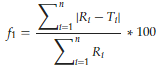
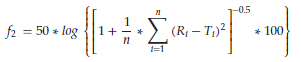
The model-independent parameters, difference factor f1 and similarity factor f2, are used to compare release profiles. f1 describes the relative error between two release profiles. It is calculated from the cumulative amounts released at a specific time T for a test and a reference formulation, or more generally, between any two formulations—for example, during drug development. On the other hand, f2 is based on the sum of squared deviations of the released drug amounts from the two profiles [4,5,7,8,9].

Focuses on drug-loaded pellets and their controlled release

Increasing attention has therefore focused on drug-loaded pellets and their controlled release. Specifically, this control is achieved by slowly swelling matrix systems or, alternatively, a final functional coating. Consequently, researchers have investigated the release of drugs from matrix pellets prepared by extrusion/spheronization and, moreover, coated with different amounts and types of insoluble ethylcellulose [10,11,12].

In addition, other studies report additional factors influencing drug release. For example, these include the filler type [13], the pH of the release fluid [4], storage conditions of the drug and methylcellulose matrix pellets [14], the amount of enteric polymer coating [15], and, finally, the salt concentration in the release fluid [16].

Further investigations examine the effects of talc and hydrogenated castor oil on the dissolution of metformin-loaded matrix pellets with an acrylic-based sustained-release coating [17]. Researchers also studied the sustained release of Lisinopril from mucoadhesive matrix pellets [18] and sinomenine hydrochloride from pellets produced using a novel whirlwind fluidized bed process [19].

Drug-layered inert pellets coated with polymer (heterogeneous pellets) were studied in order to assess the influence of release kinetics. Specifically, researchers investigated modifications of ethylcellulose coatings [20]; furthermore, they studied ethylcellulose mixed with polyvinylpyrrolidone (PVP) as a pore former [21], alternating layers of ethylcellulose and polyvinylacetate [22], various coating levels with final curing [23], and additionally, acetaminophen-layered sugar pellets coated with ethylcellulose [24]. Moreover, with polyacrylate coatings, drug release from layered pellets was delayed [7,25]. Therefore, changing the polymer type and layer thickness allowed control of the release rate over a wide range [8].

heterogeneous pellets coated with sodium benzoate

In our previous studies, heterogeneous pellets were manufactured using fluidized bed technology with a Wurster inlet. Initially, inert microcrystalline cellulose pellets (Cellets®175, median 170 µm), which offer a large specific surface area, were first coated with excipients as well as the water-soluble model drug sodium benzoate [26,27,28]. Consequently, these sodium benzoate (SB) pellets showed narrow particle size distribution, high sphericity, homogeneous layers, and additionally, rapid drug release. Subsequently, to achieve retarded release, the SB pellets were coated a second time with different amounts of ethylcellulose using the same fluidized bed technique [29]. As expected, the release rate decreased with increasing coating thickness. Moreover, the process was monitored in-line using spatial filter velocimetry (SFV) probes [27,28] to ensure control over particle size, distribution, and ethylcellulose layer thickness.

The present project aimed to produce heterogeneous pellets in a fluidized bed with a Wurster inlet while controlling the process using in-line particle size and coating thickness measurements. We studied sodium benzoate release kinetics, interpreted the partial processes affecting release, correlated release rate with polymer thickness, and determined the coating process endpoint to improve pellet quality.

PVP binder to improve layer stability

For pellet manufacturing, we followed a similar experimental approach to [26,27,28]. Small initial inert pellets (Cellets®175, median 170 µm) with large specific surface areas were coated with a sodium benzoate solution containing a small amount of PVP binder to improve layer stability. In the second step [29], SB pellets received varying amounts of insoluble but slowly swelling polyacrylate for retarded release. Agglomeration risk during coating was minimized by adjusting process parameters and adding talcum as an anti-stick agent. The SFV probe monitored particle size and detected agglomerates in real time.

Drug release was analyzed using zero-order, first-order, square-root, and cubic-root kinetic models. We identified the most likely release model by calculating area under the curve (AUC), dissolution efficiency (DE), and mean dissolution time (MDT), and by comparing the CoD of different models. We also calculated the difference factor f1 and similarity factor f2 to compare release profiles of different polyacrylate-layered pellet batches. Linearization works well for first-order kinetics. For other release profiles, nonlinear methods describe dissolution curves more accurately and reduce standard deviation in fitting parameters [30].

2. Materials and Methods

2.1. Materials

Pellets of microcrystalline cellulose (Cellets® 175, particle size range 150–200 µm, median 170 µm, IPC Dresden,, Germany), together with sodium benzoate (Applichem, Darmstadt, Germany, solubility 57 g in 100 g water at room temperature), PVP (Kollidon®25, Carl Roth, Karlsruhe, Germany), talcum (Talkum Pharma, C. H. Erbslöh, Krefeld, Germany), magnesium stearate (VEG Pharma, Rome, Italy), and additionally polyacrylate dispersion (Eudragit®NE 30D, Evonik Industries, Darmstadt, Germany, containing ethylacrylate-methylmethacrylate copolymer 30% w/w) were used. Importantly, all substances conform to European Pharmacopoeia (Ph.Eur.) quality [31].

2.2. Formulation of Sodium Benzoate-Coated Pellets

Microcrystalline cellulose pellets were coated with an aqueous solution of sodium benzoate 30% (w/w), PVP 1.5% (w/w) and talcum 0.5% (w/w) in a first coating step (Table 1). Sodium benzoate and PVP were dissolved one after another in purified water and finally talcum was suspended under agitation with a blade stirrer.
Table 1. Sodium benzoate pellet formulation.
Content (%)
Sodium benzoate 32.6
Microcrystalline cellulose 65.3
PVP 1.6
Talcum 0.5
100.0

2.3. Formulation of polyacrylate-coated sodium benzoate pellets

In the second coating step, SB pellets were layered with polyacrylate in three concentration lots: P1 (11.1% w/w PVP), P2 (14.3% w/w), and P3 (17.6% w/w). Magnesium stearate and talcum were added to the coating fluid. They acted as a plasticizer and an anti-stick agent, respectively (Table 2).

The polyacrylate coating fluid contained 13.3% (w/w) polyacrylate copolymer, 1.3% (w/w) magnesium stearate, and 5.3% (w/w) talcum. To prepare the mixture, we added a Eudragit®NE 30D dispersion to a beaker. Next, magnesium stearate and talcum were added one after another. The dispersion was homogenized under strong agitation with a disperser (Ultra Turrax T50 standard, Janke & Kunkel, IKA Labortechnik, Staufen, Germany; length 225 mm, diameter 18 mm, rotation 5000 rpm).

Table 2. Polyacrylate coated sodium benzoate pellet.
Lot P1 P2 P3
Content (%)
Sodium benzoate 25.9 24.4 22.9
Microcrystalline cellulose 55.7 52.6 49.3
PVP 1.3 1.2 1.1
Polyacrylate 11.1 14.3 17.6
Talcum 4.9 6.1 7.4
Magnesium stearate 1.1 1.4 1.7
100.0 100.0 100.0

2.4. Fluidized bed pellet coating

The coating process took place in a batch laboratory fluidized bed apparatus (GPCG 1.1, Glatt, Binzen, Germany). The system included a Wurster inlet and an SFV probe in the process chamber [27]. A spray nozzle of 1.0 mm diameter was used, with the nozzle cap set at 2.5 scales. The distance between the lower cylinder end and the perforated bottom plate B was fixed at 20 mm. The process air volume rate varied between 40 and 60 m³/h and was adapted to the increasing pellet weight during coating.

In the first step, Cellets®175 were coated with a sodium benzoate/PVP/talcum aqueous fluid (Table 3). In the second step, pellets received a polyacrylate dispersion under mild conditions. A lower spray rate and reduced process air temperature prevented pellet adhesion and sticking. Afterward, the polyacrylate-coated pellets were tempered for one hour at 30 °C. They were spread as a thin layer on a steel dish to allow coalescence and film formation.

Table 3. Process parameters of pellet fluidized bed coating with sodium benzoate (first step) and polyacrylate (second step).
Parameter First Step Second Step
sodium benzoate polyacrylate
pellet batch (g) 300
process air temperature (°C) 80 40
product temperature (°C) 40 25
process air volume rate (m3/h) 40–60
spray rate (g/min) 20 6
spray pressure (bar) 3

2.5. Particle Size Coating Layer Thickness Measurement with SFV Probe

The particle size and thickness of the coating layer were measured in-line by the SFV probe (IPP 70, Parsum, Chemnitz, Germany). The probe was directly installed into the down-bed zone of the process chamber. Details of probe measurement are described elsewhere [27,28].

2.6. Sodium Benzoate Release and Content Investigation

The release was tested using a dissolution tester (PTW 2, Pharmatest, Hainburg). Specifically, the setup included six vessels containing 1.0 L purified water maintained at 37 °C, with a blade rotation of 75 rpm. Then, sampling took place at 10, 20, 30, 45, 60, 120, and 180 minutes. After each withdrawal, the volume was refilled with fresh purified water. Subsequently, sodium benzoate was analyzed using a UV–Vis spectrophotometer (Spekol 1300, Analytik Jena, Germany) with a 1 cm quartz cuvette at 220 nm.

For sodium benzoate content analysis, 50 mg of pellets were dispersed in 1.0 L purified water. These pellets contained 13.5 mg sodium benzoate. Dissolution and release were complete after 4 hours. The content was then analyzed as described above.

2.7. Linearization of Release Curves

The evaluation of the release curves was performed according to the different models of release kinetics also used by a number of authors [1,3,5,6,9,14]. In the first step of the release evaluation, the amount of cumulative released substance is plotted versus time. Linear curves arise in the case of zero order kinetics, i.e., equal amounts of the drug are released in equal time intervals (Equation (1)).

Mt = −k0 ∗ t + M0

First-order release kinetics are typical for slightly soluble drugs in solid preparations such as tablets, pellets, and granules. These systems are dominated by slow dissolution and diffusion control. At the beginning of the process, the release rate is highest. This occurs because the large concentration gradient drives diffusion, as described in Fick’s first law (Equation 2). However, the release rate gradually decreases as the concentration gradient diminishes during the process.

1/A ∗ dn/dt = −D ∗ dc/dx

The released amount Mt at the moment t refers to (Equation (3)), and linearization results in the Sigma minus function (Equation (4)).

Mt = M0 ∗ (1 − exp(−k1∗t))
ln (M0 − Mt) = ln (M0) − k1 ∗ t

The Weibull function (Equation (5)) and its linearized form (Equation (6)) presuppose first order kinetics.

Mt = M0 ∗ (1− exp (−t b/a)
ln (−ln (1−Mt/M0)) = b ∗ ln (t) − ln (a)

Square root kinetics occurs at non-disintegrating solid matrix formulations (Equation (7)).

Mt = kq ∗ √ t

Cubic root kinetics are observed in the case of spherical multiparticulate formulations (linearized form, Equation (8)).

Mt = M0 − kc ∗ t

2.8. Model Independent Parameters: Difference Factor f1 and Similarity Factor f2

The difference factor f1 describes the relative error between two release profiles. It is calculated from the cumulative released amounts Ri and Ti at distinct time points for reference and test formulations (Equation 9). In contrast, the similarity factor f2 is based on the sum of squared deviations of released drug amounts (Equation 10). It expresses the statistical similarity between two profiles.

The f2 value equals 100 for identical profiles and ranges between 50 and 100 for similar ones. Together, both factors serve to compare the release profiles of generic and standard drug products. This comparison helps determine whether the generic profile matches or surpasses the standard.

In this study, we applied both factors to evaluate differences and similarities in sodium benzoate release profiles with various polymer coatings.

Eq9

(9)

Eq10

(10)

2.9. Microscopically Investigation

Coated pellets were placed on black paper for an improved contrast. Size and shape were investigated with a stereo light microscope (Stemi 2000-C, Carl Zeiss, Oberkochen, Germany, ocular: W-PI, 10×/23, magnification: 5.0, 50 scale = 1 mm). Photographs were shot by mobile.

2.10. Sphericity

The sphericity of the pellet lots was measured by digital image processing (Camsizer®, Retsch, Haan, measuring particle size range 40–3000 µm, measured particles 20,000 per second). The chord length was used for the evaluation of particle size and particle size distribution.

2.11. SFV Measurement

The SFV probe was installed directly into the process chamber of the fluidized bed apparatus between the inner chamber wall and the Wurster inlet. Details are described elsewhere [27].

3. Results and Discussion

3.1. Properties of Sodium Benzoate and Polyacrylate Coated Pellets

SB pellets are received as a free-flowing material. The coating process proceeded smoothly, and the Wurster inlet created a homogeneous fluidized bed pattern. As a result, the product shows a narrow particle size distribution [27]. The median x50.3 increased from 170 µm (uncoated Cellets® 175) to 200 µm. The sphericity of both the initial Cellets®175 and SB pellets remained above 0.9.

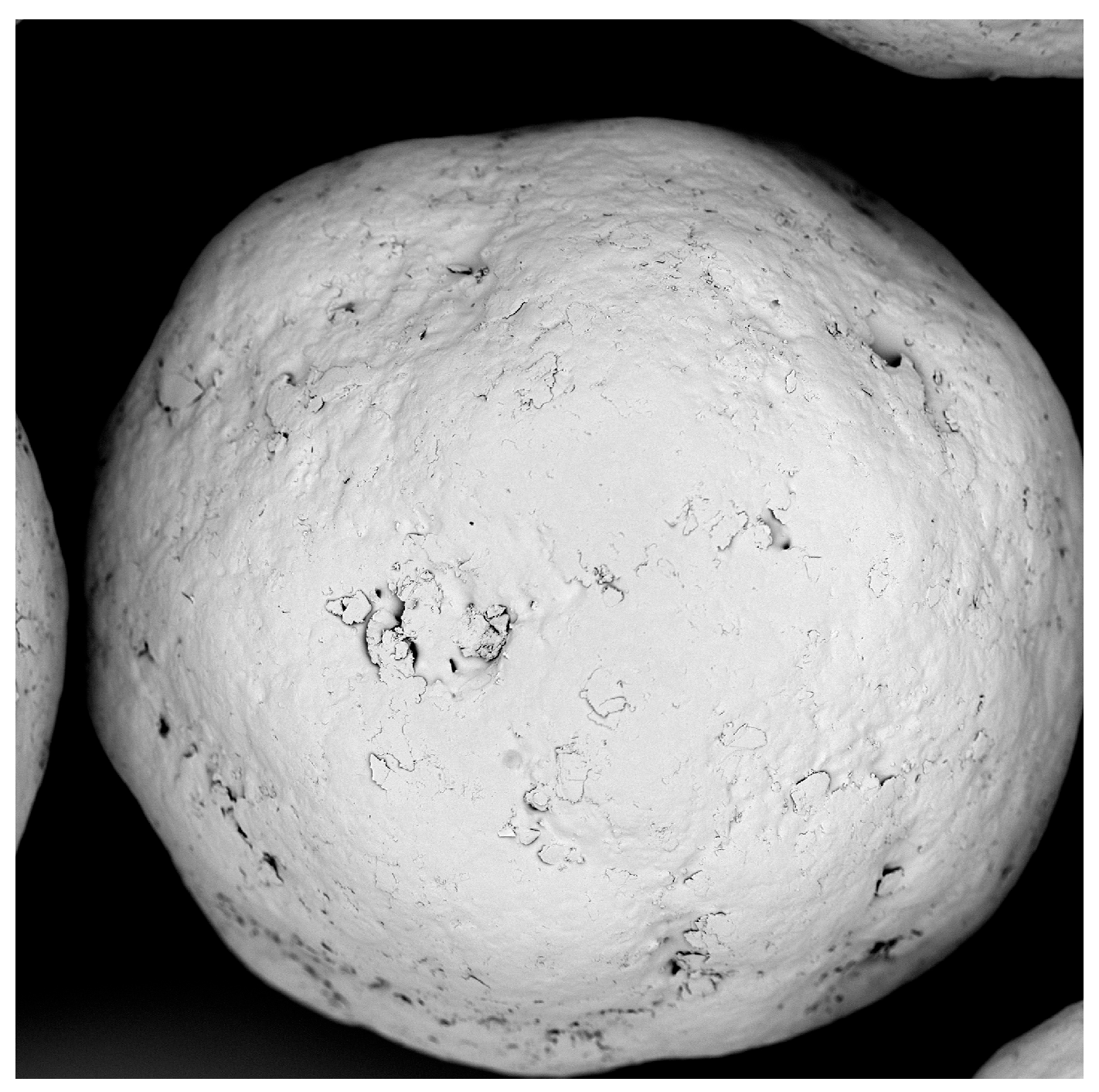
The polyacrylate coating of SB pellets caused no significant agglomeration. Only a few twins and triplets appeared under microscopic observation (Figure 1). The median size of polyacrylate-coated pellets grew to 232.2 µm, with a layer thickness of 16.1 µm (Table 4, P3, 17.6% polyacrylate content). Yield losses and incomplete sodium benzoate recovery resulted from material precipitation at the textile filter and inner chamber wall. Nevertheless, a sphericity above 0.9 confirms the formation of spherical products and indicates homogeneous processing.

Figure 1. SEM photograph of a polyacrylate coated SB pellet.

Influence of Polymer Film Thickness on Drug Release from Fluidized Bed Coated Pellets

Table 4. Median, polyacylate layer thickness, product yield, sodium benzoate content and sphericity of polyacrylate coated SB pellets.
X50.3 (µm) Polyacrylate
Layer
Thickness (µm)
Yield (%) Sodium
Benzoate
Content (%)
Sphericity
(-)
P1 213.0 6.5 84 92 0.91
P2 221.0 10.5
P3 232.2 16.1

3.2. Sodium Benzoate Release Kinetics

3.2.1. Double Linear Diagram (Zero Order Release Kinetics)

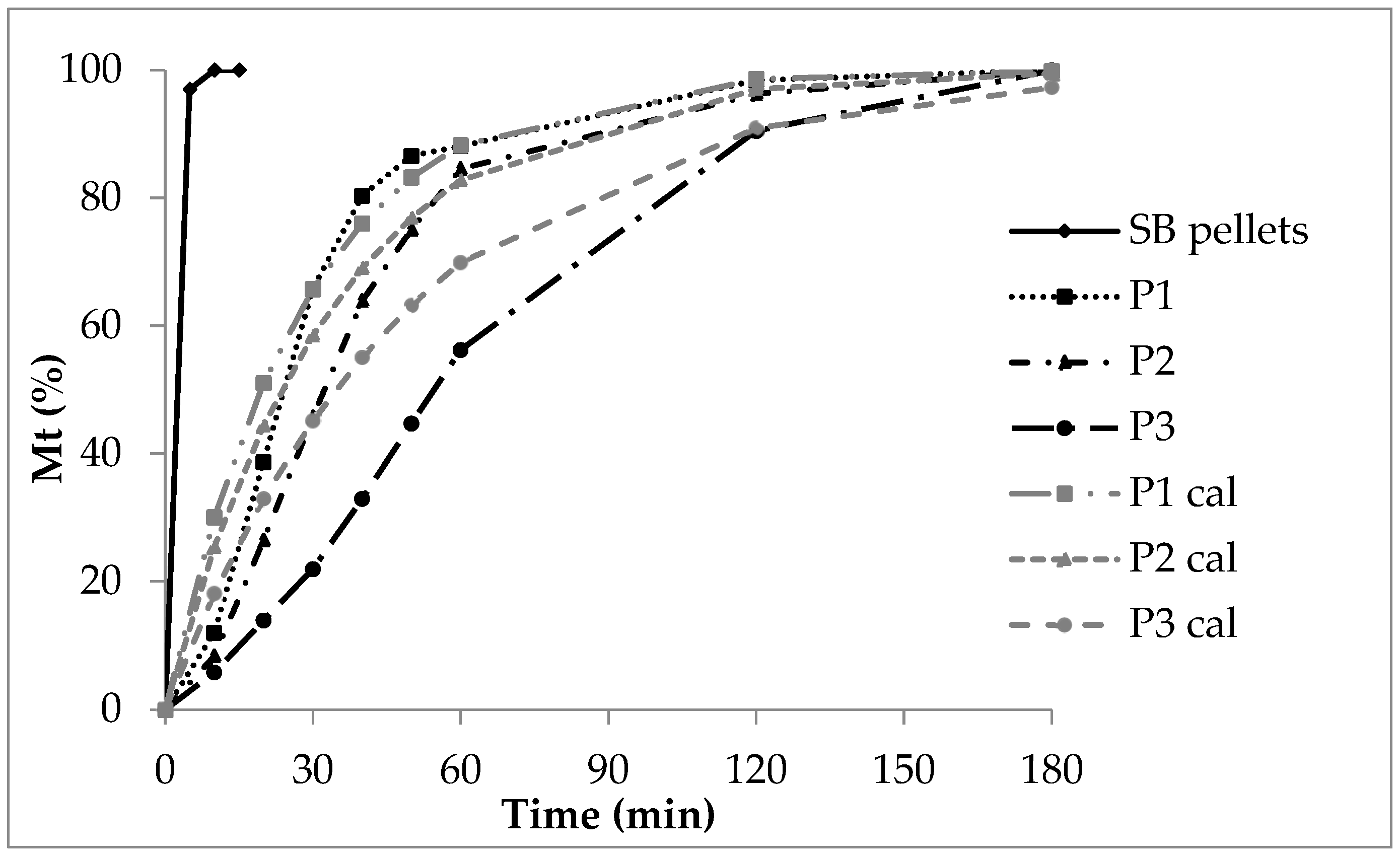
After five minutes, more than 90% of sodium benzoate dissolves from SB pellets without a polymer layer. This is due to its high solubility and rapid dissolution rate. Sodium benzoate behaves as a strong electrolyte (sodium salt of benzoic acid, pKa 4.19 [31]), so it dissociates considerably into sodium cations and benzoate anions.

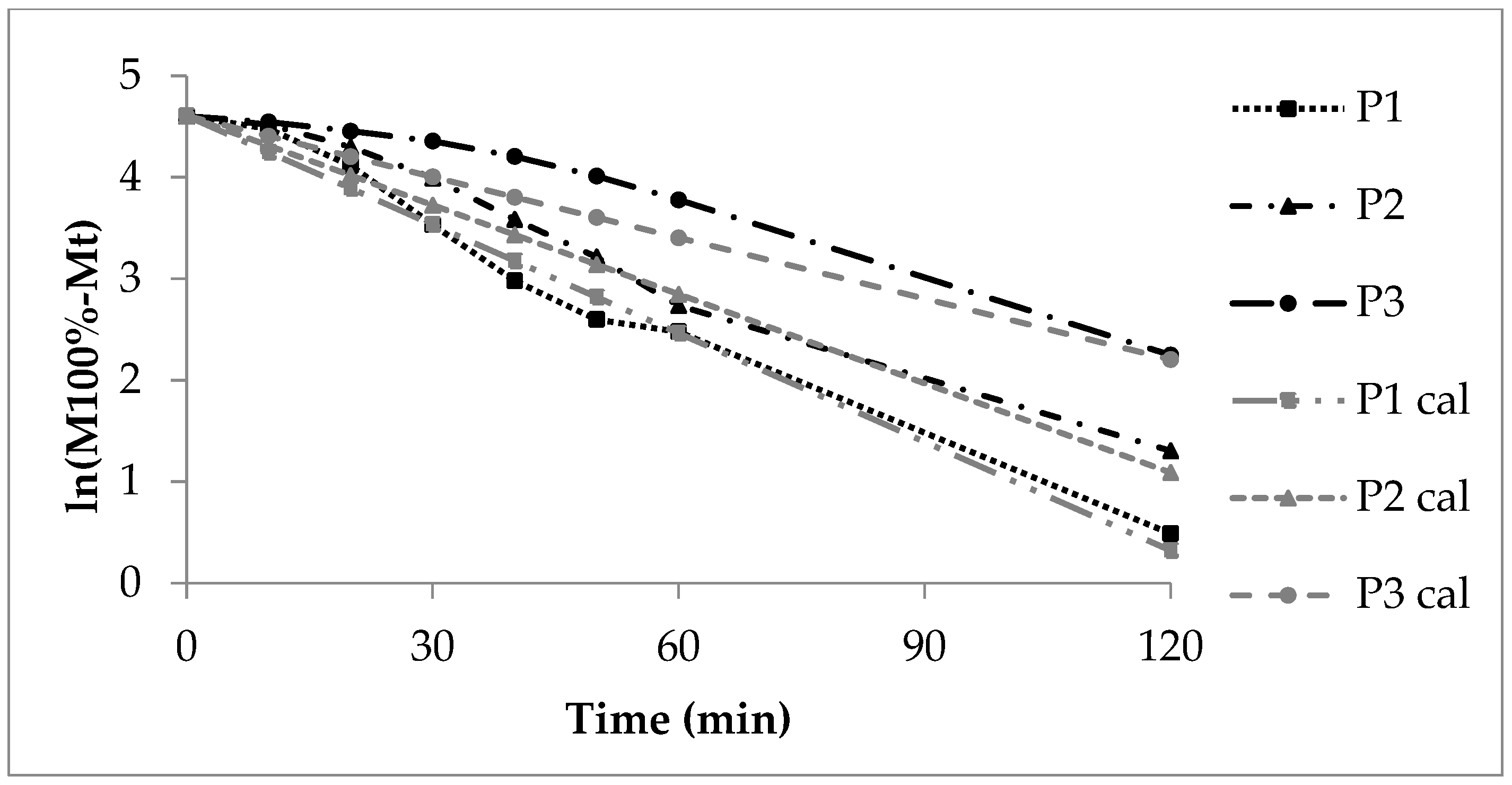
In contrast, the release from polyacrylate-coated pellets follows exponential curves (Figure 2). Generally, the release rate decreases as the polyacrylate layer thickens. The insoluble polyacrylate acts as a barrier. After ten minutes, 30% of sodium benzoate is released from low coating (P1), 20% from medium coating (P2), and 8% from high coating (P3).

diffusion of sodium benzoate molecules and ions

The dissolution rate of sodium benzoate alone cannot explain the release. Instead, diffusion of sodium benzoate molecules and ions through the polymer layer controls the rate. Initially, a high concentration gradient drives rapid release. Later, the release rate slows as the concentration gradient decreases.

For low coating (P1), the CoD of zero-order kinetics is 0.57 (Table 5), indicating zero-order release is unlikely. First-order diffusion seems to control the process. With increasing polyacrylate thickness, zero-order CoD rises (P2: 0.70, P3: 0.93). This reflects additional effects, such as polymer swelling and prolonged diffusion distance. Consequently, the release rate decreases as polyacrylate content rises, which is evident in decreasing AUC and DE, and increasing MDT (Table 6).

Figure 2. Double linear plot of the sodium benzoate release, SB pellets without polyacrylate layer, experimental release from polyacrylate-coated lots P1, P2 and P3 with increasing layer thickness and calculated release P1cal, P2cal and P3cal.

Influence of Polymer Film Thickness on Drug Release from Fluidized Bed Coated Pellets 002

Table 5. CoD of sodium benzoate release profiles, kinetic models of zero order, first order, square root and cubic root; lots P1, P2 and P3.
CoD (R2)
Model P1 P2 P3
Zero order 0.57 0.70 0.93
First order Sigma minus 0.98 0.98 0.95
First order Weibull 0.87 0.99 0.99
Square root 0.81 0.88 0.94
Cubic root 0.68 0.80 0.98
Table 6. Area under the curve, AUC, dissolution efficiency, DE, and mean dissolution time, MDT, of sodium benzoate release; lots P1, P2 and P3.
AUC (%∗min) DE (-) MDT (min)
P1 14,820 0.82 32
P2 13,927 0.77 41
P3 11,587 0.64 63

indicating equivalence between P1 and P2

The release profiles of lots P1 and P2 (Figure 2) differ only slightly. Therefore, the f1 value of 12 (Table 7) is below 15, indicating equivalence between P1 and P2. In contrast, the deviation between P1/P3 and P2/P3 is much more pronounced. This is due to the thicker polyacrylate coating layers, which lead to an f1 above 15. Consequently, these pairs are evaluated as “not equivalent” regarding the relative error between cumulative released amounts Ri and Ti at specific moments. Overall, increasing the coating layer thickness clearly changes the release profiles.
Table 7. Difference factor and similarity factor of sodium benzoate release profiles, comparison of lots P1, P2 and P3.
Parameter Evaluation P1/P2 P1/P3 P2/P3
Difference factor f1 “equivalent”
0–15
12 24 25
Similarity factor f2 “similar”
50–100
74 63 67

similarity factor f2 decreases with the increasing layer thickness

The similarity factor f2 decreases with the increasing layer thickness and diminished release rate, which is obvious comparing P1 with P2 (74) and P1 with P3 (63). Nevertheless, both f2s confirm the similarity of the release profiles.
Release curves (P1cal, P2cal and P3cal, Figure 2) were calculated according to first order kinetics (Equation (2)) and by use of the experimental release rate constants of P1, P2 and P3 (Table 5) from the Sigma minus plots (Figure 3).
Figure 3. First order Sigma minus function of the experimental and calculated (cal) sodium benzoate release, lots P1, P2 and P3.
 Influence of Polymer Film Thickness on Drug Release from Fluidized Bed Coated Pellets 003

The calculated double linear curves (grey) roughly matched the experimental curves (black, Figure 2). However, the deviation was greatest for P3, which had the thickest polyacrylate layer. This was caused by several coinciding processes: slow film wetting and swelling, delayed water uptake, and limited diffusion through the polyacrylate film to the sodium benzoate layer. Next came sodium benzoate dissolution and its diffusion through the swollen polymer into the release fluid.

The high coating thickness played a critical role. It created a long diffusion path and continuously altered the sodium benzoate concentration gradient within the polyacrylate layer. Consequently, these factors strongly influenced the overall release rate.

3.2.2. First Order Kinetics, Sigma Minus Function

The Sigma minus function gives linear trends of the sodium benzoate release (Figure 3) according to first order kinetics and a CoD above 0.9 (Table 5). The release rate constant k1 decreases with growing polyacrylate coating (Table 8). The calculated curves P1cal and P2cal (Equation (3)) meet the experimental curves of P1 and P2, respectively (Figure 3). The diffusion of sodium benzoate through the polyacrylate layer and to some extent the polymer swelling are the rate controlling steps. The more pronounced deviation of the experimental from the calculated curve in case of P3 is explained by the reasons mentioned above.
Table 8. First order release parameters of the Sigma minus and Weibull function, lots P1, P2 and P3.
k1 (1/min) Sigma Minus b (-)
Weibull
1/a (-)
Weibull
t63.2% (min)
Weibull
P1 0.036 1.08 0.25 30
P2 0.030 1.58 0.17 40
P3 0.020 1.36 0.17 70

3.2.3. First Order Kinetics, Weibull Function

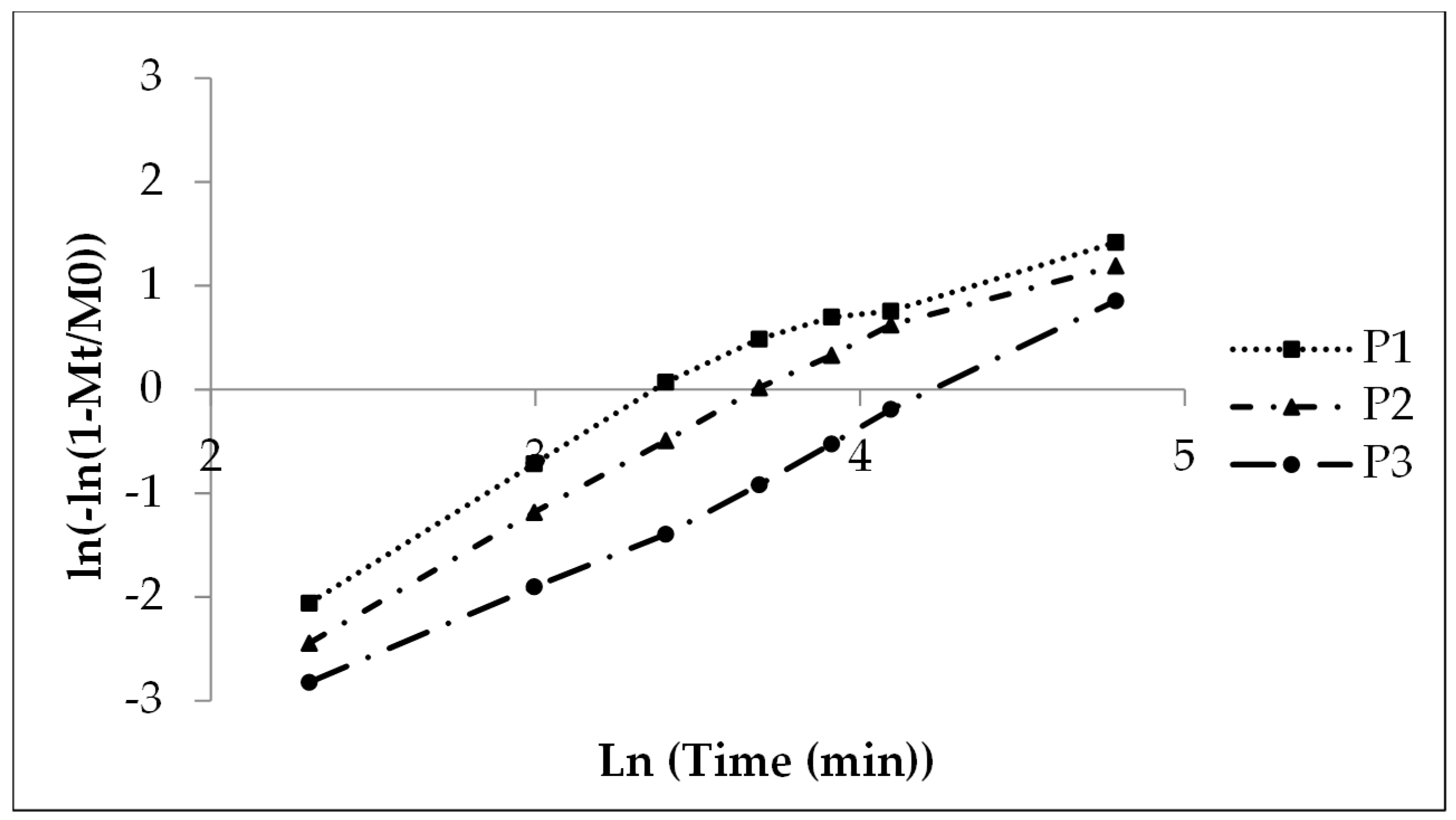
The Weibull function gives linear curves (Figure 4) comparable to the Sigma minus function (Figure 3) with coefficients of determination of 0.99 for P2 and P3 (higher polyacrylate coating) and a value of 0.87 for P1 (Table 5) due to the fast release in the initial phase and finally the slow release rate after 45 min (x-axis value 3.8, Figure 5).
Figure 4. First order Weibull function of the experimental sodium benzoate release, lots P1, P2 and P3.
Pharmaceutics 16 01307 g004
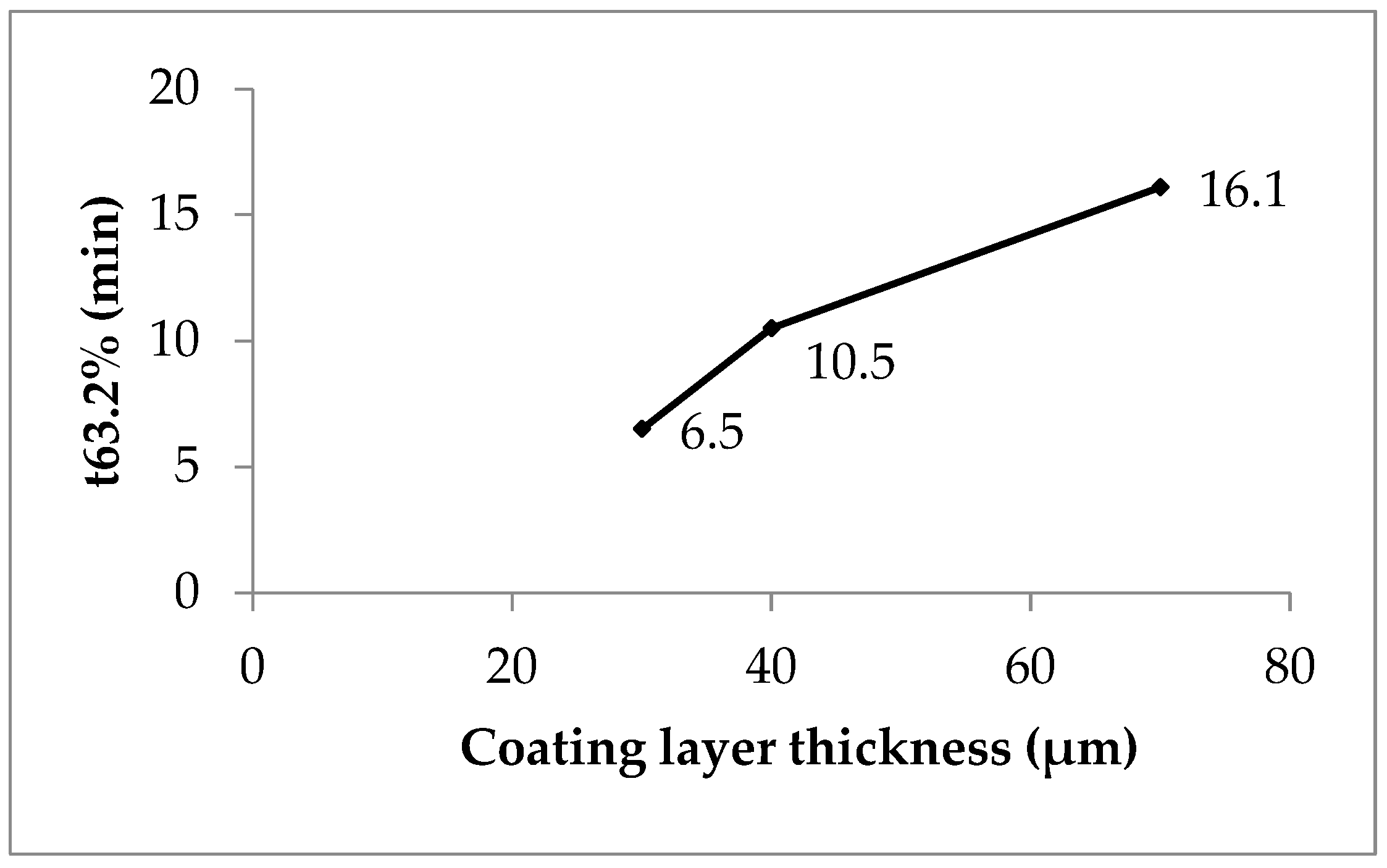
Figure 5. Weibull function release parameter t63.2% versus coating layer thickness, lots P1 (coefficient of determination 0.87, polyacrylate content 6.5%), P2 (0.99, 10.5%) and P3 (0.99, 16.1%).
Pharmaceutics 16 01307 g005

A shape parameter of 1 indicates monophasic release. In contrast, values above 1 suggest multiphasic release. In the present case, multiphasic release included an initial lag phase caused by wetting and swelling of the polyacrylate film. This was followed by an accelerated release rate up to the inflection point due to the high concentration gradient. Afterward, the rate slowed as the gradient decreased until drug dissolution and release were complete.

monophasic and multiphasic kinetics

P1, with low coating, showed nearly monophasic kinetics (shape parameter 1.08, Table 8). However, P2 (1.58) and P3 (1.36) indicated a more pronounced multiphasic release. The scale parameter (1/a) refers to the rate constant. It decreased with increasing coating thickness (Table 8). The time parameter t63.2% marks the moment when 63.2% of sodium benzoate is released. This value increased with higher polyacrylate thickness, ranging from 30 to 70 minutes (Table 8, Figure 5; see also Figure 2).

Clearly, polyacrylate coating thickness strongly influenced release kinetics (Table 4). A practical strategy for manufacturing coated pellets with controlled release is as follows. First, prepare laboratory-scale lots with increasing coating thickness. Then, measure thickness with the SFV probe. Next, investigate in vitro release and correlate it with polymer thickness. Finally, in production scale, stop the coating process once the desired thickness is detected.

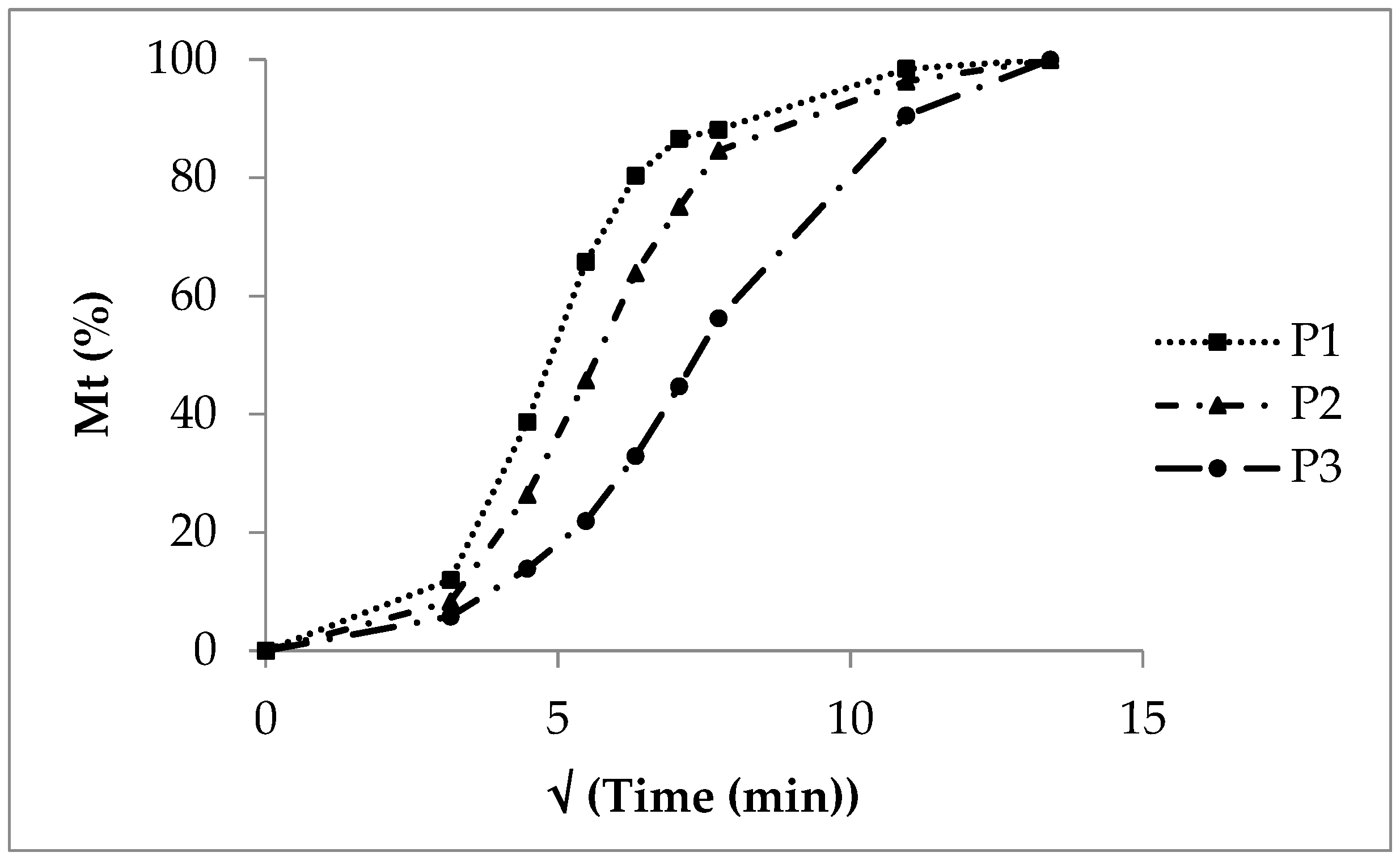
3.2.4. Square Root Function

A cumulative release plot versus the square root of time yields straight lines for diffusion-controlled release. This is typical for non-disintegrating matrices such as tablets and semisolid systems (ointments, creams). Lots P1 and P2 showed nearly straight lines between 10 and 60 minutes (Figure 6). However, the initial phase (up to 10 minutes) and the terminal phase (after 60 minutes) did not fit the square root model. The CoD values ranged from 0.81 for P1 to 0.94 for P3 (Table 5). Therefore, the square root model was not suitable to describe the release from pellets with an insoluble but swellable polymer coating.

Figure 6. Square root function of the experimental sodium benzoate release, lots P1, P2 and P3.
Pharmaceutics 16 01307 g006

3.2.5. Cubic Root Function

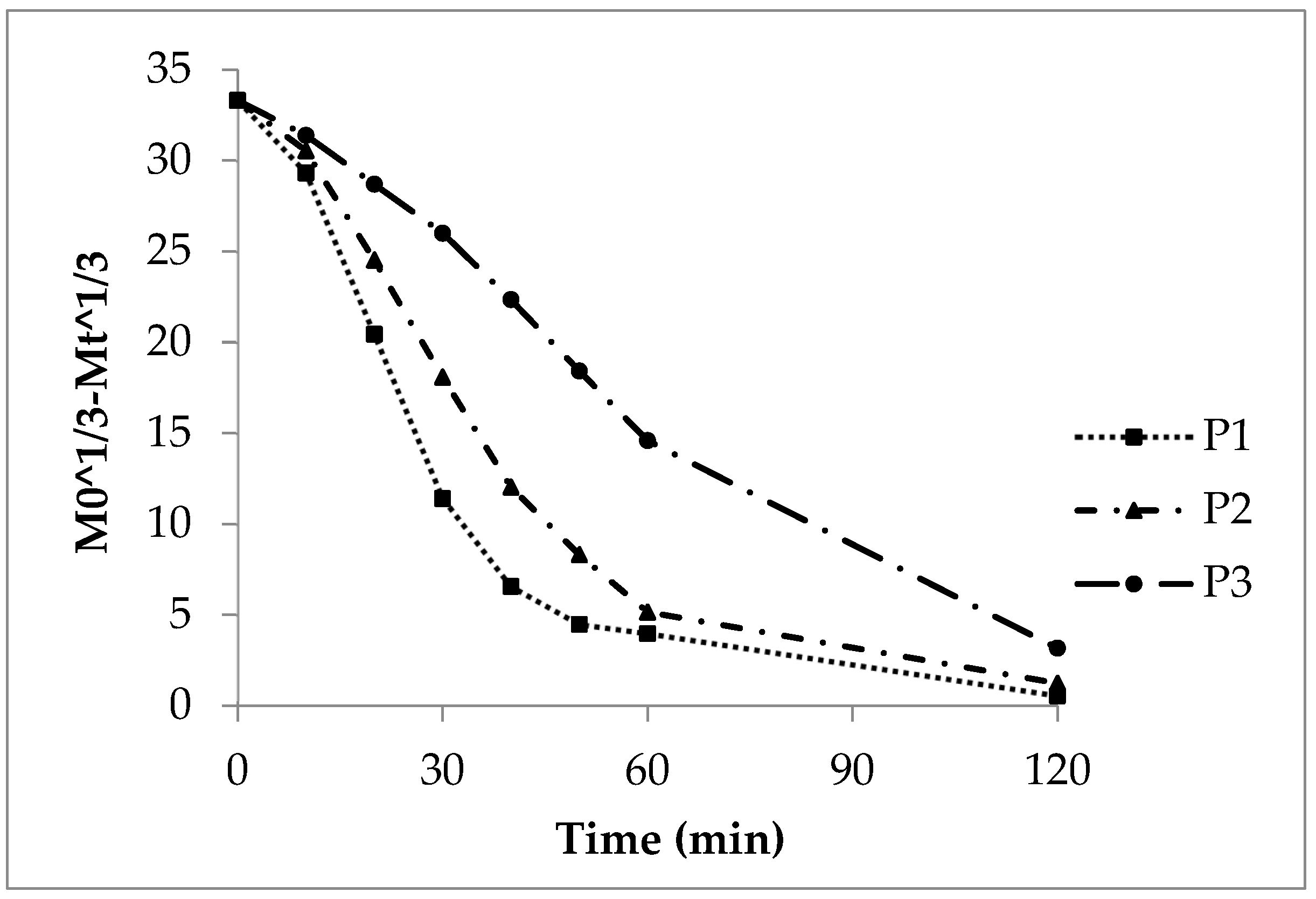
The cubic root function applies to the dissolution of spherical particles. This is because both weight and surface area decrease during dissolution. When the cubic roots of the dose and cumulative released substance are plotted against time, straight lines should appear.

However, this was not observed for sodium benzoate release from polyacrylate-coated pellets (Figure 7). The deviation from linearity was clear in lots P1 and P2, especially in the terminal release phase after 45 minutes. Their CoD values were 0.68 and 0.80, respectively (Table 5). In contrast, the slower-releasing P3 showed a nearly straight curve with a CoD of 0.98.

Thus, the cubic root model seems suitable only for pellets with thick polyacrylate coatings. Lots P1 and P2, with thinner coatings, did not follow cubic root kinetics or typical sphere dissolution.

Figure 7. Cubic root function of the experimental sodium benzoate release, lots P1, P2, and P3.

Pharmaceutics 16 01307 g007

4. Conclusions

Inert Cellets® 175 were coated in two steps. First, they received the model drug sodium benzoate. Second, they were coated with a water-insoluble polyacrylate dispersion in a fluidized bed with a Wurster inlet. Particle size increase and coating thickness were measured in-line during the entire process using the SFV probe. Sodium benzoate release was then tested in vitro. The release profiles were linearized and evaluated with different kinetic models.

As the polyacrylate coating layer thickened, the sodium benzoate release rate decreased. This trend was confirmed by release parameters, rate constants, AUC, MDT, and DE. A difference factor f1 above 15 indicated dissimilar profiles between low-coated (P1, P2) and high-coated (P3) pellets. Thus, coating thickness significantly influenced sodium benzoate release. The similarity factor f2 ranged from 67 to 74, confirming comparable release profiles across lots P1, P2, and P3.

high CoD values

The high CoD values of linearized release profiles suggested first-order kinetics as the most suitable model. This outcome can be explained by the strong effect of sodium benzoate diffusion through the swollen polyacrylate film. With thicker coatings, polymer swelling increased. Consequently, diffusion distances for water and sodium benzoate grew longer, while concentration gradients exerted stronger control over release.

Overall, the detailed study of release profiles in relation to coating thickness allows accurate detection of the coating endpoint. Therefore, the method supports manufacturing custom-coated drug pellets with defined release properties.

Authors and affiliations

Marcel Langner (1), Florian Priese (2), and Bertram Wolf (2)
1 IDT Biologika, Am Pharmapark, 06861 Dessau-Roßlau, Germany
2 Department of Applied Biosciences and Process Engineering, Anhalt University of Applied Sciences, Bernburger Straße 55, 06366 Köthen, Germany

Author Contributions

Conceptualization, B.W.; methodology, M.L.; data curation, B.W.; writing—original draft preparation, M.L.; writing—review and editing, F.P. and B.W.; supervision, F.P.; project administration, B.W.; funding acquisition, F.P. All authors have read and agreed to the published version of the manuscript.

Funding

This work was financially supported by the Federal Ministry of Education and Research of Germany (BMBF) within the research project WIGRATEC+ and the German Research Foundation (Deutsche Forschungsgemeinschaft DFG)—project number 491460386—plus the Open Access Publishing Fund of Anhalt University of Applied Sciences.

Institutional Review Board Statement

Not applicable.

Informed Consent Statement

Not applicable.

Data Availability Statement

All relevant data are available in the article.

Conflicts of Interest

The authors declare no conflicts of interest.

Notations

M0 initial drug dose, drug content (%)
Mt released drug amount at time (%)
AUC area under the curve (%*min)
DE dissolution efficiency (-)
MDT mean dissolution time (min)
Ti released drug amount at moment t test formulation (%)
Ri released drug amount at moment t reference formulation (%)
n number of time points (-)
I release time point (min)
T moment of drug release (min)
k0 release rate constant, zero order release kinetics (%/min)
k1 release rate constant, first order release kinetics (1/min)
kq release rate constant, square root release kinetics (-)
kc release rate constant, cubic root release kinetics (-)
1/a scale parameter of Weibull function (-)
b shape parameter of Weibull function (-)
x50.3 median of volume density distribution (µm)
R2 coefficient of determination (CoD) (-)
A cross section area (m2]
D diffusion coefficient (cm2/s)
dn/dt transport flow (mol/min)
dc/dx concentration gradient (mol/l*m)
f1 difference factor (-)
f2 similarity factor (-)

Abbreviations

CoD coefficient of determination
P1, P2, P3 coated pellet lots, experimental release
P1cal, P2cal, P3cal coated pellet lots, calculated release
Ph.Eur. European Pharmacopoeia
pKa logarithmic acid dissociation constant
PVP polyvinylpyrrolidone
rpm rotation per minute
SB pellets sodium benzoate coated pellets
SFV spatial filter velocimetry

References

  1. Koch, H.P. Die Technik der Dissolutionsbestimmung. Teil 2. Experimentelle Methodik, Auflösungsgesetze, Auswertung und graphische Darstellung der Ergebnisse, Kenngrößen der Dissolution, Korrelation. Pharm. Acta Helv. 198459, 130–139. [Google Scholar]
  2. Yonezawa, Y.; Kawase, S.; Sasaki, M.; Shinohara, I. Dissolution of solid dosage form. V. New form equations for the non-sink dissolution of a monodisperse system. Chem. Pharm. Bull. 199543, 304–310. [Google Scholar] [CrossRef]
  3. Pereira de Almeida, L.; Simões, S.; Brito, P.; Portugal, A.; Figueiredo, M. Modeling dissolution of sparingly soluble multisized powders. J. Pharm. Sci. 199786, 726–732. [Google Scholar] [CrossRef] [PubMed]
  4. Liu, Y.; Sun, Y.; Sun, J.; Zhao, N.; Sun, M.; He, Z. Preparation and in vitro/in vivo evaluation of sustained-release venlafaxine hydrochloride pellets. Int. J. Pharm. 2012426, 21–28. [Google Scholar] [CrossRef]
  5. Javadzadeh, Y.; Monajjemzadeh, F.; Safaei, E.; Adibkia, K.H. Release kinetics of sodium diclofenac from controlled release device. Pharm. Ind. 201476, 1786–1793. [Google Scholar]
  6. Viswanadha, L.S.; Arcot, Y.; Lin, Y.-T.; Akbulut, M.E.S. A comparative investigation of release kinetics of paclitaxel from natural protein and macromolecular nanocarriers in nanoscale drug delivery systems. J. Colloid Interf. Sci. Open 202415, 100120. [Google Scholar] [CrossRef]
  7. Wang, J.; Sun, Y.; Li, B.; Fan, R.; Li, B.; Yin, T.; Rong, L.; Sun, J. Preparation and evaluation of tamsulosin hydrochloride sustained-release pellets modified by two-layered membrane techniques. Asian J. Pharm. Sci. 201510, 31–39. [Google Scholar] [CrossRef]
  8. Kovacevic, J.; Mladenovic, A.; Djuris, J.; Ibric, S. Evaluation of powder, solution and suspension layering for the preparation of enteric coated pellets. Eur. J. Pharm. Sci. 201685, 84–93. [Google Scholar] [CrossRef]
  9. Cascone, S. Modeling and comparison of release profiles: Effect of the dissolution method. Eur. J. Pharm. Sci. 2017106, 352–361. [Google Scholar] [CrossRef]
  10. Marucci, M.; Andersson, H.; Hjärtstam, J.; Stevenson, G.; Baderstedt, J.; Stading, M.; Larsson, A.; Corswant, C. New insights on how to adjust the release profile from coated pellets by varying the molecular weight of ethyl cellulose in the coating film. Int. J. Pharm. 2013458, 218–223. [Google Scholar] [CrossRef]
  11. Xu, M.; Liew, C.V.; Heng, P.W.S. Evaluation of the coat quality of sustained release pellets by individual pellet dissolution methodology. Int. J. Pharm. 2015478, 318–327. [Google Scholar] [CrossRef]
  12. Villar López, E.; Luzardo Álvarez, A.; Blanco Méndez, J.; Otero Espinar, F.J. Cellulose-polysaccharide film-coating of cyclodextrin based pellets for controlled drug release. J. Drug Deliv. Sci. Technol. 201742, 273–283. [Google Scholar] [CrossRef]
  13. Sousa, J.J.; Sousa, M.J.; Moura, M.J.; Podczeck, F.; Newton, J.M. The influence of core materials and film coating on the drug release from coated pellets. Int. J. Pharm. 2002233, 111–122. [Google Scholar] [CrossRef] [PubMed]
  14. Krueger, C.; Thommes, M.; Kleinebudde, P. Influence of storage conditions on properties of MCC II-based pellets with theophylline-monohydrate. Eur. J. Pharm. Biopharm. 201488, 483–491. [Google Scholar] [CrossRef]
  15. Albanez, R.; Nitz, M.; Pereira Taranto, O. Influence of the type of enteric coating suspension, coating layer and process conditions on dissolution profile and stability of coated pellets of diclofenac sodium. Powder Technol. 2015269, 185–192. [Google Scholar] [CrossRef]
  16. Kazlauske, J.; Cafaro, M.M.; Caccavo, D.; Marucci, M.; Lasson, A. Determination of the release mechanism of theophylline from pellets coated with Surelease®—A water dispersion of ethyl cellulose. Int. J. Pharm. 2017528, 345–353. [Google Scholar] [CrossRef]
  17. Hiew, T.N.; Siew, L.W.; Wannaphatchaiyong, S.; Elsergany, R.N.; Pichayakorn, W.; Boonme, P.; Heng, P.W.S.; Liew, C.V. Influence of talc and hydrogenated castor oil on the dissolution behavior of metformin-loaded pellets with acrylic-based sustained release coating. Int. J. Pharm. 2023640, 122984. [Google Scholar] [CrossRef]
  18. Alagili, M.F.; AlQuadeib, B.T.; Ashri, L.Y.; Ibrahim, M.A. Optimization and evaluation of Lisinopril mucoadhesive sustained release matrix pellets: In-vitro and ex-vivo studies. Saudi Pharm. J. 202331, 101690. [Google Scholar] [CrossRef]
  19. Wu, S.; Zeng, Q.; Zhang, Z.; Zhang, X.; Hou, Y.; Li, Z.; Jia, C.; Liu, Y.; Li, W. Development of sinomenine hydrochloride sustained-release pellet using a novel whirlwind fluidized bed. J. Drug Deliv. Sci. Technol. 202278, 103956. [Google Scholar] [CrossRef]
  20. Muschert, S.; Siepmann, F.; Leclercq, B.; Carlin, B.; Siepmann, J. Prediction of drug release from ethylcellulose coated pellets. J. Control Release 2009135, 71–79. [Google Scholar] [CrossRef]
  21. Yang, M.; Xie, S.; Li, Q.; Wang, Y.; Chang, X.; Shan, L.; Sun, L.; Huang, X.; Gao, C. Effects of polyvinylpyrrolidone both as a binder and pore-former on the release of sparingly water-soluble topiramate from ethylcellulose coated pellets. Int. J. Pharm. 2014465, 187–196. [Google Scholar] [CrossRef] [PubMed]
  22. Dekyndt, B.; Verin, J.; Neut, C.; Siepmann, F.; Siepmann, J. How to easily provide zero order release of freely soluble drugs from coated pellets. Int. J. Pharm. 2015478, 31–38. [Google Scholar] [CrossRef] [PubMed]
  23. Thapa, P.; Thapa, R.; Choi, D.H.; Jeong, S.H. Effect of pharmaceutical processes of the quality of ethylcellulose coated pellets: Quality by Design approach. Powder Technol. 2018339, 25–38. [Google Scholar] [CrossRef]
  24. Kaur, S.; Sivasankaran, S.; Wambolt, E.; Jonnalagadda, S. Determinants of zero-order release kinetics from acetaminophen-layered Suglet® pellets, Wurster-coated with plasticized Aquacoat® ECD (ethyl cellulose dispersion). Int. J. Pharm. 2020573, 118873. [Google Scholar] [CrossRef]
  25. Kállai, N.; Luhn, O.; Dredán, J.; Kovács, K.; Lengyel, M.; Antal, I. Evaluation of drug release from coated pellets based on isomalt, sugar and microcrystalline cellulose inert cores. AAPS PharmSciTech 201011, 383–391. [Google Scholar] [CrossRef]
  26. Priese, F.; Wolf, B. Development of high drug loaded pellets by Design of Experiment and population balance model calculation. Powder Technol. 2013241, 149–157. [Google Scholar] [CrossRef]
  27. Wiegel, D.; Eckardt, G.; Priese, F.; Wolf, B. In-line particle size measurement and agglomeration detection of pellet fluidized bed coating by Spatial Filter Velocimetry. Powder Technol. 2016301, 261–267. [Google Scholar] [CrossRef]
  28. Petrak, D.; Eckardt, G.; Dietrich, S.; Köhler, M.; Wiegel, D.; Wolf, B.; Priese, F.; Jacob, M. In-line measurement of layer thickness, agglomerate fraction and spray drying during pellet coating in the fluidized bed. Pharm. Ind. 201880, 262–270. [Google Scholar]
  29. Priese, F.; Frisch, T.; Wolf, B. Comparison of film-coated retarded release pellets manufactured by layering technique or by fluidized bed rotor pelletization. Pharm. Dev. Technol. 201520, 417–424. [Google Scholar] [CrossRef]
  30. Juhász, A.; Ungor, D.; Berta, K.; Seres, L.; Csapó, E. Spreadsheet-based nonlinear analysis of in vitro release properties of a model drug from colloidal carriers. J. Mol. Liq. 2021328, 115405. [Google Scholar] [CrossRef]
  31. European Pharmacopoeia 11.5, 2024. Available online: https://pheur.edqm.eu/subhome/11-5 (accessed on 29 August 2024).