Chewable formulations with MCC starter cores

Chewable formulations with MCC starter cores: Patient-centric design and pharmaceutical relevance

Chewable formulations with MCC starter cores are an advanced oral dosage form that combines patient-friendly administration with robust pharmaceutical performance. Thereby, patient refers includes humans and non-human mammalian animals, such as dogs, cats, mice, rats, guinea pigs, rabbits, ferrets, cows, horses, sheep, goats, and pigs. At the outset, these formulations address a key challenge in drug therapy, namely patient compliance, by offering a dosage form that patients can chew without water. Consequently, they are particularly suitable for pediatric, geriatric, and veterinary applications. Moreover, chewable dosage forms allow formulators to improve taste, mouthfeel, and ease of use, which directly supports adherence to therapy. At the same time, MCC starter cores provide excellent mechanical stability, uniformity, and processing reliability. Therefore, they enable consistent drug loading, predictable disintegration, and scalable manufacturing. As a result, this combination creates significant opportunities for modern, patient-centric drug delivery.

Chewable formulations with MCC starter cores according to WO2022049149A1

The patent WO2022049149A1 describes chewable pharmaceutical compositions designed to disintegrate rapidly while maintaining acceptable texture and stability. In particular, the invention focuses on soft chewable dosage forms that contain at least one active pharmaceutical ingredient together with carbonate or bicarbonate compounds that act as efficient disintegrants. As a result, the dosage form breaks down quickly when exposed to aqueous or gastric media. This rapid disintegration directly supports fast and reproducible dissolution of the API. Furthermore, the patent emphasizes that surface structure, porosity, and wettability of the chewable matrix strongly influence drug release. Therefore, careful control of formulation and processing parameters becomes essential. The disclosed chewable products typically achieve disintegration within pharmacopeial limits and release a high proportion of the API within short dissolution times. In addition, the patent highlights the importance of balancing lipophilic excipients, since excessive hydrophobicity can delay disintegration. Consequently, the invention aims to deliver chewable dosage forms that combine good palatability with reliable pharmaceutical performance. Overall, the patent demonstrates how optimized excipient systems can overcome common limitations of chewable drugs while improving patient acceptance.

Chewable formulations with MCC starter cores

Chewable formulations with MCC starter cores

Advances, dissolution considerations, and API challenges in chewable dosage forms

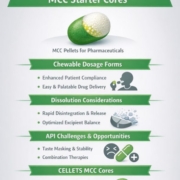
Chewable formulations with MCC starter cores illustrate clear advances in chewable drug technology. First, the use of spherical MCC cores supports multiparticulate designs that improve content uniformity and process robustness. Moreover, these cores enable precise API layering, which enhances dose accuracy and reproducibility. When considering dissolution profiles, formulators must carefully manage core porosity, disintegrant efficiency, and wettability. Therefore, rapid liquid penetration and controlled matrix breakdown remain critical success factors. At the same time, APIs in chewable formulations face both obstacles and opportunities. On one hand, taste masking, stability, and dissolution control present technical challenges. On the other hand, chewable formats open new possibilities for poorly compliant patient groups and combination therapies. Consequently, successful products require a well-balanced formulation strategy that aligns API properties with excipient functionality.

Role of CELLETS® in the context of this patent

Although WO2022049149A1 does not explicitly name commercial products, its technical concept strongly aligns with MCC starter cores such as CELLETS® 100 (100-200 µm) and CELLETS® 200 (200-355 µm). These microcrystalline cellulose spheres offer high sphericity, low friability, and narrow particle size distribution. Therefore, they provide an ideal substrate for API layering in chewable multiparticulate systems. CELLETS® 100 and CELLETS® 200 support uniform coating, predictable dissolution behavior, and efficient processing in fluidized bed systems. In addition, their inert and tasteless nature helps minimize interactions with APIs and flavoring agents. As a result, they play a crucial functional role in achieving stable, reproducible, and patient-acceptable chewable formulations.

Conclusion and outlook for chewable formulations with MCC starter cores

Chewable formulations with MCC starter cores represent a strategic convergence of patient-centric design and pharmaceutical engineering. In conclusion, the integration of MCC starter cores enhances manufacturing reliability, dose uniformity, and dissolution performance while supporting improved patient compliance. Moreover, patents such as WO2022049149A1 demonstrate how modern excipient systems can overcome traditional limitations of chewable dosage forms. Looking ahead, further innovation will likely focus on advanced taste-masking technologies, tailored dissolution profiles, and broader API compatibility. Therefore, chewable formulations with MCC starter cores are well positioned to play an increasingly important role in future oral drug delivery.

Patent Summary

  • Name of Patent: Chewable formulations
  • Patent Number: WO2022049149A1
  • Year of Patent: 2021
  • Patent Holders: Clément Maxime Chevreau, Pascal Grenier, Claudia Reitz
  • Affiliation: Elanco Tiergesundheit AG
Soft tabletting of pellets - Cellets small

Introduction to soft tabletting of pellets and MCC pellet functionality

Soft tabletting of pellets is a specialized pharmaceutical compaction approach that enables the compression of coated pellet subunits into tablets while preserving pellet integrity and drug release performance. In this context, Multiple Unit Pellet Systems, or MUPS, combine the biopharmaceutical advantages of multiparticulates with the handling and patient benefits of tablets. MCC-based pellets play a central role in this technology because they deform plastically, cushion mechanical stress, and maintain coating functionality during compression. As a result, MCC pellets support robust tabletting, rapid tablet disintegration, and reliable dissolution behavior. Moreover, MUPS tablets reduce dose dumping risk, improve gastrointestinal distribution, and enhance patient compliance compared to conventional single-unit tablets. Consequently, soft tabletting of pellets has become a preferred strategy for modified-release, delayed-release, and combination products where performance consistency matters.

Soft tabletting of pellets - Cellets

Summary of the publication on soft tabletting of pellets

The referenced publication investigates soft tabletting of pellets using MCC 102 and UICEL-A/102 as key pellet-forming and cushioning materials. The research focuses on producing MUPS tablets that achieve sufficient mechanical strength while preserving the original dissolution profile of coated pellets. Therefore, the work examines how pellet composition, morphology, and compaction behavior interact during tabletting.

The study uses sodium diclofenac as a model drug and applies a sustained-release polymer coating to the pellets. Both homogeneous pellets, produced by extrusion–spheronization, and inhomogeneous pellets, produced by dry powder layering on inert cores, were evaluated. As a result, the work provides insight into how pellet structure affects deformation and coating integrity during compression.

MCC 102 pellets demonstrated strong plastic deformation, which enabled softer compaction and better preservation of pellet structure. In contrast, UICEL-A/102 pellets showed higher porosity and swelling capacity. Consequently, UICEL-A/102-based MUPS disintegrated faster and released the drug more rapidly. However, this same swelling behavior limited their suitability for sustained-release applications.

When used in MUPS tablets, MCC 102 pellets achieved crushing strengths between 70 and 100 N while still disintegrating rapidly. Therefore, these tablets closely matched the dissolution behavior of uncompressed pellets. UICEL-A/102 pellets also formed mechanically stable tablets, but their higher swelling led to faster disintegration and altered release kinetics.

The study further highlights the importance of pellet production method. Inhomogeneous pellets layered onto inert starter cores responded differently to compression than homogeneous pellets. Notably, MCC-based starter cores supported softer tabletting and reduced coating damage. In contrast, sugar-based cores increased compaction stress and slowed tablet disintegration. Thus, the choice of core material directly influenced MUPS performance.

Overall, the publication demonstrates that successful soft tabletting of pellets requires careful alignment of pellet material, structure, and compaction parameters. Otherwise, coating damage or delayed disintegration may compromise therapeutic performance.

Role of Cellets, key insights, and material-related effects

In this publication, Cellets function as MCC-based inert starter cores for dry powder layering. Therefore, they provide a plastically deformable substrate that absorbs compression forces during tabletting. As a result, pellets layered onto Cellets show improved coating integrity and more predictable dissolution behavior compared to sugar-based cores.

The most important take-home message is that pellet material properties govern MUPS performance more than tablet hardness alone. Specifically, MCC 102 offers a balanced profile for sustained-release MUPS, whereas UICEL-A/102 favors immediate-release systems. Consequently, formulation goals should guide cellulose selection early in development.

Obstacles for MCC pellets include managing excessive densification during compression and controlling disintegration time. However, opportunities exist in tailoring MCC pellet porosity, size distribution, and deformation behavior. Advanced Cellets grades may further optimize cushioning and release stability.

Pellet sphericity improves flowability and die filling, which enhances tablet uniformity. At the same time, low friability limits coating damage and fines generation. Hardness requires precise adjustment, because excessive hardness delays disintegration, while insufficient hardness weakens tablets. Therefore, balancing these parameters remains critical for reliable soft tabletting of pellets.

Conclusion and outlook

Soft tabletting of pellets enables advanced MUPS dosage forms that combine multiparticulate performance with tablet convenience. This publication clearly shows that MCC pellets, especially Cellets, support soft compaction and stable drug release when formulation parameters align with material behavior. Although challenges remain, ongoing improvements in pellet engineering and MCC excipient design will expand MUPS applications. In the future, predictive formulation strategies and optimized MCC pellets will further strengthen soft tabletting of pellets as a core pharmaceutical technology.

References

[1] Dissertation, Balzano, Vincenzo; doi: 10.5451/unibas-004872301.

Particle Size Distributions of Inert Spheres

Introduction to Particle Size Distributions of Inert Spheres and Their Role in Pelletized Pharmaceutical Products

In pharmaceutical formulation science, Particle Size Distributions of Inert Spheres represent a fundamental quality attribute for multiparticulate dosage forms. Inert spheres, such as microcrystalline cellulose pellets, act as neutral carriers for active pharmaceutical ingredients. They enable precise drug layering, predictable dissolution, and uniform content distribution in capsules or tablets. A narrow and well-characterized PSD improves processability and coating uniformity. It also supports reproducible drug delivery performance in multiparticulate systems. Inert spheres such as CELLETS® offer tight PSD and high sphericity. Therefore, they provide robust cores for dosage forms ranging from low-dose products to extended-release multiparticulates.

A Publication Worth Reading: computerized image analysis

The publication by Heinicke and Schwartz [1] evaluates computerized image analysis for measuring PSD in pharmaceutical spheres and pellets. The study covers particle size ranges from approximately 425 to 1400 micrometers. Traditional sizing methods, such as sieve analysis, provide limited resolution and statistical detail. In contrast, image analysis demonstrated high repeatability and sensitivity. It quantified size differences that traditional methods could not detect. The authors compared two inert sphere lots before drug layering in a fluid-bed rotor granulator. Differences in starting PSD appeared clearly in the resulting granulated products. This result highlights the importance of core PSD for downstream performance. Furthermore, image analysis detected coating thickness increments as small as four micrometers.

The authors also investigated sampling strategies and sample sizes necessary for reliable measurements, recognizing that an appropriate representativeness of sample draws is critical for statistically meaningful PSD outcomes. Importantly, image analysis captured not only size distribution but also provided visual and morphological data for each particle, thereby enriching the dataset beyond mere dimensional statistics. The technique’s effectiveness was tested in both laboratory and commercial scale contexts, including measuring polymer-coated nonpareils during continuous fluid-bed processing. The similarity between in-situ samples (collected via process sampling ports) and whole batch samples suggested that fluid-bed processes in these systems provide sufficiently homogeneous conditions for representative PSD capture by image analysis.

Beyond the direct findings, the work situates PSD measurement via image analysis within a broader pharmaceutical quality landscape. Historically, PSD has been a critical parameter because it influences particle flow, coating behavior, drug layering uniformity, content uniformity, and ultimately drug release characteristics. The continuous development of in-line and at-line image analysis methods positions this approach as part of process analytical technology (PAT), enabling more dynamic control and monitoring of multiparticulate manufacturing.

Advances in Image Analysis for Determining Particle Size Distributions of Inert Spheres

Image analysis has evolved rapidly as a high-resolution method for determining PSD in pharmaceutical spheres. It directly measures individual particle dimensions and morphologies with high precision. Unlike sieve analysis or laser diffraction, image analysis provides particle-by-particle size and shape data. Therefore, it improves PSD accuracy, reproducibility, and visualization during development and quality control. Dynamic image analysis platforms process thousands of particles within minutes. As a result, they generate robust PSD and shape statistics correlated with functional performance criteria.

Important facts include the distinction between number-based and volume-based PSD measures. Metrics such as D10, D50, and D90 describe the spread and balance of the size distribution. In addition, image analysis extracts shape parameters such as sphericity and aspect ratio. These parameters strongly influence flow properties and coating behavior. Moreover,  image analysis enables rapid in-process feedback for monitoring and control. This capability supports coating thickness control and ensures batch-to-batch consistency.

Persisting Obstacles

Despite these advances, obstacles persist. Adequate sample preparation is essential to avoid overlapping particles and bias, especially when using static imaging methods. Agglomeration, depth-of-field effects, and segmentation challenges in image processing can introduce measurement uncertainty if not properly managed. Opportunities exist to integrate enhanced machine vision, artificial intelligence (AI), and real-time imaging to improve discrimination of individual particles in complex mixtures or in high-throughput manufacturing environments. In-line imaging systems with real-time analytics can transform PSD from a static quality attribute to a dynamic process performance indicator.

CELLETS® exemplify the concept of narrow PSD and high surface homogeneity in inert spheres. These microcrystalline cellulose pellets exhibit tight particle size distributions within specified fractions (e.g., 100–200 µm, 150–300 µm, up to 1000-1400 µm) with high sphericity, low friability, and consistent surface characteristics that enhance coating uniformity and enable predictable performance in multiparticulate dosage forms. The narrow PSD and uniform surface enable reproducible drug layering, optimized flow properties, and controlled release profiles, making them ideal cores in fluid bed and Wurster coating operations.

Particle Size Distributions of Inert Spheres

Conclusion and Outlook

The study by Heinicke and Schwartz underscores the value of image analysis for PSD determination. They compared traditional sizing methods with image analysis for inert spheres and coated pharmaceutical pellets. The detection of fine particle diameter differences and detailed morphology supports formulation design, process control, and quality assurance. Future image analysis developments, including AI and in-line PAT integration, will further enhance PSD measurement capabilities. These advances will enable real-time adjustments and closed-loop control in pellet manufacturing. As multiparticulate drug delivery advances, precise characterization of Particle Size Distributions of Inert Spheres remains essential. This precision supports consistent therapeutic outcomes, regulatory compliance, and manufacturing efficiency. Ongoing innovations in imaging hardware, software, and data analytics will strengthen real-time quality control and predictive modeling.

References

[1] G. Heinicke, J. B. Schwartz, Pharmaceutical Development and Technology 2005 (9) 4, 359-367, doi:10.1081/PDT-200032996

CELLETS pharmaceutical starter cores

CELLETS® Pharmaceutical Starter Cores for Pellets & Functional Coatings

CELLETS® are high-purity pharmaceutical starter cores. They combine spherical geometry with narrow particle size distribution and defined density. They provide reproducible carriers for functional coatings and enable controlled layer formation in fluid bed and drum coating processes. Thanks to their uniform geometry, CELLETS® ensure stable fluidization, consistent rolling, and homogeneous wetting during coating. This guarantees uniform layer thicknesses and precise control of active ingredient release.

In controlled-release applications—such as sustained-release, delayed-release, or gastro-resistant systems—CELLETS® support reproducible release profiles. They minimize variability in active ingredient application and polymer layer thickness, creating robust, scalable formulations. CELLETS® enable efficient transfer from formulation development to production scale, improving process reliability and batch-to-batch consistency.

Standardized Starter Cores for GMP-Compliant Processes

CELLETS® are manufactured under controlled conditions with reproducible physical properties. Their narrow particle size, defined density, and high sphericity support consistent process control. This facilitates equipment and process qualification. Regulatory documentation (e.g., DMF information) and GMP compatibility allow CELLETS® to be used across the entire product lifecycle. Using standardized starter cores reduces regulatory risks and supports process validation and batch consistency.

CELLETS pharmaceutical starter cores

Seamless Transfer from Development to Production

CELLETS® enable a smooth scale-up from lab to pilot and commercial production without altering material properties. This simplifies understanding and control of critical process parameters (CPPs). Formulations developed on CELLETS® can scale reproducibly, shortening development timelines and minimizing process adjustments.

Controlled Release & Enteric Coating Precision

CELLETS® provide a neutral, robust core for controlled or delayed drug release. Their uniform surface allows homogeneous application of functional polymer layers, such as sustained-release or enteric coatings. They reduce variability in layer thickness and drug distribution, ensuring reproducible release profiles. CELLETS® support the development of stable controlled-release and enteric coating systems in both R&D and commercial production.

Are You Already Using MCC Starter Spheres?

Take your chance and request sampling units today.