Introduction to Multilayered Pharmaceutically Active Compound Technology
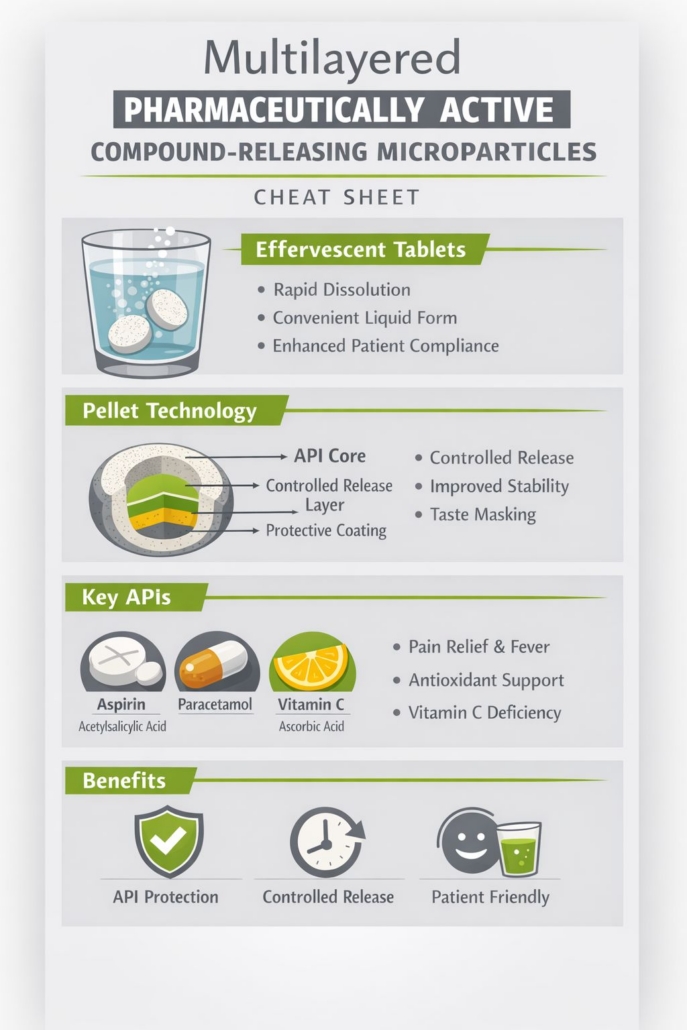
Multilayered pharmaceutically active compound-releasing microparticles in a liquid dosage form represent an innovative approach to oral drug delivery. This technology combines the benefits of coated pellets with the convenience of liquid administration. Effervescent tablets are solid dosage forms that release carbon dioxide when they dissolve in water. This reaction results from the interaction between an acid source, such as citric acid, and a carbonate or bicarbonate salt. Patients consume the resulting solution or suspension immediately after preparation. Consequently, effervescent tablets improve ease of administration and often enhance patient compliance.
Pellets play an increasingly important role in modern effervescent tablet formulations. Unlike conventional powder blends, pellets can carry individual functional coatings that protect active pharmaceutical ingredients (APIs) from degradation. In addition, pellets can separate incompatible ingredients within the same dosage form. They also improve taste masking and enable modified-release properties. As a result, formulators can develop more stable and effective products. Furthermore, pellet-containing effervescent tablets often reduce gastrointestinal irritation and improve dose uniformity. These advantages benefit both the final pharmaceutical product and the patient.
Multilayered pharmaceutically active compound-large
Summary of EP3117824A1
The European patent EP3117824A1 describes a drug delivery platform based on multilayered pharmaceutically active compound-releasing microparticles suspended in a liquid dosage form. The invention addresses a major challenge in pharmaceutical formulation. Many controlled-release and enteric-coated particles lose functionality when they remain in contact with water for extended periods. Therefore, maintaining stability during storage becomes difficult.
The patented technology uses microparticles that contain an API-loaded core surrounded by multiple functional coating layers. A controlled-release or enteric coating forms the intermediate layer. An additional outer protective layer surrounds this coating. The inventors designed this outer layer from a combination of hydrophilic and hydrophobic materials. Consequently, the layer protects the underlying release-controlling membrane from premature exposure to the liquid environment.
During storage, the protective coating minimizes drug leakage and preserves the integrity of the controlled-release system. As a result, the microparticles maintain their desired release characteristics for extended periods. Once the patient administers the formulation, the outer coating dissolves rapidly in the stomach. Subsequently, the underlying controlled-release coating resumes its intended function. This mechanism allows the formulation to deliver the API at a predefined location or rate within the gastrointestinal tract.
The invention offers particular advantages for drugs that require modified release, intestinal targeting, or protection from acidic gastric conditions. In addition, the technology supports the development of patient-friendly liquid formulations. This feature benefits pediatric, geriatric, and dysphagic patients who often struggle to swallow tablets or capsules. Overall, the patent combines the flexibility of pellet-based drug delivery with improved stability in aqueous dosage forms. Therefore, it represents an important advancement in oral pharmaceutical technology.
Impact of MCC spheres in this Patent
In EP3117824A1, CELLETS® or similar spherical starter cores serve as the fundamental substrate for producing the multilayered pharmaceutically active compound-releasing microparticles. These inert pellet cores, commonly composed of microcrystalline cellulose, provide a highly uniform and mechanically stable surface onto which drug-containing layers and subsequent functional coatings can be applied with high precision.
Their excellent sphericity promotes uniform coating thickness, which is critical for achieving reproducible controlled-release performance and minimizing variability between pellets. Furthermore, Cellets enable high drug loading while maintaining robust processing characteristics during fluid-bed coating operations.
Pellet size also plays an important role in the final product performance. Smaller pellets, typically in the range of 100–500 µm (such as CELLETS® 100, 200, 350), offer a larger surface area and can provide faster or more uniform drug release, whereas larger pellets, often between 500–1500 µm (such as CELLETS® 500, 700, 1000), facilitate the application of multiple coating layers and may support more sophisticated release profiles.
In addition, smaller pellets generally improve content uniformity and patient acceptability, especially in liquid and effervescent dosage forms, because they create a smoother mouthfeel and more homogeneous suspension. Therefore, selecting the appropriate Cellet size represents a key formulation parameter that influences coating efficiency, drug release kinetics, stability, and overall patient experience.
Acetylsalicylic Acid, Paracetamol, and Ascorbic Acid in Pellet-Based Effervescent Formulations
Although EP3117824A1 does not specifically focus on acetylsalicylic acid, paracetamol, or ascorbic acid, the technology applies well to these APIs. Acetylsalicylic acid, commonly known as aspirin, belongs to the nonsteroidal anti-inflammatory drug (NSAID) class. It treats pain, fever, inflammation, and cardiovascular disorders. Depending on the classification source and physiological conditions, aspirin generally falls within BCS Class I or Class III. Because aspirin can irritate the gastric mucosa, pellet-based controlled-release systems may improve gastrointestinal tolerability.
Paracetamol is an analgesic and antipyretic agent that treats pain and fever. It is generally classified as a BCS Class I compound due to its high solubility and permeability. Furthermore, pellet technology can improve taste masking and provide modified-release options. These properties make paracetamol formulations more suitable for pediatric and elderly patients.
Ascorbic acid, also known as vitamin C, functions as a water-soluble vitamin and antioxidant. Healthcare professionals use it to prevent and treat vitamin C deficiency. It exhibits high aqueous solubility and frequently appears in effervescent products. Moreover, pelletization can improve formulation stability by separating ascorbic acid from reactive ingredients. This approach may reduce degradation during storage and improve product quality.
Conclusion and Outlook
Multilayered pharmaceutically active compound technology offers a sophisticated solution for modern oral drug delivery. It combines coated pellet systems with liquid dosage forms while maintaining controlled-release functionality. Moreover, the technology supports improved stability, enhanced patient convenience, and flexible formulation design. When formulators incorporate pellets into effervescent tablets, they can protect sensitive APIs, reduce gastrointestinal side effects, and optimize therapeutic performance. As pharmaceutical research advances, multilayered pharmaceutically active compound systems will likely support more complex formulations and personalized treatment strategies. Consequently, this technology may become an increasingly important platform for next-generation oral medicines.
Patent Summary
- Name of Patent: Multilayered pharmaceutically active compound-releasing microparticles in a liquid dosage form
- Patent Number: EP3117824A1
- Year of Patent: 2015
- Patent Holders: Federica Ronchi, Jonathan Goole, Karim Amighi, Georges Guillaume, Vincent Stephenne
- Affiliation: Be Pharbel Manufacturing